Liber XXVII · Sikhism · Chapter I: Gurdwara & Practice
Gurdwara, Langar and Sikh Practice: Worship, Rites, Festivals
Sikh practice explained: the gurdwara and its worship, kirtan and Ardas, the langar free kitchen, daily prayer, weddings and funerals, festivals and Takhts.

Sikh practice centres on the gurdwara, the "door of the Guru", where the scripture Guru Granth Sahib is enthroned, hymns are sung, the community prays together and everyone, whatever their faith or status, is fed free of charge in the langar. Around it are arranged the daily prayers of individual Sikhs, the rites of naming, marriage and death, and festivals commemorating the Gurus. There is no ordained priesthood: any Sikh, man or woman, may lead worship.
The Gurdwara: Door of the Guru§
In Guru Nanak's time Sikhs met in a dharamsāl, a place of righteousness, to sing hymns together; the name gurdwārā became general later. A gurdwara can be anything from a room in a house to a great complex, but its essential elements are the same: the Guru Granth Sahib, installed on a raised throne (takht or pālkī) beneath a canopy; a main hall where the congregation (saṅgat) sits on the floor; a kitchen and dining hall for the langar; and, outside, the triangular flag called the Nishān Sāhib, flown from a tall pole wrapped in cloth and bearing the khaṇḍā emblem. Many gurdwaras also provide lodging for travellers, classes in Punjabi and music, and libraries.
Visitors of any religion are welcome. They cover their heads, remove their shoes, wash their hands, and bring no tobacco or alcohol onto the premises. On entering the hall worshippers bow before the scripture, touching the forehead to the ground (mathā ṭeknā), and often make an offering of money or food before sitting down; men and women commonly sit on different sides. A granthī looks after the scripture and reads from it, and musicians (rāgīs) lead the singing, but these are roles of service rather than priestly offices.
The most famous gurdwara is the Harmandir Sahib, "Temple of God", in Amritsar, popularly called the Golden Temple after its gilding under Maharaja Ranjit Singh in the early nineteenth century. It stands in the middle of a sacred pool, with doors on all four sides, and faces the Akal Takht, the seat of temporal authority founded by Guru Hargobind. Most major gurdwaras in India are administered by the Shiromani Gurdwara Parbandhak Committee, an elected body established after the reform movement of the 1920s.
Worship in the Gurdwara: Kirtan, Ardas and Karah Prasad§
The main element of Sikh worship is kīrtan, the singing of hymns from the scripture to the accompaniment of harmonium and tabla, and in a revived traditional style with stringed instruments. The Gurus composed their hymns to be sung in specific ragas, and listening attentively to gurbāṇī, the Guru's word, is itself regarded as a form of devotion, described in Sikh Beliefs. Services may include a reading and an explanation of a hymn (kathā).

Gatherings close with Ardās, a communal prayer recited standing, with palms joined, facing the scripture. It opens with a stanza by Guru Gobind Singh invoking God and the ten Gurus, recalls the sacrifices of Sikh martyrs and the historic gurdwaras, asks for blessings for the community and the specific purpose of the gathering, and ends with a petition for the welfare of all. The congregation answers with the cry Bole so nihāl, Sat srī akāl: "whoever utters it shall be fulfilled: true is the Timeless Lord". A hymn is then read as the hukamnāmā, and kaṛāh prasād, a sweet offering made of flour, sugar and clarified butter, blessed during the prayer, is distributed to everyone in equal portions.
Langar: The Guru's Free Kitchen§
The langar, the communal kitchen and meal, goes back to Guru Nanak's community at Kartarpur, and Guru Amar Das made it a rule that all who came to see him should first eat there, rich and poor, high and low caste, seated together. Sikh tradition remembers Guru Angad's wife, Mata Khivi, for her care of the early langar, and the Mughal emperor Akbar is said to have sat in it. Its purpose was both charity and the practical abolition of caste distinctions, which in Indian society were strongly expressed in rules about who could eat with whom.
The meal is simple and vegetarian, so that people of any dietary tradition can share it, and is usually served to diners sitting in rows (paṅgat) on the floor, though tables are used in some places. It is prepared and served by volunteers as sevā, and paid for by donations. The langar at the Harmandir Sahib feeds tens of thousands of people every day, and many more on festivals. Sikh organisations have extended the practice through disaster relief and street kitchens around the world.
Daily Prayer and Personal Discipline§
Observant Sikhs rise early, bathe and, in the "ambrosial hours" before dawn, meditate on the divine name. The Sikh Rahit Maryādā prescribes a daily cycle of prayers (nitnem): in the morning, Guru Nanak's Japjī Sāhib, Guru Gobind Singh's Jāp Sāhib and his Ten Savaiyās; at sunset the Rahrās; and before sleep the Kīrtan Sohilā. Many Sikhs add further compositions, such as the Chaupaī and the Anand Sāhib, to their morning prayers, and many keep a copy of the prayers (guṭkā) for personal use. Families who keep a full copy of the Guru Granth Sahib at home dedicate a separate room to it.
Sikh Rites of Passage: Naming, Marriage and Death§
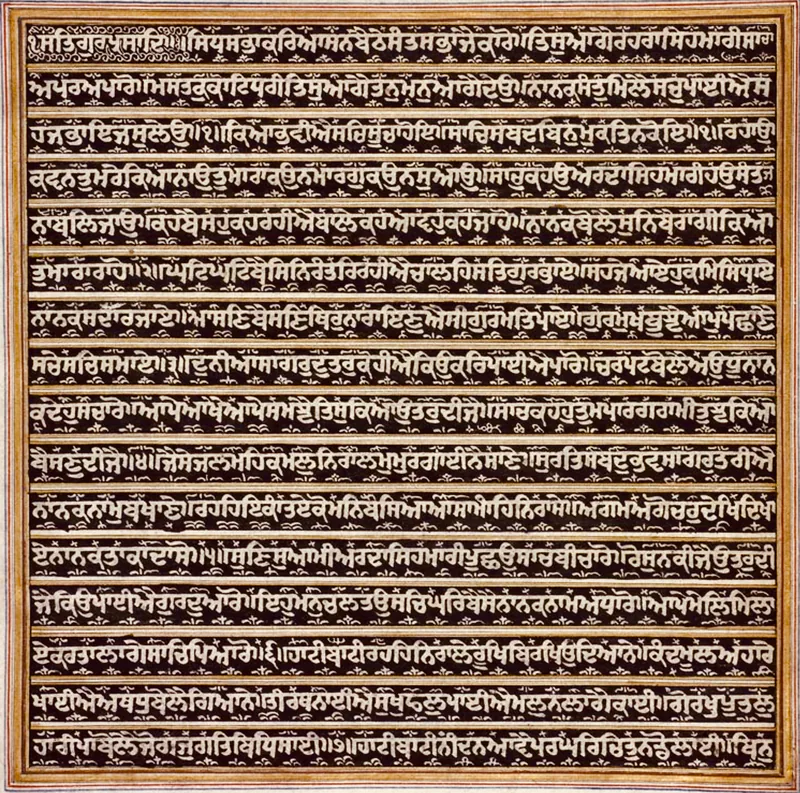
After a birth, the family visits the gurdwara, where the scripture is opened at random and the child's name is chosen to begin with the first letter of the hymn on the page. Boys and some girls later have a turban-tying ceremony (dastār bandī), and young people may choose to receive initiation into the Khalsa, described in The Khalsa and the Five Ks.
The Sikh marriage ceremony, Anand Kāraj, "ceremony of bliss", takes place in the presence of the Guru Granth Sahib. As the four stanzas of the wedding hymn (lāvāṅ) composed by Guru Ram Das are read and sung, the couple walk clockwise around the scripture four times, the bride usually following the groom and joined to him by a scarf. The hymn describes the stages of the soul's union with God, so marriage itself is presented as a spiritual path. The rite was given legal recognition in British India by the Anand Marriage Act of 1909.
At death, Sikhs are taught to accept God's will and to avoid excessive mourning. The body is washed, dressed with the Five Ks if the person was initiated, and cremated while the evening prayer Kīrtan Sohilā and the Ardās are recited. The ashes are usually immersed in running water, and a complete reading of the scripture is held in the following days.
Festivals, Takhts and Pilgrimage§
Sikh festivals are of two kinds. Gurpurbs commemorate events in the lives of the Gurus, above all the birthdays of Guru Nanak and Guru Gobind Singh and the martyrdoms of Guru Arjan and Guru Tegh Bahadur; they are marked by continuous readings of the scripture, kīrtan and processions (nagar kīrtan) led by five Sikhs representing the Panj Piāre. Seasonal festivals, shared in date with Punjabi tradition, were given Sikh meanings: Vaisakhi in April celebrates the founding of the Khalsa in 1699; Bandi Chhor Divas, at the time of Diwali, recalls Guru Hargobind's release from Gwalior fort and is celebrated with illuminations at the Golden Temple; and Hola Mohalla, at Anandpur after Holi, features martial displays. The dating of festivals according to a proposed Sikh calendar, the Nanakshahi calendar adopted in 2003 and later revised, has been a matter of debate.
Sikh teaching does not require pilgrimage, and the Gurus criticised bathing at holy places as a means of merit, but Sikhs visit historic gurdwaras with great devotion. The five Takhts, "thrones" of authority, are the Akal Takht at Amritsar and the gurdwaras at Anandpur, Patna, Nanded and Talwandi Sabo, all linked with the Gurus. Gurdwaras at Nankana Sahib and Kartarpur in Pakistan, associated with Guru Nanak's birth and death, are reached through special arrangements; in 2019 a visa-free corridor opened between India and the Kartarpur gurdwara. The historical background of these sites is told in Sikh History.
Frequently asked questions§
Can non-Sikhs visit a gurdwara and eat in the langar?§
Yes. Gurdwaras are open to everyone, and visitors of any faith are welcome to attend worship and eat in the langar. They are asked to cover their heads, remove their shoes and refrain from bringing tobacco or alcohol.
Do Sikhs have priests?§
Sikhism has no ordained clergy. A granthī cares for and reads from the scripture, and rāgīs sing hymns, but any Sikh who can read the Gurmukhi script may perform these roles, and congregations manage their own gurdwaras.
What happens at a Sikh wedding?§
In the Anand Kāraj the couple sit before the Guru Granth Sahib and walk around it four times while the four stanzas of the wedding hymn by Guru Ram Das are sung. The ceremony ends with Ardās, the sharing of kaṛāh prasād and usually a langar meal.
Sources and further reading§
- The Sikhs: Their Religious Beliefs and Practices — W. Owen Cole & Piara Singh Sambhi, 1978
- Sikhism: A Very Short Introduction — Eleanor Nesbitt, 2005
- Sikhism: An Introduction — Nikky-Guninder Kaur Singh, 2011
- The Oxford Handbook of Sikh Studies — Pashaura Singh & Louis E. Fenech (eds.), 2014
- Sikhs in Britain: The Making of a Community — Gurharpal Singh & Darshan Singh Tatla, 2006