Liber XXVII · Sikhism · Chapter III: Guru Nanak & the Ten Gurus
Guru Tegh Bahadur: Life, Teachings and Martyrdom in Delhi
Guru Tegh Bahadur (1621–1675), ninth Sikh Guru: his years at Bakala, travels to Assam, hymns of detachment and his execution in Delhi in 1675.

Guru Tegh Bahadur (1621–1675) was the ninth Sikh Guru. A son of Guru Hargobind, he spent long years in meditation at Bakala before becoming Guru in 1664, travelled widely through northern and eastern India, founded the town that became Anandpur, and wrote hymns on detachment and fearlessness that were later added to the Guru Granth Sahib. He was executed in Delhi in November 1675 on the orders of the Mughal authorities, and Sikhs honour him as a martyr who gave his life for the freedom of conscience of others.
Early Life: From Tyag Mal to Tegh Bahadur§
The ninth Guru was born in Amritsar, traditionally on 1 April 1621, the youngest son of Guru Hargobind and Mata Nanaki. His childhood name was Tyag Mal, "master of renunciation". Sikh tradition says that he fought bravely beside his father at the battle of Kartarpur against a Mughal force in 1635, and that his father then named him Tegh Bahadur, "brave of the sword". The two names, one of renunciation and one of valour, are often taken as a summary of his character.
He married Gujri, daughter of Lal Chand of Kartarpur. After Guru Hargobind's death in 1644 the Guruship passed not to him but to his nephew Har Rai, and then in 1661 to Har Rai's young son, Har Krishan. Tegh Bahadur, with his mother and wife, settled at Bakala, a village near the Beas river, where he lived quietly for some two decades. Sikh accounts describe him spending long hours in meditation in an underground room, a period remembered as preparation for his later ministry.
Guru Ladho Re: Recognition at Bakala§
Guru Har Krishan died of smallpox in Delhi in 1664, still a child. According to Sikh tradition his last words, Bābā Bakāle, indicated that his successor was to be found at Bakala. A number of Sodhi relatives, tradition says as many as twenty-two, promptly set themselves up there as claimants.
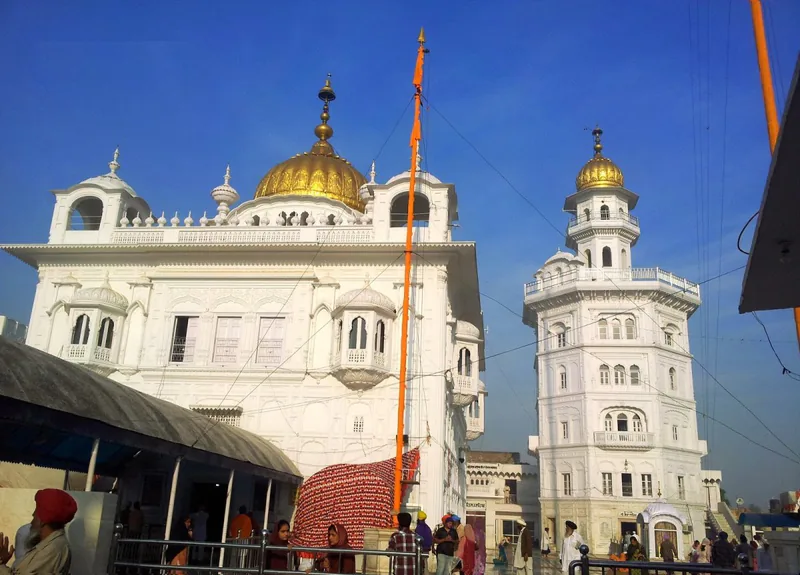
The best-known story of the succession concerns Makhan Shah, a Labana trader whose ship had been saved from a storm after he vowed an offering of gold coins to the Guru. Arriving at Bakala, he placed a small offering before each claimant. When Tegh Bahadur gently asked why he had given less than he had promised, Makhan Shah is said to have climbed onto a roof and cried Gurū lādho re, "I have found the Guru". Whatever its details, the story expresses the conviction that the true Guru is recognised by spiritual insight, not by family claim.
Tegh Bahadur's recognition was resisted. His nephew Dhir Mal, who held an early manuscript of the scripture at Kartarpur, disputed it, and tradition records an attack on the Guru by one of Dhir Mal's followers. When the Guru visited Amritsar, the custodians of the Harmandir Sahib, from the rival Mina line, closed its doors against him; a small shrine outside the precinct marks where he waited. These conflicts belong to the long history of rival lineages described in Guru Nanak and the Ten Sikh Gurus.
Travels in Northern and Eastern India§
In 1665 the Guru bought land from the Raja of Kahlur (Bilaspur) in the Shivalik foothills and founded Chakk Nanaki, named after his mother; it grew into the town of Anandpur. Soon afterwards he set out on extended journeys that took him through the Malwa and Bangar regions of the Punjab and then east to Mathura, Agra, Prayag, Banaras, Gaya and Patna. He left his family at Patna, where his son Gobind was born in 1666, and continued into Bengal and Assam.
In Assam, according to Sikh tradition, he accompanied the Mughal general Raja Ram Singh of Amber on a campaign against the Ahom kingdom around 1668–1670 and helped to bring about a settlement; Gurdwara Dhubri Sahib on the Brahmaputra commemorates his stay. He returned to the Punjab around 1671–1672 and spent the following years at Anandpur and on preaching tours in the Malwa, where Sikh memory credits him with digging wells, planting trees and encouraging communities in famine-prone country. Congregations established or visited on these journeys, many marked by gurdwaras today, helped to extend the Sikh Panth far beyond the Punjab.
The Hymns of Guru Tegh Bahadur§
Guru Tegh Bahadur's compositions, 59 hymns (shabads) and 57 couplets (saloks) in fifteen ragas, were added to the Sikh scripture by Guru Gobind Singh, completing the text that became the Guru Granth Sahib. They include the only hymns in the scripture set in Rag Jaijavanti.
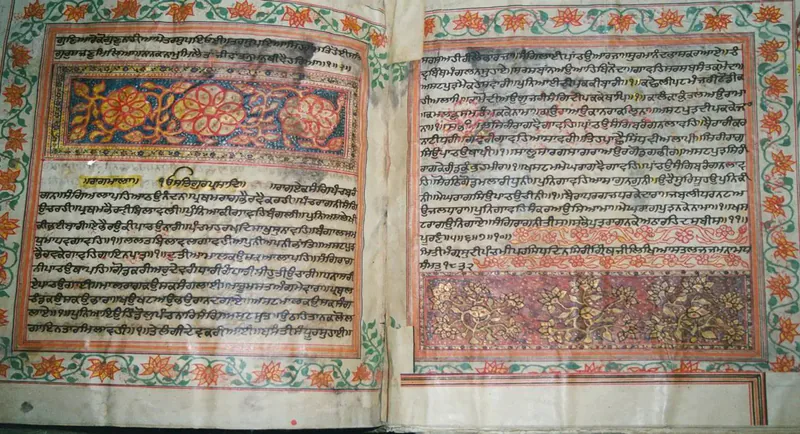
His verse is spare, sober and meditative. Its recurring themes are the impermanence of the body and of worldly ties, the futility of pride, and the steadiness of the person who has learned detachment (vairāg) while still living in the world. The ideal person, he writes, is one who neither frightens anyone nor fears anyone, a line that Sikhs often quote as a key to his life. The final saloks of the Guru Granth Sahib, recited at the close of every complete reading of the scripture, are his, and many Sikhs know them by heart; they move from a sense of the world as a passing dream to the assurance that the Name of God is the only lasting support. The connection of this teaching with nām simran and with the five realms of spiritual progress is set out in Sikh Beliefs.
Martyrdom in Delhi, 1675§
In 1675, according to Sikh tradition, a delegation of Kashmiri Brahmins led by Pandit Kirpa Ram came to Anandpur to seek the Guru's help against pressure to convert to Islam under the governor of Kashmir. The Guru reflected that only the sacrifice of a great person could protect them, and his nine-year-old son Gobind replied that there was no one greater than his father. The Guru told the Brahmins to inform the authorities that if he could be persuaded to convert, they would follow.
He was arrested, with several companions, and brought to Delhi. Sikh tradition records that three of his followers were executed before him to break his resolve: Bhai Mati Das was sawn apart, Bhai Sati Das was wrapped in cotton and set alight, and Bhai Dayala was boiled in a cauldron. The Guru, refusing to convert or, in some accounts, to perform a miracle to prove his status, was beheaded in Chandni Chowk, traditionally on 11 November 1675; the Nanakshahi calendar observes the anniversary on 24 November.
In a storm that followed, tradition says, a Sikh named Bhai Jaita carried the Guru's head to Anandpur, where Guru Gobind Singh embraced him with the words Raṅgreṭe Gurū ke beṭe, "the Rangretas are the Guru's own sons", honouring his low-caste community. A carter, Lakhi Shah Vanjara, took the body to his home at Raisina and set fire to the house to cremate it secretly. Gurdwara Sis Ganj in Chandni Chowk and Gurdwara Rakab Ganj near Parliament House mark these places. The story of the son who succeeded him is told in Guru Gobind Singh: Life and Legacy.
Interpretation and Legacy: Hind di Chadar§
Guru Gobind Singh's autobiographical Bachittar Natak describes his father's death as a sacrifice made to protect the forehead mark and sacred thread of others: he gave his head but not his resolve. On this basis Sikhs call Guru Tegh Bahadur Hind dī Chādar, "the shield (literally the sheet or covering) of India", and present his martyrdom as a defence of freedom of conscience on behalf of people who were not Sikhs. The 350th anniversary of his martyrdom was widely commemorated in 2025.
Historians approach the event through scarce and late sources. The Kashmiri episode is attested mainly in Sikh writings of the eighteenth and nineteenth centuries, and Persian chronicles say little; one later Persian history, the Siyar al-Mutaʾakhkhirīn of 1782, presents the Guru unsympathetically as a disturber of order. Scholars therefore discuss how far political suspicion of an influential, travelling religious leader with armed followers, and how far Aurangzeb's religious policy, explain his execution. The fact of the execution in Delhi, and its profound effect on Sikh history, is not in doubt. Together with the death of Guru Arjan Dev, it helped to shape the Sikh ideal of martyrdom and the resolve that led, a generation later, to the founding of the Khalsa.
Frequently asked questions§
Why is Guru Tegh Bahadur called Hind di Chadar?§
The title means "shield of India". Sikhs use it because tradition holds that he gave his life in 1675 to defend the right of Kashmiri Brahmins, who were not Sikhs, to practise their own religion.
Where was Guru Tegh Bahadur executed?§
He was beheaded in Chandni Chowk in Delhi in November 1675. Gurdwara Sis Ganj Sahib stands at the site, and Gurdwara Rakab Ganj Sahib marks the place where his body was cremated.
How many hymns did Guru Tegh Bahadur write?§
The Guru Granth Sahib contains 59 hymns and 57 saloks by him, in fifteen ragas. They were added to the scripture by his son, Guru Gobind Singh.
Sources and further reading§
- Guru Tegh Bahadur: Prophet and Martyr — Trilochan Singh, 1967
- Guru Tegh Bahadur: Martyr and Teacher — Fauja Singh & Gurbachan Singh Talib, 1975
- Martyrdom in the Sikh Tradition: Playing the "Game of Love" — Louis E. Fenech, 2000
- The Sikhs of the Punjab — J. S. Grewal, 1990
- A History of the Sikhs — Khushwant Singh, 1963
- The Sikh Religion: Its Gurus, Sacred Writings and Authors — Max Arthur Macauliffe, 1909