Liber XXVII · Sikhism · Chapter III: Guru Nanak & the Ten Gurus
Guru Arjan Dev: Adi Granth, Harmandir Sahib and Martyrdom
Guru Arjan Dev (1563–1606), fifth Sikh Guru: builder of the Harmandir Sahib, compiler of the Adi Granth, author of Sukhmani Sahib and the first Sikh martyr.

Guru Arjan Dev (1563–1606) was the fifth Sikh Guru. During his twenty-five years as Guru he completed the sacred pool and temple at Amritsar, compiled the Adi Granth, the scripture that later became the Guru Granth Sahib, composed more hymns than any other contributor to it, and was executed at Lahore in 1606 on the orders of the Mughal emperor Jahangir, becoming the first martyr of the Sikh tradition.
Early Life and the Disputed Succession§
Arjan was born at Goindval on the river Beas, traditionally on 15 April 1563, the youngest of three sons of Bhai Jetha, later Guru Ram Das, and Bibi Bhani, daughter of the third Guru, Amar Das. He grew up at Goindval, then the centre of the young Sikh movement, and later at Ramdaspur, the town that became Amritsar.
Guru Ram Das passed over his eldest son, Prithi Chand, and installed Arjan as his successor in 1581. Prithi Chand did not accept the decision. He and his descendants maintained a rival line of Gurus, and Sikh sources refer to them by the hostile name Mīṇe, usually glossed as "scoundrels" or "deceivers". The rivalry was not trivial: Prithi Chand's son Miharvan produced an important janamsākhī, a hagiography of Guru Nanak, and the Mina line controlled Amritsar for periods in the seventeenth century. Much of what Guru Arjan did to fix the Sikh canon and centre should be read against this background of competing claims to the Guru's authority, which Guru Nanak and the Ten Sikh Gurus places in the wider succession.
Builder of Amritsar and the Sikh Towns§
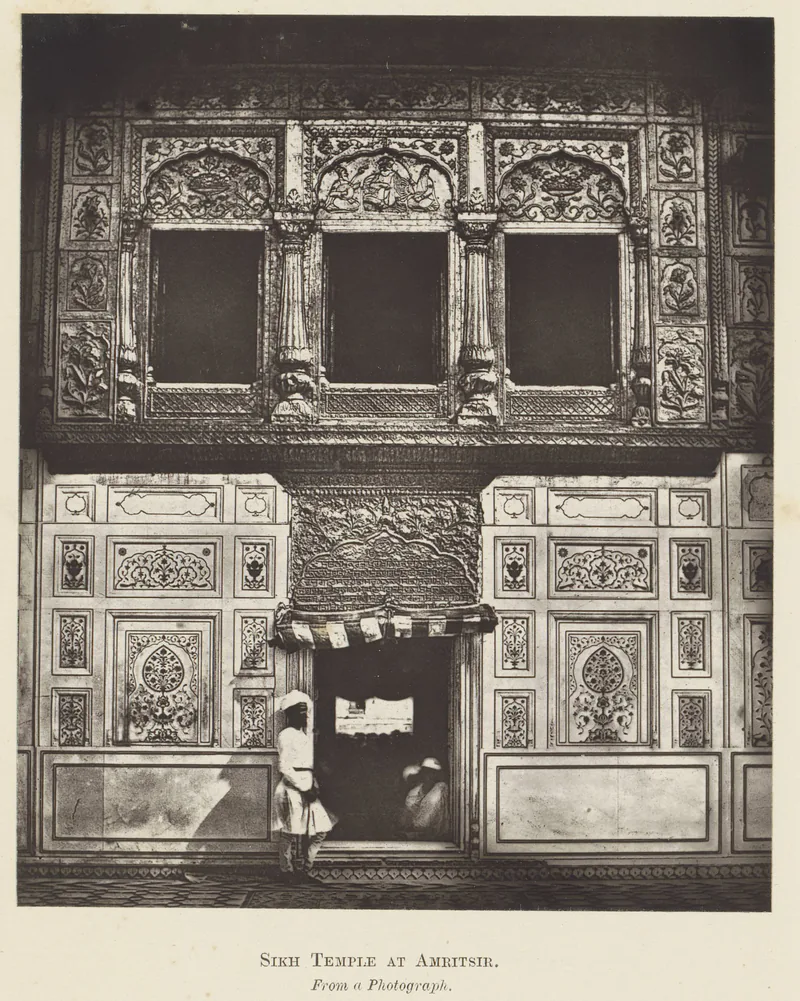
Guru Ram Das had begun the excavation of a sacred pool at Ramdaspur. Guru Arjan completed it and built in its centre the Harmandir Sahib, "the temple of God", now known worldwide as the Golden Temple. Sikh tradition holds that the foundation stone was laid in 1588 by the Lahore Sufi Mian Mir; the story is cherished as a sign of the Guru's openness, although historians point out that it is first recorded long afterwards. The temple was set low, so that worshippers descend to it, and given doors on all four sides, features later read as symbols of humility and of welcome to people of every caste and direction.
The Guru also founded Tarn Taran, with its own large pool, around 1590, Kartarpur in the Jalandhar Doab around 1594, and Sri Hargobindpur on the Beas. These towns attracted traders and artisans and gave the community a network of centres in the central Punjab. To support the growing institution, the system of masands, agents who collected offerings from distant congregations and brought them to the Guru, was organised more formally, and the custom of dasvandh, giving a tenth of one's income, is traditionally associated with this period.
Compiling the Adi Granth§
Guru Arjan's best-known achievement is the compilation of the Adi Granth, the "first book". The hymns of the earlier Gurus had been written down before him; the most important earlier collection is the set of manuscripts known as the Goindval Pothis, associated with Guru Amar Das. Tradition says Guru Arjan obtained these volumes from Baba Mohan, a son of Guru Amar Das, and then, working at Ramsar near Amritsar with his scribe Bhai Gurdas, organised a much larger collection.
The result, completed in 1604, arranged the hymns not by author but by rāga, the musical mode in which each hymn is to be sung, and within each raga by poetic form and author. The Gurus' compositions are identified by the word Mahalā with a number (Mahala 1 for Guru Nanak, Mahala 5 for Guru Arjan), so that all are presented under the name Nanak. Alongside them the Guru included verses by bhagats, devotional poets from Hindu and Muslim backgrounds, among them Kabir, Ravidas, Namdev and Shaikh Farid, whose place in the Sikh story is described in Sikhism and the Sant Tradition.
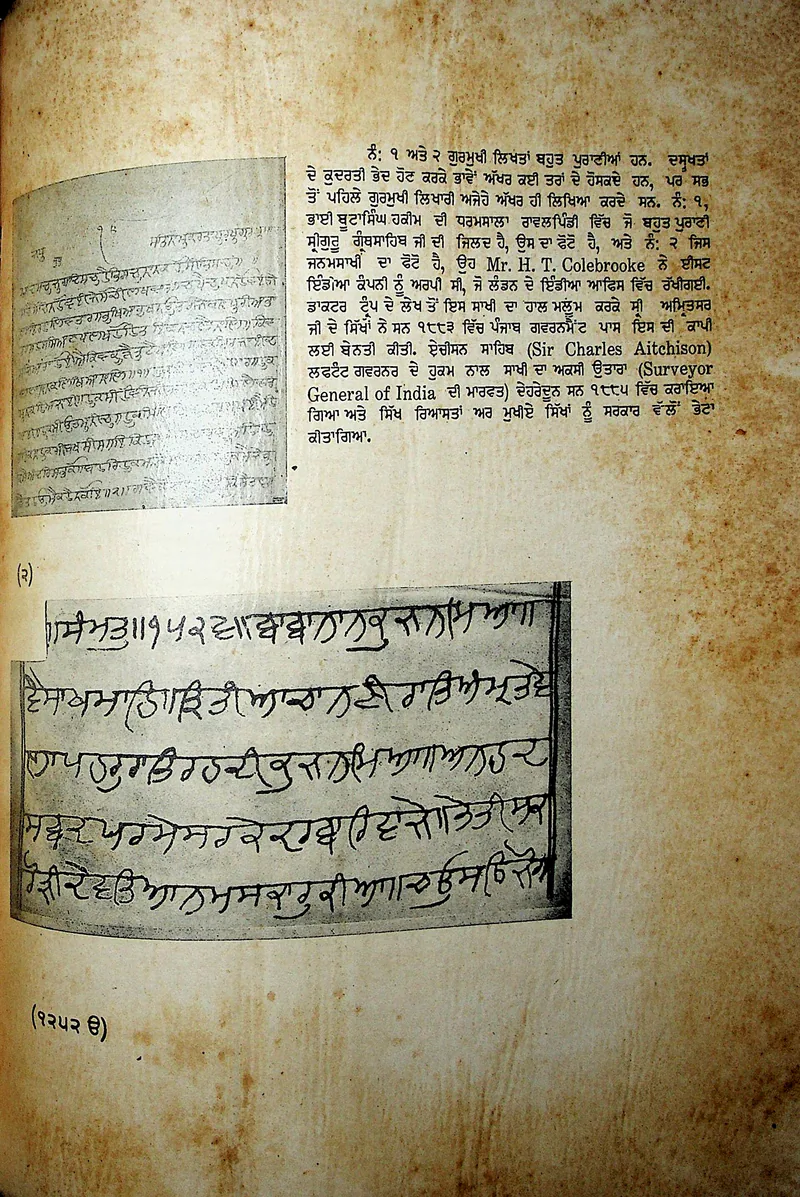
A manuscript known as the Kartarpur Pothi, held by the Sodhi family of Kartarpur and dated 1604, is regarded by many Sikhs and some scholars as the volume prepared under the Guru's supervision; its exact relationship to the Guru remains a subject of scholarly debate. The Adi Granth was installed in the Harmandir Sahib in 1604, with the elder Sikh Baba Buddha as its first custodian. A century later Guru Gobind Singh added the hymns of Guru Tegh Bahadur, and in 1708 the expanded book was declared the eternal Guru Granth Sahib.
The Poetry of Guru Arjan and Sukhmani Sahib§
Guru Arjan is the largest single contributor to the scripture, with more than two thousand compositions in some thirty ragas. His verse is fluent and gentle in tone, rich in images of the household, the seasons and the longing of the soul-bride for her divine Spouse.
Among his best-known works is Sukhmanī Sāhib, "the jewel of peace", a long composition in Rag Gauri of twenty-four sections, each opening with a short salok and followed by eight stanzas. Its theme is the transforming power of remembering the divine Name (nām simran) and the qualities of the brahmgiānī, the person who knows God and lives free of fear and enmity. Many Sikhs recite it daily or at times of difficulty, and congregational readings are common at family occasions. Other well-known works include the Bārah Māhā in Rag Majh, which follows the twelve months of the year as stages of the soul's separation from and union with the Beloved, and Bāvan Akharī, an acrostic poem on the letters of the alphabet. The central teachings he expresses are set out more fully in Sikh Beliefs: Ik Onkar, Nam Simran, Hukam, Seva.
Imprisonment and Death in Lahore, 1606§
The Mughal emperor Akbar, according to Sikh tradition, met Guru Arjan and was shown the Adi Granth when complaints were raised about it, finding nothing objectionable. Akbar died in October 1605 and was succeeded by his son Jahangir. Within months Jahangir's eldest son, Prince Khusrau, rebelled and fled towards Lahore, passing through the region of Goindval. It was reported that the Guru had received or blessed the prince.
Jahangir's own memoirs, the Jahāngīrnāma, mention the episode. The emperor writes that a Hindu named Arjan at Goindval had gathered many simple-minded people, Hindus and Muslims alike, as his followers, that he had long wished either to put an end to what he regarded as a false trade in holiness or to bring its leader into Islam, and that after the Guru's meeting with Khusrau he ordered his property confiscated and him put to death. The passage is one of the rare contemporary references to a Sikh Guru in Persian court sources, and it shows that religious as well as political considerations were in the emperor's mind. A letter of the Jesuit missionary Jerome Xavier, written from Lahore in 1606, also refers to the death of the Guru after suffering.
Sikh tradition gives a fuller account. The Guru was held in Lahore and subjected to torture: he was seated on a red-hot iron plate, burning sand was poured over him and he was placed in boiling water, yet he remained calm, accepting what happened as the will of God (bhāṇā). Tradition blames a Hindu official named Chandu Shah, whose offer of his daughter in marriage to the Guru's son had been refused; many historians doubt this element, which is not found in early sources. According to the tradition, the Guru asked to bathe in the river Ravi and was not seen again. He died on 30 May 1606 by the older reckoning; the reformed Nanakshahi calendar fixes the anniversary in mid-June. Gurdwara Dera Sahib in Lahore, beside the Mughal fort, marks the place.
Historians continue to discuss the balance of causes. Some stress Khusrau's rebellion and the Mughal treatment of anyone who aided a rebel; others point to Jahangir's stated hostility to the Guru's growing following, and to a letter of the Naqshbandi Sufi Shaikh Ahmad Sirhindi that appears to welcome the execution, though its significance is disputed.
Legacy: Martyrdom and the Turn to Miri-Piri§
Sikhs remember Guru Arjan as the first of their martyrs and as the model of serene acceptance of God's will under suffering. On the anniversary of his death, which falls in the heat of early summer, Sikhs set up roadside stalls called chhabīl offering sweetened chilled water to passers-by, an act of service that recalls his ordeal.
His death also marked a turning point in Sikh history. His son and successor, Guru Hargobind (1595–1644), is said to have girded himself with two swords, one for spiritual authority (pīrī) and one for temporal authority (mīrī), built the Akal Takht facing the Harmandir Sahib and maintained armed followers. The same pattern of conflict with the Mughal state recurred with the execution of the ninth Guru, described in Guru Tegh Bahadur: Life, Teachings and Martyrdom. Guru Arjan's twin legacies, a fixed scripture and a central shrine, gave the Sikh community the foundations on which every later generation built.
Frequently asked questions§
Why is Guru Arjan Dev called the first Sikh martyr?§
He was the first Sikh Guru to be put to death by a ruling power, executed in Lahore in 1606 under the Mughal emperor Jahangir. Sikh tradition holds that he endured torture without renouncing his faith, and he is honoured as the "crown of the martyrs".
What did Guru Arjan Dev write?§
He composed over two thousand hymns, the largest share of any author in the Guru Granth Sahib. His best-known works include Sukhmani Sahib, the Barah Maha in Rag Majh and Bavan Akhari.
Who laid the foundation stone of the Golden Temple?§
Sikh tradition credits the Lahore Sufi Mian Mir with laying the foundation stone in 1588 at Guru Arjan's invitation. The story is widely loved, but historians note that it is recorded only in later sources.
What is the Kartarpur Pothi?§
It is a manuscript of the Sikh scripture dated 1604 and kept by the Sodhi family of Kartarpur. Many regard it as the copy of the Adi Granth prepared under Guru Arjan's supervision, although scholars debate its exact status.
Sources and further reading§
- Life and Work of Guru Arjan: History, Memory, and Biography in the Sikh Tradition — Pashaura Singh, 2006
- The Guru Granth Sahib: Canon, Meaning and Authority — Pashaura Singh, 2000
- The Making of Sikh Scripture — Gurinder Singh Mann, 2001
- The Jahangirnama: Memoirs of Jahangir, Emperor of India — Wheeler M. Thackston (trans.), 1999
- Martyrdom in the Sikh Tradition: Playing the "Game of Love" — Louis E. Fenech, 2000
- The Sikhs of the Punjab — J. S. Grewal, 1990
- The Sikh Religion: Its Gurus, Sacred Writings and Authors — Max Arthur Macauliffe, 1909