Liber XXVII · Sikhism · Chapter III: Guru Nanak & the Ten Gurus
Guru Nanak and the Ten Sikh Gurus: Lives, Teachings, Legacy
Guru Nanak and the ten Sikh Gurus, 1469 to 1708: their lives, teachings and martyrdoms, the founding of Amritsar and the Khalsa, and the eternal Guru.

The ten Sikh Gurus were the spiritual leaders who founded and shaped the Sikh faith over more than two centuries, from Guru Nanak (1469–1539) to Guru Gobind Singh (1666–1708). Sikhs believe that the same divine light passed from each Guru to the next, "as one lamp lights another", and that after Guru Gobind Singh the Guruship was vested permanently in the scripture, the Guru Granth Sahib, and in the community of the Khalsa.
Historical Sources for the Lives of the Gurus§
The Gurus' own hymns, preserved in the Guru Granth Sahib, reveal their teaching but say little directly about their lives. The fullest narratives come from the janamsākhīs, "birth stories" of Guru Nanak, which survive in versions from the seventeenth century onward, together with the ballads (vārs) of the scholar Bhai Gurdas (d. 1636), later Sikh chronicles, and Persian sources from the Mughal court. The janamsakhis mix remembered history with hagiography intended to convey spiritual truths. The New Zealand scholar W. H. McLeod's critical analysis of them in the 1960s provoked debate with Sikh historians who considered his scepticism excessive. The account below follows the traditional narrative while noting where it is uncertain.
Guru Nanak: Birth, Calling and Travels§
Nanak was born in 1469 at Talwandi, a village near Lahore now called Nankana Sahib in Pakistan, to a Hindu family of the Khatri caste; his father, Mehta Kalu, was a village accountant. Tradition describes a contemplative child who questioned empty ritual, refusing for example to accept the sacred thread of the upper castes. As a young man he worked as a storekeeper for a Muslim official at Sultanpur Lodhi, where his sister Nanaki lived, and married Sulakhani, with whom he had two sons.
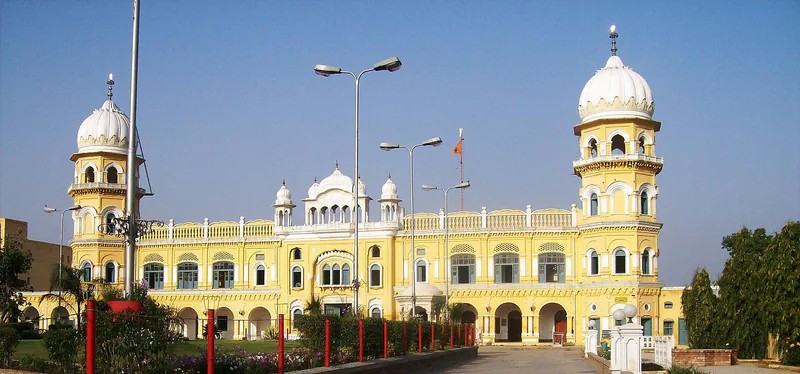
Around 1499, according to the janamsakhis, he went to bathe in the river and disappeared for three days, during which he was taken into God's presence. He returned with the words "There is no Hindu, there is no Musalman", which Sikhs understand as a declaration that God sees beyond religious labels. He then set out on long journeys (udāsīs), accompanied by the Muslim musician Mardana, who played the rabab while Nanak sang. Tradition takes him east to Bengal and Assam, south as far as Sri Lanka, north into the Himalayas and west to Mecca and Baghdad; historians regard the routes and some episodes as uncertain. Famous stories include his reply at Mecca, when rebuked for sleeping with his feet toward the Ka'ba: "turn my feet in a direction where God is not." Several of his hymns lament the violence of Babur's invasion of the Punjab in the 1520s.
Kartarpur and the First Sikh Community§
In about the 1520s Guru Nanak settled at Kartarpur on the Ravi river, where he spent his last years as a farmer and teacher. There a community of disciples formed around a daily discipline that would become the pattern of Sikh life: early-morning singing of hymns, work in the fields, a shared meal in which all ate together regardless of caste, and evening prayer. Instead of appointing one of his sons, the Guru chose a devoted disciple, Lehna, renamed him Angad, "my own limb", and installed him as his successor. Guru Nanak died in 1539. A well-known tradition tells that Hindus and Muslims disputed whether to cremate or bury him, and that when the sheet over his body was lifted only flowers were found. His teachings are explored in Sikh Beliefs.
The Second to Fifth Gurus: Building Institutions§
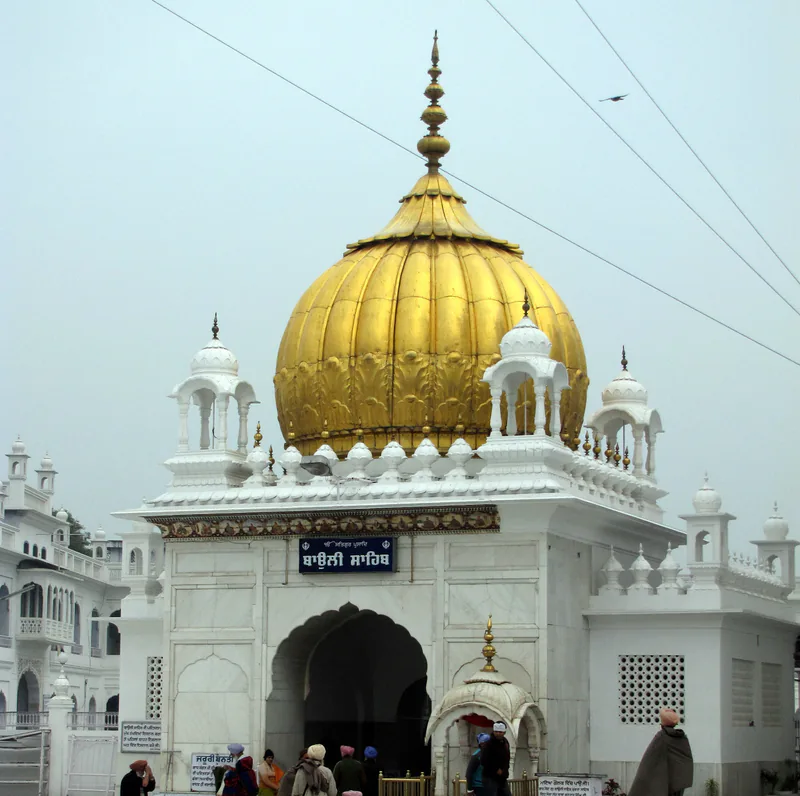
Guru Angad (Guru 1539–1552) worked from Khadur. Tradition credits him with standardising the Gurmukhi script in which Punjabi and the Sikh scriptures are written, and his wife, Mata Khivi, is remembered for her management of the langar. Guru Amar Das (1552–1574), who became Guru in old age, made Goindval a centre of pilgrimage with a stepwell (bāolī), organised the growing community into districts (manjīs), insisted that all visitors eat in the langar before meeting him, a rule the emperor Akbar is said to have honoured, and opposed the veiling of women and the burning of widows. Collections of hymns made in his time, the Goindval pothīs, prepared the way for the scripture.
Guru Ram Das (1574–1581), his son-in-law, founded the town of Ramdaspur around a sacred pool that gave it its later name, Amritsar, "pool of nectar", and composed the hymns (lāvāṅ) still sung at Sikh weddings. From him the Guruship passed within his family. Guru Arjan (1581–1606), his youngest son, built the Harmandir Sahib in the middle of the pool, with doors on four sides as a sign of openness to all, and in 1604 compiled the Sikh scripture, the Ādi Granth, with the scholar Bhai Gurdas as scribe, including hymns of earlier Gurus, his own and those of Hindu and Muslim saints. In 1606 he was arrested and died in Mughal custody in Lahore under the emperor Jahangir; historians discuss the political motives, including the Guru's reported blessing of Jahangir's rebel son Khusrau, but for Sikhs he is the first great martyr of the faith.
Guru Hargobind to Guru Tegh Bahadur: Miri and Piri§
Guru Hargobind (1606–1644), Guru Arjan's son, responded to his father's death by wearing two swords, symbolising mīrī, temporal authority, and pīrī, spiritual authority. He built the Akal Takht, "throne of the Timeless", facing the Harmandir Sahib, kept armed followers and fought several skirmishes with Mughal forces. Imprisoned for a time in Gwalior fort, he is remembered for securing the release of fellow prisoners, an event commemorated at Bandi Chhor Divas. Guru Har Rai (1644–1661) kept a mounted guard but lived largely in peace at Kiratpur; tradition remembers his care for the sick. Guru Har Krishan (1661–1664) became Guru at the age of five and died of smallpox in Delhi at about seven, having, according to tradition, tended victims of the epidemic; the Gurdwara Bangla Sahib marks the site.
Guru Tegh Bahadur (1664–1675), a son of Guru Hargobind, founded the town that became Anandpur, travelled widely in eastern India, and composed hymns of detachment later added to the scripture. In 1675 he was executed in Delhi on the orders of the emperor Aurangzeb. Sikh tradition relates that he had taken up the cause of Kashmiri Brahmins facing forced conversion, and he is honoured as one who gave his life for the freedom of conscience of others. Gurdwara Sis Ganj in Delhi stands at the place of his execution.
Guru Gobind Singh and the End of Human Guruship§
Guru Gobind Singh (1675–1708), born in Patna in 1666, became Guru at the age of nine after his father's death. A poet in Braj, Persian and Punjabi as well as a military leader, he made Anandpur a centre of learning and arms. In 1699 he founded the Khalsa, the order of initiated Sikhs, described in The Khalsa and the Five Ks. Conflicts with the hill rajas and Mughal governors culminated in the siege and evacuation of Anandpur around 1704–1705. His two elder sons died fighting at Chamkaur, and his two younger sons were executed at Sirhind, events Sikhs remember with deep grief. Afterwards he wrote a Persian letter to Aurangzeb, the Zafarnāma, "letter of victory", rebuking the emperor for broken oaths.
At Damdama (Talwandi Sabo) the Guru prepared the final recension of the scripture, adding his father's hymns. Many other compositions attributed to him were later gathered in a separate collection, the Dasam Granth, whose authorship and status remain debated among Sikhs. After Aurangzeb's death he travelled south with the new emperor Bahadur Shah and, at Nanded in the Deccan, was stabbed by assassins; he died of his wounds in October 1708. Before his death he declared that the line of personal Gurus was complete: the Guru would henceforth be the scripture, the Guru Granth Sahib, and the community, the Guru Panth. The history that followed is told in Sikh History.
Frequently asked questions§
Who was the first Sikh Guru?§
Guru Nanak (1469–1539), born at Talwandi in the Punjab, was the first Guru and founder of Sikhism. His hymns open the Guru Granth Sahib, and his birthday, Guru Nanak Gurpurb, is the most widely celebrated Sikh festival.
Who is the current Guru of the Sikhs?§
Sikhs regard the scripture, the Guru Granth Sahib, as their eternal and living Guru, together with the collective authority of the Khalsa community. There has been no human Guru since Guru Gobind Singh's death in 1708 for mainstream Sikhs, although some groups, such as the Namdharis, recognise living Gurus.
Why did the Gurus become militarised?§
After the execution of Guru Arjan in 1606, Guru Hargobind adopted the principle of mīrī-pīrī, uniting spiritual and temporal authority, to defend the community. Sikh tradition presents armed resistance as justified only in defence of righteousness and the oppressed.
Sources and further reading§
- Guru Nanak and the Sikh Religion — W. H. McLeod, 1968
- Early Sikh Tradition: A Study of the Janam-sakhis — W. H. McLeod, 1980
- The Sikh Religion: Its Gurus, Sacred Writings and Authors — Max Arthur Macauliffe, 1909
- A History of the Sikhs — Khushwant Singh, 1963
- Martyrdom in the Sikh Tradition: Playing the "Game of Love" — Louis E. Fenech, 2000
- The Sikh Zafar-namah of Guru Gobind Singh — Louis E. Fenech, 2013