Liber XXVII · Sikhism · Chapter II: Guru Granth Sahib
Dasam Granth: Guru Gobind Singh's Book, Contents and Debate
The Dasam Granth explained: works attributed to Guru Gobind Singh, Jaap Sahib, Bachittar Natak, Chandi di Var, Zafarnama and the authorship debate.

The Dasam Granth, "the Book of the Tenth [Guru]", is a large collection of poetry attributed in whole or in part to Guru Gobind Singh (1666–1708), the tenth Sikh Guru. It contains prayers recited daily by Sikhs, an autobiographical poem, retellings of Hindu mythology, a long series of moral tales and a Persian letter to the emperor Aurangzeb. Sikhs honour it as sacred literature, but it is distinct from the Guru Granth Sahib, which alone is the Guru, and the authorship of much of it has been debated for more than a century.
Compilation of the Dasam Granth§
Guru Gobind Singh's court at Anandpur, and earlier at Paonta on the Yamuna, was a centre of literature. Tradition speaks of dozens of poets (kavīs) in his service who translated and retold Sanskrit classics into the vernacular, alongside the Guru's own compositions. Much of this material is said to have been lost when Anandpur was evacuated in 1704–1705 and the Guru's party was scattered at the crossing of the Sirsa river.
After the Guru's death in 1708, surviving writings were gathered into a single volume. The best-known tradition credits Bhai Mani Singh (d. 1738), the learned Sikh who also served at Amritsar, with the compilation, citing a letter he is said to have written to the Guru's widow Mata Sundari; the authenticity of that letter is itself questioned by some scholars. Several early manuscripts survive with differing contents and order. In the late nineteenth century a committee of the Singh Sabha reform movement compared manuscripts and settled the text of a standard edition, which became the basis of the printed volume used today.
The name Dasam Granth became standard only later; older manuscripts call it "the Book of the Tenth King" (Dasven Pātshāh kā Granth) or simply the Granth. Its use differs across the community. At two of the five Takhts, Hazur Sahib in Nanded and Patna Sahib, and among the Nihang Sikhs, it is installed and honoured beside the Guru Granth Sahib; in most gurdwaras it is not.
Contents of the Dasam Granth§
The standard edition contains the following principal works, in roughly this order.
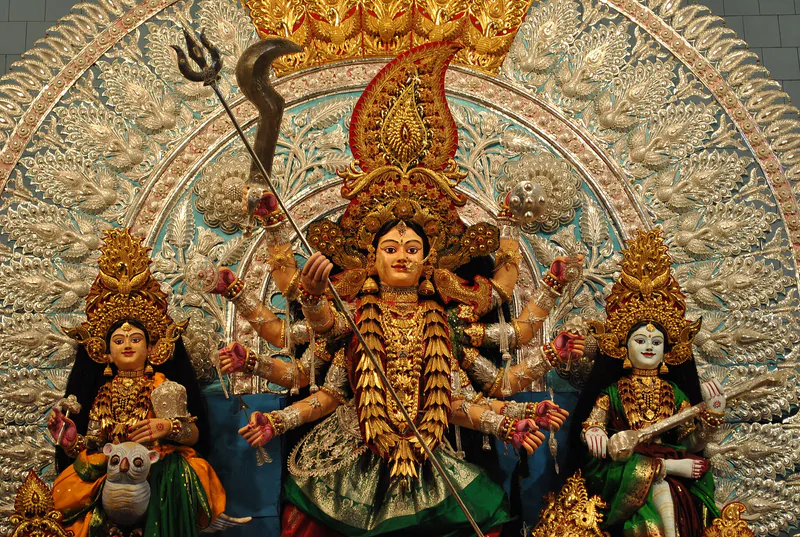
- Jaap Sahib, a hymn of praise of nearly two hundred verses listing the attributes of the timeless God, many in negative form ("without colour, without form").
- Akal Ustat, "Praise of the Timeless One", which includes verses insisting that all human beings are one and that temple and mosque are the same.
- Bachittar Natak, "the Wondrous Drama", an autobiographical poem in which the Guru describes his previous austerities, his divine commission and the battles of his early years.
- Chandi Charitra (two versions) and Chandi di Var, retellings of the battles of the goddess Chandi with demons drawn from the Sanskrit Devī Māhātmya; the Var, in Punjabi, supplies the opening lines of the Sikh Ardas.
- Chaubis Avtar, "the Twenty-Four Incarnations", a long retelling of the avatars of Vishnu, including substantial sections on Rama and Krishna, with Brahma and Rudra avatars following.
- Shabad Hazare and Thirty-Three Savaiye, devotional and critical verses on true and false religion.
- Shastar Nam Mala, "the Garland of Weapon Names", in which weapons are named and praised as manifestations of divine power.
- Charitropakhyan or Pakhyan Charitra, 404 tales of human cunning and deceit, many concerning women, ending in the prayer known as Benti Chaupai.
- Zafarnama, "Epistle of Victory", a Persian letter to Aurangzeb, followed by the Hikayats, Persian tales.
Its range of genres, from metaphysical hymn to war ballad and story, sets it apart from the purely devotional Guru Granth Sahib.
Daily Prayers from the Dasam Granth§
Whatever their views on the collection as a whole, Sikhs of almost all persuasions recite parts of it every day. The Sikh Rahit Maryādā, the code of conduct approved in 1950, prescribes Jaap Sahib and the Ten Savaiye from Akal Ustat (the Tav-Prasād Savaiye) in the morning prayers, and Benti Chaupai in the evening. These three, with Japji Sahib and Anand Sahib from the Guru Granth Sahib, are the banis recited by the Panj Piare during the preparation of amrit, described in The Khalsa and the Five Ks.
The Ardas, the prayer said at the close of almost every Sikh service, opens with lines from Chandi di Var that invoke Bhagautī (understood by Sikhs as God in the form of the sword or divine power) and then the Gurus from Nanak onward. Couplets ascribed to the Guru from this literature, such as the plea to be granted the strength never to turn from righteous deeds, are widely sung. The Zafarnama, with its rebuke of the emperor for broken oaths and its justification of armed resistance as a last resort, is central to Sikh memory of the Guru; it is studied in detail in Louis Fenech's work on the text.
Mythology, the Goddess and Interpretation§
The large place given to Hindu mythology in the Dasam Granth raises questions of interpretation. Chandi Charitra and Chaubis Avtar retell the deeds of the goddess and the avatars with evident literary relish, yet the Guru Granth Sahib and other passages of the Dasam Granth itself reject the worship of avatars as God. Sikh interpreters usually explain this in two ways. First, the mythological works are seen as heroic poetry intended to inspire courage in a community facing war, using stories already familiar to the audience. Second, they point to passages where the poet declares that he does not worship Rama, Krishna or other deities but the timeless One alone.
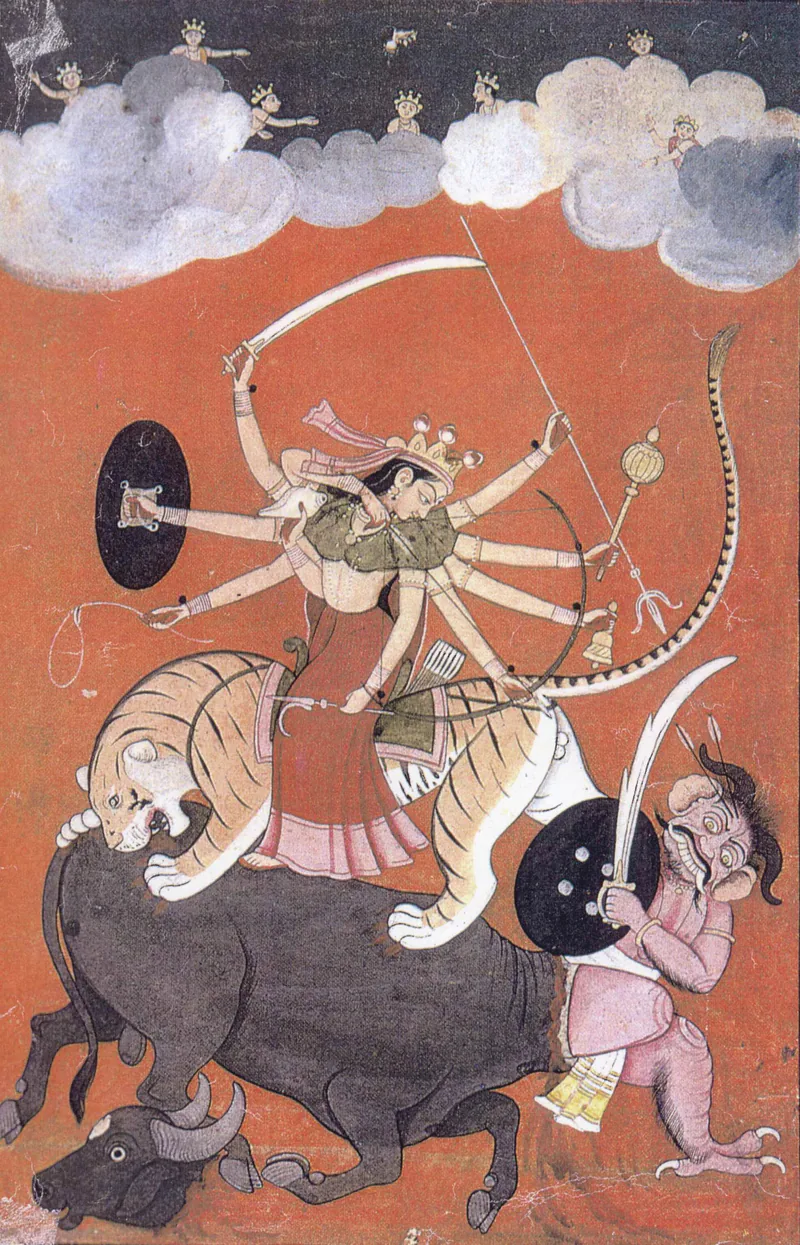
The goddess material has drawn the attention of historians of religion. Some scholars have read the prominence of Chandi and of weapon imagery as evidence of Shakta influences in the Guru's court, a view related to wider discussions of Shaktism and the Hindu goddess; others argue that Bhagautī and the sword function as symbols of divine power within a strictly monotheistic theology. The tales of Charitropakhyan, many of them frankly sexual, have been the subject of the sharpest controversy. Defenders read them as cautionary stories, drawn from older Indian and Persian story collections, warning the Guru's soldiers against deception; critics argue that they cannot be the work of a Guru.
The Authorship Debate§
Three broad positions have emerged since the late nineteenth century. One holds that the entire Dasam Granth is the work of Guru Gobind Singh, and this is the view of the Nihangs, many traditional scholars and the Takhts at Patna and Nanded. A second holds that only part of it is the Guru's: the hymns used in daily prayer, Bachittar Natak, Zafarnama and some other works, while the mythological retellings and the tales are the work of court poets, several of whom appear to sign their verses with names such as Shyam and Ram. A third, held by a minority, considers little or none of the collection authentic.
Western scholarship has mostly adopted versions of the second position while stressing the limits of the evidence. Robin Rinehart's Debating the Dasam Granth (2011) surveys the manuscripts and the history of the dispute and argues that the debate itself reveals competing visions of Sikh identity, especially over the Khalsa's martial ethos and its relation to Hindu tradition. The question has repeatedly entered Sikh politics. Prominent figures who publicly rejected parts of the collection have faced disciplinary action, and the Akal Takht has asked Sikhs not to stir controversy over the Dasam Granth while affirming the established use of its banis.
The Dasam Granth Today§
Most Sikhs today encounter the Dasam Granth through its prayers rather than as a book. Complete printed editions exist in Gurmukhi, and partial English translations, especially of Jaap Sahib, Bachittar Natak and Zafarnama, are widely available. In Nihang encampments, at Hazur Sahib and at Patna Sahib, the whole collection is read ceremonially. Among scholars it is increasingly studied as a major work of early modern Braj literature and as a window into the court culture of the late Mughal Punjab, a perspective developed in Fenech's studies of the Guru's darbār. For the life of its traditional author, see Guru Gobind Singh.
Frequently asked questions§
Is the Dasam Granth the Guru of the Sikhs?§
No. Sikhs believe that Guru Gobind Singh vested the Guruship in the Guru Granth Sahib alone. The Dasam Granth is honoured as sacred literature, and some communities install it ceremonially, but it does not have the status of Guru.
Which prayers come from the Dasam Granth?§
Jaap Sahib, the Tav-Prasad Savaiye and Benti Chaupai, recited in the daily prayers and at the amrit ceremony, come from the Dasam Granth. The opening lines of the Ardas come from its Chandi di Var.
Why is the Dasam Granth controversial?§
Because it was compiled after the Guru's death, survives in differing manuscripts and contains mythological retellings and erotic tales that some Sikhs find inconsistent with Sikh teaching. Opinions range from full acceptance to acceptance of only certain compositions.
Sources and further reading§
- Debating the Dasam Granth — Robin Rinehart, 2011
- The Sikh Zafar-namah of Guru Gobind Singh — Louis E. Fenech, 2013
- The Darbar of the Sikh Gurus: The Court of God in the World of Men — Louis E. Fenech, 2008
- The Sikh Religion: Its Gurus, Sacred Writings and Authors — Max Arthur Macauliffe, 1909
- Textual Sources for the Study of Sikhism — W. H. McLeod, 1984
- The Oxford Handbook of Sikh Studies — Pashaura Singh & Louis E. Fenech (eds.), 2014
- The Construction of Religious Boundaries: Culture, Identity and Diversity in the Sikh Tradition — Harjot Oberoi, 1994