Liber XXVII · Sikhism · Chapter III: Guru Nanak & the Ten Gurus
Guru Gobind Singh: Life, Khalsa, Martyrdoms and Legacy
Guru Gobind Singh (1666–1708), the tenth Sikh Guru: his childhood, the Khalsa of 1699, the loss of his four sons, the Zafarnama and the eternal Guru Granth.

Guru Gobind Singh (1666–1708) was the tenth and last human Guru of the Sikhs. Becoming Guru as a child after the execution of his father, Guru Tegh Bahadur, he led the Sikh community through two decades of conflict with the hill chiefs and the Mughal state, founded the Khalsa in 1699, lost his mother and all four of his sons in the wars of 1704–1705, and before his death at Nanded declared that the Guruship would henceforth rest in the scripture, the Guru Granth Sahib, and the Sikh community.
Birth and Childhood at Patna and Anandpur§
The tenth Guru was born Gobind Das, usually called Gobind Rai, at Patna in Bihar, traditionally on 22 December 1666 (a date reckoned from the lunar calendar, so his birthday festival moves each year). His father, Guru Tegh Bahadur, was travelling in eastern India, and the boy spent his early years at Patna with his mother, Mata Gujri, and her family. The house of his birth is now the site of Takht Sri Patna Sahib, one of the five Sikh Takhts.
In the early 1670s the family moved to Chakk Nanaki, the town in the Shivalik foothills founded by Tegh Bahadur and later known as Anandpur. There the boy was educated in Punjabi, Braj, Sanskrit and Persian and trained in riding and arms. In 1675 Guru Tegh Bahadur went to Delhi, where he was executed on the orders of the Mughal authorities; Sikh tradition holds that he gave his life defending the right of Kashmiri Brahmins to practise their religion, and he is remembered as Hind dī chādar, "the shield of India". His son, aged nine, was installed as Guru at Anandpur.
The Young Guru: Court, Poetry and the Battle of Bhangani§
The young Guru's court combined spiritual authority with princely style. He received offerings of weapons and horses, kept a war drum, and around 1685 moved for a few years to Paonta on the Yamuna, in the hill state of Sirmur. Paonta became a literary centre where poets translated and retold Sanskrit epics and Puranic stories; the Guru's own early works, preserved in the Dasam Granth, are associated with this period.
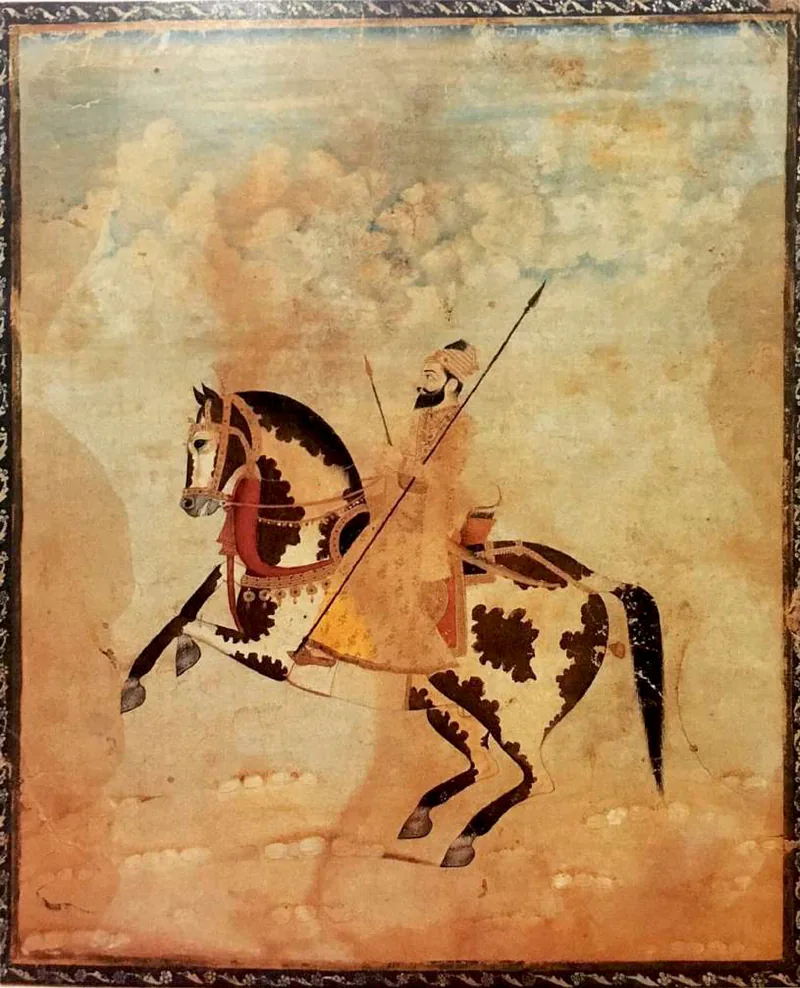
The growth of an armed and independent community alarmed neighbouring Rajput hill chiefs. In 1688 the Guru defeated a coalition led by Raja Fateh Shah of Garhwal at the battle of Bhangani, near Paonta, an event he describes in his autobiographical poem Bachittar Natak. He returned to Anandpur, where he fortified the town, and fought further engagements, including the battle of Nadaun (around 1690–1691), in which he supported the hill chiefs against a Mughal commander. Historians read these years as a period in which the Guru's community became a regional power, a development begun by Guru Hargobind's doctrine of mīrī and pīrī, temporal and spiritual authority.
Vaisakhi 1699 and the Founding of the Khalsa§
On the spring festival of Vaisakhi in 1699, according to Sikh tradition, the Guru called a great assembly at Anandpur and, sword in hand, asked who would offer his head. Five men from different castes and regions came forward one after another; these Panj Piare, "Five Beloved Ones", were initiated with amrit, water stirred with a double-edged sword while sacred hymns were recited, into which, tradition says, the Guru's wife added sugar crystals. The Guru then asked the Five to initiate him in turn, and he took the name Gobind Singh.
The new order, the Khalsa, abolished the authority of the masands, regional agents who had become intermediaries between the Guru and his followers, and placed initiated Sikhs in direct relationship with the Guru. Its members took the name Singh ("lion") for men and, in later usage, Kaur for women, kept their hair uncut and observed a discipline that later became the Five Ks. The details of the ceremony and its meaning are set out in The Khalsa and the Five Ks. Historians note that the earliest accounts of the event are later than 1699 and differ on details, but they agree that the creation of the Khalsa was the defining act of the Guru's life.
The Siege of Anandpur and the Loss of the Sahibzade§
The Khalsa's growth led to renewed conflict with the hill rajas, who sought Mughal help. After a long siege, the Guru and his followers left Anandpur in December 1704 (some sources give 1705) on promises of safe conduct that, in Sikh memory, were broken as soon as they emerged. In the confusion of the crossing of the swollen Sirsa river the party was divided.
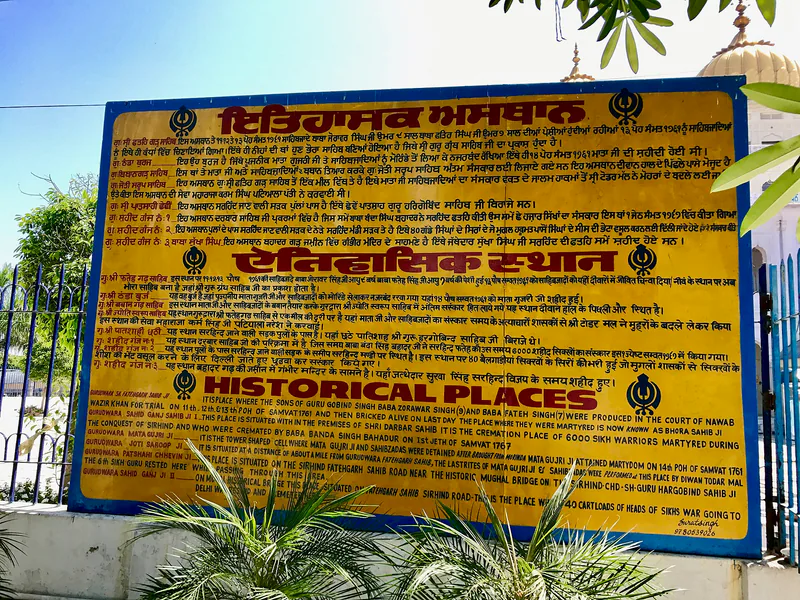
The Guru and his two elder sons, Ajit Singh (about 18) and Jujhar Singh (about 14), reached the village of Chamkaur, where a small band held a mud fortress against a much larger force. Both sons died in the fighting, and the Guru escaped at night at the urging of his companions. His mother, Mata Gujri, and his two younger sons, Zorawar Singh (about 9) and Fateh Singh (about 6), were betrayed and taken to Sirhind, where the governor, Wazir Khan, ordered the boys' execution after they refused to renounce their faith; tradition says they were bricked up alive before being killed, and Mata Gujri died in captivity. These four boys, the Sāhibzāde, are among the most deeply honoured figures in Sikh memory, and the season of their deaths in December is marked with solemn remembrance; Fatehgarh Sahib now stands at Sirhind.
Pursued through the Malwa region, the Guru was joined by forty Sikhs who had earlier deserted him at Anandpur and returned, encouraged by a woman named Mai Bhago. They fell in battle at Khidrana, now Muktsar, in 1705, and the Guru blessed them as the Chālī Mukte, the "Forty Liberated Ones", who are remembered in the daily Ardas.
The Zafarnama, Damdama and the Final Journey to Nanded§
From the Malwa country the Guru wrote the Zafarnāma, "Epistle of Victory", a Persian letter in verse to the emperor Aurangzeb. It reproaches the emperor for the broken oaths at Anandpur and defends the use of the sword when all other means have failed. He then stayed for about a year at Talwandi Sabo, now Damdama Sahib, where, according to tradition, he dictated a final recension of the scripture that added the hymns of Guru Tegh Bahadur; this is the version that became the Guru Granth Sahib.
After Aurangzeb's death in 1707 the Guru met his successor, Bahadur Shah, and travelled south with the imperial camp into the Deccan. At Nanded on the Godavari river he met a Bairagi ascetic, Madho Das, who became his follower under the name Banda Singh and was sent north to lead the Khalsa; his campaigns are described in Sikh History. In 1708 the Guru was stabbed by a Pathan assailant, possibly acting for Wazir Khan, and died of his wounds in October. Before his death, Sikh tradition records, he bowed before the scripture and declared it the Guru, with the Khalsa community embodying the Guru's presence. His place of cremation is Takht Sachkhand Hazur Sahib at Nanded.
Legacy and Remembrance of the Tenth Guru§
Sikhs call Guru Gobind Singh Dasmesh Pitā, "the tenth Father", Kalgīdhar, "wearer of the plume", and Sarbans Dānī, "the one who gave all his family". His birthday, a major gurpurab, is celebrated with processions and continuous readings of the scripture, and Hola Mohalla at Anandpur, a festival of martial display he is credited with instituting, draws large crowds each spring. His most enduring legacies are institutional: the Khalsa, with its code of discipline and outward identity, and the doctrine that the Guru now lives in the Guru Granth Sahib and the community.
Historians continue to discuss the Guru's life critically. Questions include the reliability of later sources such as the eighteenth-century Gurbilās literature, the exact dates of the evacuation of Anandpur and the executions at Sirhind, the authorship of the works attributed to him, and the balance of religious and political motives in his wars. J. S. Grewal and S. S. Bal's biographical study of 1967 and Purnima Dhavan's work on the eighteenth-century warrior tradition are standard points of reference. For Sikhs, however, his life is above all a model of devotion, courage and sacrifice, summed up in the ideal of the sant-sipāhī, the saint-soldier.
Frequently asked questions§
Who were the four sons of Guru Gobind Singh?§
They were Ajit Singh, Jujhar Singh, Zorawar Singh and Fateh Singh. The two elder sons died in battle at Chamkaur, and the two younger sons were executed at Sirhind in December 1704 or 1705; together they are honoured as the Sahibzade.
Why did Guru Gobind Singh end the line of human Gurus?§
Sikh tradition holds that he declared the scripture the eternal Guru so that authority would rest in the divine word, interpreted by the community of the Khalsa, rather than in any single person. This ended disputes over succession that had troubled earlier generations.
Where did Guru Gobind Singh die?§
He died at Nanded on the Godavari river in Maharashtra in October 1708, after being wounded by an assailant. The site is marked by Takht Sachkhand Hazur Sahib, one of the five Sikh Takhts.
Sources and further reading§
- Guru Gobind Singh: A Biographical Study — J. S. Grewal & S. S. Bal, 1967
- The Sikh Zafar-namah of Guru Gobind Singh — Louis E. Fenech, 2013
- When Sparrows Became Hawks: The Making of the Sikh Warrior Tradition, 1699–1799 — Purnima Dhavan, 2011
- Martyrdom in the Sikh Tradition: Playing the "Game of Love" — Louis E. Fenech, 2000
- The Sikh Religion: Its Gurus, Sacred Writings and Authors — Max Arthur Macauliffe, 1909
- A History of the Sikhs — Khushwant Singh, 1963
- The Sikhs of the Punjab — J. S. Grewal, 1990