Liber XXVII · Sikhism · Chapter IV: The Khalsa
The Khalsa and the Five Ks: Sikh Initiation and Identity
The Khalsa explained: Guru Gobind Singh's founding of the order in 1699, the Panj Piare, amrit initiation, the Five Ks, the Sikh code and the turban.

The Khalsa is the community of initiated Sikhs, founded by Guru Gobind Singh at Anandpur on the festival of Vaisakhi in 1699. Its members undergo the initiation ceremony of amrit, adopt the names Singh or Kaur, follow a code of conduct (rahit) and keep five articles of faith known as the Five Ks, all beginning with the letter k in Punjabi: uncut hair, a comb, a steel bracelet, a short sword and cotton undershorts. The Khalsa embodies the Sikh ideal of the saint-soldier, devoted to God and ready to defend the oppressed.
Vaisakhi 1699: The Founding of the Khalsa§
By the late seventeenth century the Sikh community had suffered the execution of two Gurus under Mughal rule (see Guru Nanak and the Ten Sikh Gurus) and faced hostility from the Hindu hill chiefs around Anandpur. Within the community, the regional agents (masands) who collected offerings had grown corrupt. Guru Gobind Singh responded with a decisive reorganisation.
According to Sikh tradition, at the Vaisakhi gathering of 1699 the Guru stood before the assembly with a drawn sword and asked for a Sikh willing to give his head. One volunteer came forward and was led into a tent; the Guru returned with a bloodied sword and asked for another, until five had offered themselves. He then brought all five out alive, dressed in new garments, and proclaimed them his Panj Piāre, the Five Beloved Ones. Tradition names them as Daya Ram, Dharam Das, Himmat Rai, Mohkam Chand and Sahib Chand, men of different castes, from a Khatri trader to a barber and a water-carrier, and from different regions of India, a fact Sikhs see as a deliberate abolition of caste within the new order. The details are known from later sources and historians treat them with caution, but the founding of the Khalsa in 1699 is not in doubt.
The word khālsā comes from a Persian administrative term for land held directly by the sovereign rather than through intermediaries. In calling the initiated Sikhs his khālsā, the Guru declared that they belonged directly to him and to God, without the masands in between; the word also carries the sense of "pure".
The Amrit Ceremony: Initiation into the Khalsa§
The Guru initiated the five by preparing amrit, "nectar of immortality": water in an iron bowl, into which sugar puffs were added, stirred with a double-edged sword (khaṇḍā) while five compositions were recited, among them Guru Nanak's Japjī and the Guru's own Jāp Sāhib. Tradition credits the Guru's wife, Mata Sahib Kaur (or in other accounts Mata Jito), with adding the sweetness, and she is honoured as the mother of the Khalsa. The Guru then knelt and asked to be initiated by the five, making himself at once their Guru and their disciple.
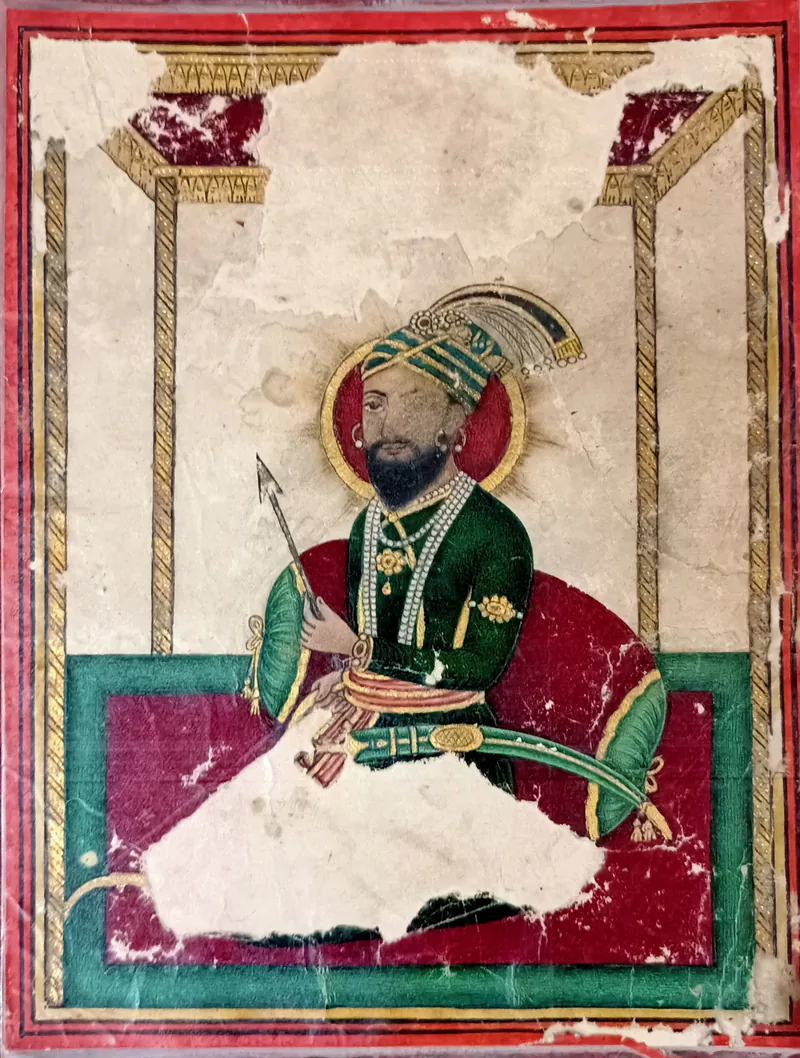
The ceremony, called amrit sañchār or khaṇḍe dī pāhul, follows the same pattern today. Five initiated Sikhs of good standing, representing the Panj Piāre, conduct it in the presence of the Guru Granth Sahib. The initiates, men and women, drink the amrit from cupped hands, have it sprinkled on their eyes and hair, and are taught the code of conduct. They are told that they are now children of Guru Gobind Singh and Mata Sahib Kaur, born at Anandpur, and members of one family in which caste has no place. Men take the name Singh, "lion", and women Kaur, a word usually glossed as "princess".
The Five Ks: Articles of Faith§
The five articles (pañj kakār) are:
- Kes: uncut hair, including the beard, kept as a gift of God and a sign of acceptance of His will.
- Kaṅghā: a small wooden comb, kept in the hair, symbolising cleanliness and order.
- Kaṛā: a steel or iron bracelet worn on the wrist, a reminder of the bond with the Guru and of restraint in action.
- Kirpān: a sword, now usually small and worn in a sheath on a cloth strap, symbolising the duty to defend the weak and uphold justice.
- Kachherā: knee-length cotton undershorts, associated with modesty, sexual restraint and readiness for action.
Sikhs explain the articles as both outward signs of identity and reminders of inner discipline. Historians note that early codes of conduct (rahitnāmās), written in the eighteenth century, list varying requirements, and that the standard list of five became fixed in the course of the eighteenth and nineteenth centuries; W. H. McLeod argued that the formulation was completed during the Singh Sabha reform movement, a view many Sikh scholars dispute. All agree that uncut hair and arms were central from 1699.
The Rahit: Code of Conduct and Prohibitions§
The Khalsa's discipline, the rahit, is set out today in the Sikh Rahit Maryādā, approved by Sikh representative bodies in the 1940s and published by the Shiromani Gurdwara Parbandhak Committee. Initiated Sikhs recite set prayers morning and evening, keep the Five Ks, give a share of their earnings and follow Sikh rites of passage. They must avoid four cardinal transgressions (kurahit): cutting or removing hair from the body, eating meat slaughtered by the ritual method of another religion (kuṭhā, understood as halal), sexual relations outside marriage, and using tobacco. Most initiated Sikhs also abstain from alcohol and other intoxicants, and many are vegetarian.
A Sikh who breaks the code may appear before five initiated Sikhs, confess and receive a penance (tankhāh), usually acts of service and prayer, before being re-initiated. One who abandons the Five Ks is called patit, "fallen". Sikhs who keep their hair but are not initiated, and those who cut their hair while identifying as Sikhs, are part of the wider community discussed in What Is Sikhism?.
The Khalsa as a Community: Saint-Soldiers and Sovereignty§
The Khalsa embodies the ideal of the sant-sipāhī, the saint-soldier, uniting the spiritual discipline of earlier Sikhism with the principle of mīrī-pīrī, spiritual and temporal authority, established by Guru Hargobind. Guru Gobind Singh is believed to have taught that when all other means have failed it is right to draw the sword, a principle he expressed in his Persian letter to the emperor Aurangzeb. In the eighteenth century the Khalsa fought for survival against Mughal governors and Afghan invaders, organised in confederacies (misls) and meeting as the Sarbat Khālsā, the "entire Khalsa", at Amritsar to pass resolutions (gurmatā) in the presence of the scripture. This history is told in Sikh History.
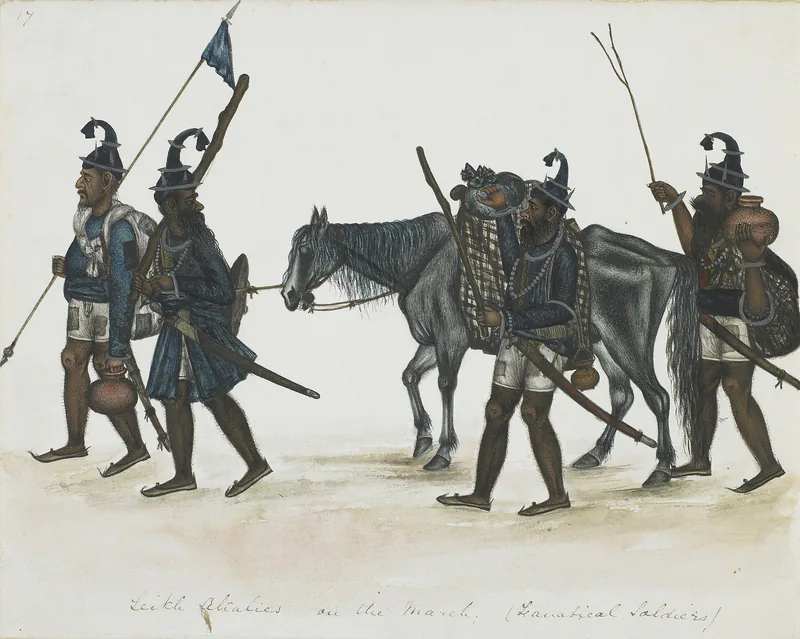
The Khalsa greeting, Vāhigurū jī kā Khālsā, Vāhigurū jī kī Fateh, "the Khalsa belongs to God, the victory belongs to God", expresses the community's understanding of itself. The Nihangs, members of a traditional Khalsa order who wear blue robes and tall turbans and carry weapons, preserve martial customs from the eighteenth century and display them at the festival of Hola Mohalla. Women have been members of the Khalsa from the beginning, and Sikh tradition honours figures such as Mai Bhago, who is said to have led men into battle in 1705.
The Turban, the Khanda and the Khalsa Today§
The turban (dastār) is not one of the Five Ks, but it covers the uncut hair and has become the most recognisable sign of Sikh identity, worn by most observant men and some women. The emblem known as the khaṇḍā, a double-edged sword within a circular throwing weapon (chakkar), flanked by two curved swords representing mīrī and pīrī, appears on the saffron or blue flag, the Nishān Sāhib, that flies over every gurdwara.
In the diaspora the Five Ks and the turban have raised legal questions. Britain exempted turbaned Sikhs from the motorcycle helmet requirement in 1976, and in 1983 the House of Lords, in Mandla v Dowell-Lee, recognised Sikhs as an ethnic group protected from discrimination in a case about a schoolboy's turban. In 2006 the Supreme Court of Canada allowed a Sikh student to wear a kirpan to school under safety conditions. Such cases show both the visibility of the Khalsa identity and its continued importance to Sikhs worldwide.
Frequently asked questions§
Do all Sikhs belong to the Khalsa?§
No. Only Sikhs who have undergone the amrit ceremony are members of the Khalsa. Many Sikhs keep uncut hair and wear the turban without being initiated, and some initiate later in life; the Khalsa is the ideal toward which Sikh teaching points.
Why do Sikhs carry a kirpan?§
The kirpān is one of the five articles of faith. It symbolises the Khalsa's duty to protect the weak and resist injustice, and is regarded as a religious article rather than a weapon; it is normally small and worn sheathed.
What do the names Singh and Kaur mean?§
Singh means "lion" and is taken by initiated Sikh men; Kaur is usually understood as "princess" and is taken by Sikh women. Many Sikhs use these names whether or not they are initiated, and the shared names express the rejection of caste-based surnames.
Sources and further reading§
- Who Is a Sikh? The Problem of Sikh Identity — W. H. McLeod, 1989
- The Construction of Religious Boundaries: Culture, Identity and Diversity in the Sikh Tradition — Harjot Oberoi, 1994
- A History of the Sikhs — Khushwant Singh, 1963
- The Sikh Zafar-namah of Guru Gobind Singh — Louis E. Fenech, 2013
- Sikh Identity: An Exploration of Groups among Sikhs — Opinderjit Kaur Takhar, 2005
- The Oxford Handbook of Sikh Studies — Pashaura Singh & Louis E. Fenech (eds.), 2014