Liber XXVII · Sikhism · Chapter V: Sikh Beliefs
Caste in Sikhism: The Gurus' Teaching and Social Reality
Caste in Sikhism: how the Gurus rejected caste pride, how langar and the Khalsa expressed equality, and how caste persists among Sikhs today.

Sikh teaching rejects the religious significance of caste. The Gurus taught that the divine light is present equally in every person, that birth confers no spiritual rank, and that pride of caste is a form of the ego that keeps people from God; institutions such as the communal kitchen, langar, and the Khalsa initiation were designed to express this equality. In social life, however, caste identities have persisted among Sikhs, shaping marriage, local gurdwaras and politics, and the gap between teaching and practice is a long-standing subject of debate within the community and among scholars.
Caste in the Punjab before the Gurus§
The Punjab of Guru Nanak's time, like the rest of northern India, was ordered by two overlapping systems. The first was varṇa, the fourfold Brahmanical scheme of priests, warriors, merchants and servants set out in texts such as the Manusmriti, with "untouchable" groups placed outside it. The second, and more important in daily life, was jāti, the hundreds of endogamous birth groups usually linked to occupations, such as Khatri traders, Jat cultivators, Tarkhan carpenters, Chamar leatherworkers and Chuhra sweepers. Rules of purity governed who could eat with whom, draw water from which well and marry into which family.
Devotional movements had already challenged these hierarchies. The Sant poets of northern India, discussed in Sikhism and the Sant Tradition, insisted that devotion to the formless God, not birth or ritual, determined a person's worth, and many of them, such as Kabir the weaver and Ravidas the leatherworker, came from low-ranking groups. Sufi teachers in the Punjab also drew followers from every level of society.
What the Gurus Taught about Caste§
The hymns of the Gurus take up this theme forcefully. Guru Nanak urged his hearers to recognise the divine light in everyone and not to ask about caste, since caste counts for nothing in the world beyond. He identified himself with the lowest of the low and declared that where the lowly are cared for, there God's grace falls. Guru Amar Das warned that no one should be proud of caste, mocking the idea that a Brahmin is made by birth rather than by knowledge of God. The scripture explains such pride as an expression of haumai, the self-centred ego that is the root of human separation from God, a doctrine set out in Sikh Beliefs.
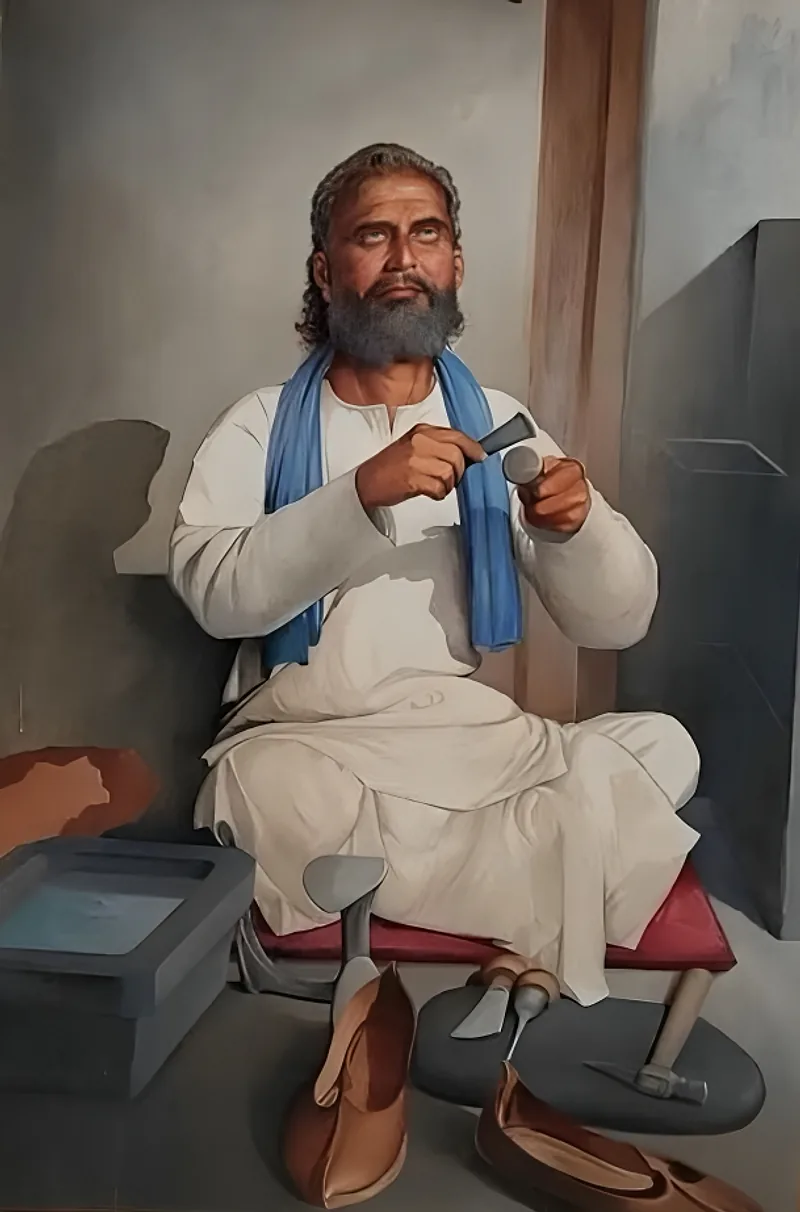
Guru Arjan's inclusion of the hymns of the bhagats in the scripture gave this teaching visible form. Ravidas, Kabir, Namdev the calico-printer, Sain the barber and Sadhna, remembered as a butcher, sit in the Guru Granth Sahib beside the Gurus themselves, their words bowed to by Sikhs of every caste. Sikh commentators stress that the scripture addresses humanity as a whole and makes the moral life and remembrance of the Name the only marks of honour.
Langar, Sangat and the Khalsa: Equality in Practice§
The Gurus also created institutions that cut across caste rules about food and touch. The congregation, saṅgat, met without distinction of rank. The free kitchen, langar, developed especially under Guru Amar Das, required everyone to sit together in rows, pangat, and eat the same food; tradition says that even the emperor Akbar sat in the pangat before meeting the Guru. These practices, which continue in every gurdwara and are described in Gurdwara, Langar and Sikh Practice, were radical in a society where shared eating was the strongest marker of caste boundaries.
The founding of the Khalsa in 1699 carried this further. According to tradition, the first five initiates, the Panj Piare, came from different castes and regions, including a Khatri, a Jat, a washerman or calico-printer, a barber and a water-carrier. All drank amrit from the same bowl, and the shared names Singh and Kaur were understood by later Sikhs as replacing caste surnames. When Bhai Jaita, a man of the low-ranking Rangreta community, carried the severed head of Guru Tegh Bahadur to Anandpur, Guru Gobind Singh is remembered as honouring his people as the Guru's own sons.
Caste and the Sikh Community in History§
Historians note that the Gurus' rejection of caste was directed at its religious claims rather than at every social convention. All ten Gurus were Khatris, and their own families married within the Khatri caste. W. H. McLeod argued that the Gurus denied any spiritual value to caste while leaving its marriage rules largely intact, a reading that many Sikh scholars contest as too narrow. Over the following centuries the Sikh community became increasingly rural, and Jat peasants came to form its largest group, a change McLeod and others connected with the growth of Khalsa militancy in the seventeenth and eighteenth centuries.

Under British rule, recruiters favoured so-called martial castes, especially Jat Sikhs, while Mazhabi Sikhs, from families of Chuhra origin, served in pioneer regiments. Low-caste converts were sometimes denied equal treatment in gurdwaras controlled by hereditary custodians. A turning point came in October 1920, when the priests of the Harmandir Sahib refused the offerings of newly initiated Dalit Sikhs and reformers took control of the shrine, an episode that launched the movement described in Singh Sabha and the Gurdwara Reform Movement.
Caste among Sikhs Today§
Today most Punjabi Sikhs still know and use caste identities. Sikh society includes Jats, the largest group and dominant in landholding and politics; urban Khatris and Aroras; Ramgarhias, an artisan community of carpenters and smiths; Ahluwalias, Kambojs, Sainis and Labanas; and Dalit Sikhs, chiefly Mazhabis and Ramdasias (also called Ravidasias), who form a substantial share of Sikhs in a state where Scheduled Castes made up about 32 per cent of the population at the 2011 census. Most marriages are still arranged within caste, even though the Sikh Rehat Maryada, discussed in Sikh Rehat Maryada and the Rahitnamas, asks Sikhs to marry without regard to caste.
Sociologists such as Surinder S. Jodhka have documented villages with separate gurdwaras and cremation grounds for Dalit Sikhs, and caste-based gurdwaras exist in the diaspora as well, for example among Ramgarhia and Bhatra Sikhs in Britain. Such separation does not mean that other Sikhs are barred from these gurdwaras; often it reflects a community's wish to manage its own institutions, but it can also arise from exclusion.
Dalit Movements, Deras and Debate§
Dissatisfaction among Dalits has fed several movements. In the 1920s the Ad Dharm movement, studied by Mark Juergensmeyer, sought a separate religious identity for the Chamar community of the Punjab, centred on the Sant poets. Many Dalits have turned to ḍerās, centres led by living teachers, where they find dignity and leadership denied elsewhere. The most significant is Dera Sachkhand Ballan near Jalandhar, a Ravidassia centre; after the murder of one of its leaders in Vienna in 2009, its followers proclaimed a separate Ravidassia religion in 2010 with its own scripture made up of the hymns of Guru Ravidas.
Sikh leaders and scholars respond in different ways. Many acknowledge that caste discrimination contradicts the Gurus' teaching and call for reform through education, inter-caste marriage and fuller representation in gurdwara management. Others emphasise the practical equality of the langar and the Khalsa initiation, and point out that caste among Sikhs is far less rigid than in much of South Asia. Almost all agree that, in Sikh terms, the problem lies not in the teaching but in the persistence of haumai in social life.
Frequently asked questions§
Does Sikhism believe in caste?§
No. Sikh scripture rejects any spiritual meaning of caste and condemns pride of birth, and institutions such as langar and the Khalsa initiation express equality. Caste identities nevertheless persist among Sikhs in social life, especially in marriage.
Who are Mazhabi Sikhs?§
Mazhabi Sikhs are a Dalit Sikh community, historically from families of Chuhra origin. Many served in the army, and Sikh tradition links them with Bhai Jaita, who carried Guru Tegh Bahadur's head to Anandpur.
Why do some gurdwaras serve particular castes?§
Some congregations in the Punjab and the diaspora were founded by one caste community, such as the Ramgarhias or Ravidassias. This can reflect a wish for self-management as well as past exclusion, though Sikh teaching holds that every gurdwara is open to all.
Sources and further reading§
- The Evolution of the Sikh Community — W. H. McLeod, 1976
- Religion as Social Vision: The Movement against Untouchability in 20th-Century Punjab — Mark Juergensmeyer, 1982
- Caste in Contemporary India — Surinder S. Jodhka, 2015
- Sikh Identity: An Exploration of Groups among Sikhs — Opinderjit Kaur Takhar, 2005
- Who Is a Sikh? The Problem of Sikh Identity — W. H. McLeod, 1989
- The Sikhs of the Punjab — J. S. Grewal, 1990