Liber XXVII · Sikhism · Chapter VI: Sikh History
Singh Sabha and the Gurdwara Reform Movement, 1873–1925
The Singh Sabha movement and the Akali gurdwara reform campaigns (1873–1925): how Sikh identity, schools, rites and shrines were reshaped under British rule.

The Singh Sabha movement was a Sikh revival and reform movement that began at Amritsar in 1873 and reshaped Sikh religious life under British rule through schools, printing, literature and the standardisation of rites. Its most radical wing, the Tat Khalsa, insisted that Sikhism was a distinct religion, and its ideas fed into the Gurdwara Reform or Akali Movement of 1920–1925, a largely non-violent campaign that wrested the great Sikh shrines from hereditary custodians and placed them under an elected body, the Shiromani Gurdwara Parbandhak Committee (SGPC).
The Punjab after Annexation§
The British annexed the Punjab in 1849, a decade after the death of Maharaja Ranjit Singh. The loss of a Sikh state removed the patronage that had supported Sikh shrines and scholars, while colonial rule brought new institutions: government schools, a printing press, census-taking that sorted the population into fixed religious categories, and a recruiting policy that prized Sikh soldiers, especially those who kept the Khalsa form.
The province also became a field of religious competition. American Presbyterian missionaries had opened a mission at Ludhiana in 1834, and Christian schools spread through the Punjab after annexation. In 1877 Swami Dayanand Saraswati, founder of the Arya Samaj, toured the region; his movement won many supporters among educated Punjabi Hindus, but his criticism of Guru Nanak in the Satyārth Prakāsh later turned many Sikhs against it. Many Sikhs feared that their community, whose numbers seemed to be falling in the census, would be absorbed into Christianity or a revived Hinduism.
The Founding of the Singh Sabhas§
The immediate trigger for the first Singh Sabha, according to the usual account, was the announcement in 1873 by several Sikh pupils of the Amritsar mission school that they intended to become Christians. Leading Sikhs met in Amritsar the same year and formed the Sri Guru Singh Sabha. Its leaders included the aristocrat Thakur Singh Sandhanwalia and Baba Khem Singh Bedi, a descendant of Guru Nanak, and its outlook was conservative: it sought to promote Sikh learning and loyalty to the Crown while respecting existing customs, including the authority of Guru lineages and an easy coexistence with Hindu practice.
In 1879 a second Singh Sabha was founded in Lahore. Its leading figures, Professor Gurmukh Singh of Oriental College and the writer Giani Ditt Singh, represented a younger, more radical and more middle-class leadership. Over the following decades dozens, then hundreds, of local Singh Sabhas were founded across the Punjab and in army regiments abroad. Rivalry between the Amritsar and Lahore groups was intense, and umbrella bodies were created to coordinate them, culminating in the Chief Khalsa Diwan in 1902.
Tat Khalsa Reforms: Education, Print and Ritual§
The reformers of the Lahore party and its successors came to be called the Tat Khalsa, "the true Khalsa". Their programme had several strands. They promoted education in Gurmukhi and Punjabi and, with British support, founded Khalsa College at Amritsar in 1892. They built a Sikh press of newspapers, tracts and books; the poet and novelist Bhai Vir Singh (1872–1957), whose novel Sundarī (1898) presented an idealised Khalsa heroine, became the movement's best-known writer. The scholar Bhai Kahn Singh of Nabha published Ham Hindū Nahīṅ ("We Are Not Hindus") in 1898, arguing from scripture that Sikhism was an independent faith, and later compiled the encyclopaedic Mahān Kosh (1930). He also helped Max Arthur Macauliffe with his English translations of the Sikh scriptures.
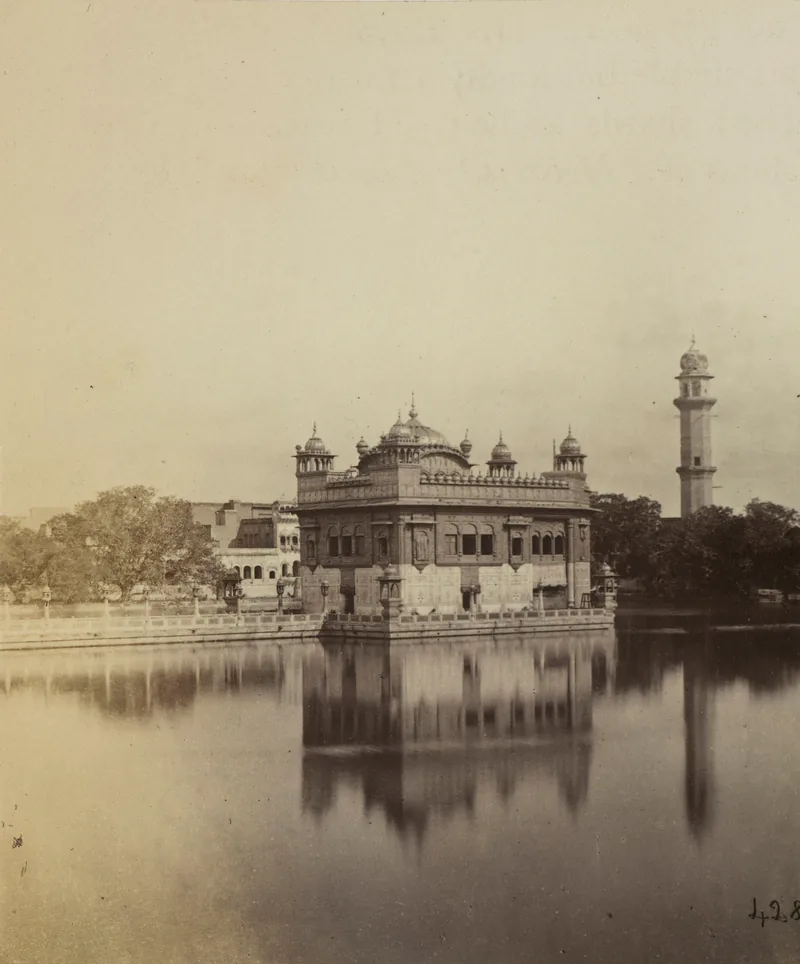
The Tat Khalsa sought to bring practice into line with their reading of the Guru Granth Sahib. They opposed the worship of images, the use of Brahmin priests at life-cycle rites, pilgrimages to non-Sikh shrines and veneration of living holy men. In 1905 Hindu images were removed from the precincts of the Harmandir Sahib. They promoted the Anand Karaj, the Sikh marriage rite centred on the scripture, whose legal validity was recognised by the Anand Marriage Act of 1909, and they encouraged initiation into the Khalsa and the outward form of the Five Ks. Their work on codifying conduct led eventually to the Sikh Rehat Maryada, whose history is told in Sikh Rehat Maryada and the Rahitnamas.
The Gurdwara Reform Movement Begins§
By the early twentieth century many important gurdwaras were controlled by hereditary custodians called mahants, often from the Udasi order, who treated shrine lands and offerings as family property. Reformers accused some of them of neglecting worship, tolerating image worship and living immorally. The management of the Golden Temple itself was overseen by a manager appointed by the government. Anger rose further after the Jallianwala Bagh massacre at Amritsar in April 1919, when the temple's manager honoured the British officer responsible.
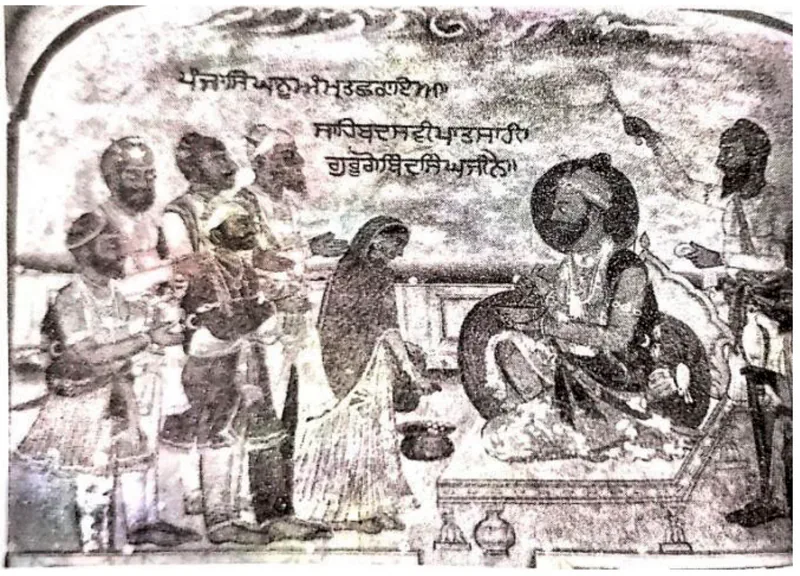
In October 1920 a group of newly initiated Sikhs from so-called low castes came to the Harmandir Sahib with reformers, and the priests refused to accept their offering of karāh prasād. A reading taken from the scripture was interpreted as supporting the newcomers; the priests withdrew, and the reformers took over the Golden Temple and the Akal Takht. In November 1920 a large assembly at the Akal Takht formed the Shiromani Gurdwara Parbandhak Committee to manage the shrines, and in December the Shiromani Akali Dal was created to organise volunteers, the Akalis.
Nankana Sahib, the Morchas and the 1925 Act§
The movement's darkest day came on 20 February 1921 at Nankana Sahib, the birthplace of Guru Nanak. When a band of Akali reformers led by Bhai Lachhman Singh entered the shrine, men hired by Mahant Narain Das attacked them; well over a hundred were killed, some burned. Nankana Sahib then passed to the reformers, and the event, now in Pakistan, is commemorated by Sikhs as a martyrdom.
There followed a series of non-violent agitations (morchās). In the "keys affair" of 1921–1922 the government took the keys of the Golden Temple treasury and returned them after mass protest; Mahatma Gandhi hailed the outcome as a decisive victory in India's struggle for freedom. At Guru ka Bagh near Amritsar in 1922, columns of unresisting Akalis were beaten by police as they tried to cut firewood on shrine land, scenes described by the Christian missionary C. F. Andrews. At Jaito in the princely state of Nabha in 1923–1925 the issue widened to the deposition of the Maharaja of Nabha, and a procession was fired upon in February 1924. Thousands were imprisoned during these years.
The campaign ended with the Sikh Gurdwaras Act of 1925, passed by the Punjab Legislative Council. It placed the principal historic gurdwaras of the province under the SGPC, a body elected by Sikh voters, and in doing so gave a legal definition of a Sikh as one who believes in the Guru Granth Sahib and the Ten Gurus and has no other religion. The SGPC and the Akali Dal remain central to Sikh religious and political life, as Sikh History explains.
Recovery or Construction? The Historians' Debate§
How to interpret the reform period remains one of the most argued questions in Sikh studies. Harjot Oberoi's The Construction of Religious Boundaries (1994) argued that nineteenth-century Sikh practice was diverse and fluid, sharing saints, shrines and rites with Hindus and Muslims, and that the Tat Khalsa created a new, sharply bounded orthodoxy by marginalising what he called the "Sanatan" Sikh tradition. W. H. McLeod's studies of Sikh identity took a related view of the Khalsa ideal's gradual consolidation.
Many Sikh scholars rejected Oberoi's thesis, arguing that the reformers restored the teachings of the Gurus and the Khalsa discipline of 1699 rather than inventing them, and that the earlier diversity reflected decline under hostile conditions. Others stress the role of colonial categories, print and census in making clear boundaries necessary. What is beyond dispute is that the Singh Sabha and Akali years shaped the Sikh institutions, education and public identity that most Sikhs know today, while groups that did not fit the reformed model, such as the Udasis and Sahajdhari Sikhs, found themselves at its margins.
Frequently asked questions§
What was the Singh Sabha movement?§
It was a Sikh reform and revival movement founded in Amritsar in 1873. Through schools, publishing and the reform of rituals it sought to strengthen Sikh identity under British rule, and its Tat Khalsa wing insisted that Sikhism was a religion distinct from Hinduism.
What happened at Nankana Sahib in 1921?§
On 20 February 1921 Akali reformers entering the gurdwara at Guru Nanak's birthplace were attacked by men employed by its custodian, Mahant Narain Das. Well over a hundred were killed, and the shrine passed to Sikh reformers soon afterwards.
What is the SGPC?§
The Shiromani Gurdwara Parbandhak Committee was formed in 1920 and given legal standing by the Sikh Gurdwaras Act of 1925. It is an elected body that manages major historic gurdwaras, including the Golden Temple.
Sources and further reading§
- The Construction of Religious Boundaries: Culture, Identity and Diversity in the Sikh Tradition — Harjot Oberoi, 1994
- The Akali Movement — Mohinder Singh, 1978
- Socio-Religious Reform Movements in British India — Kenneth W. Jones, 1989
- The Sikhs and Their Literature — N. Gerald Barrier, 1970
- Who Is a Sikh? The Problem of Sikh Identity — W. H. McLeod, 1989
- The Sikhs of the Punjab — J. S. Grewal, 1990
- A History of the Sikhs — Khushwant Singh, 1963