Liber XXVII · Sikhism · Chapter I: Gurdwara & Practice
Golden Temple (Harmandir Sahib), Amritsar: History and Worship
The Golden Temple (Harmandir Sahib), Amritsar: founding by Guru Arjan, the sacred pool, Akal Takht, daily worship and langar, gilding and 1984.

The Harmandir Sahib, "the Temple of God", also called the Darbar Sahib and known in English as the Golden Temple, is the most important gurdwara of the Sikhs. It stands in the middle of a sacred pool, the Amrit Sarovar, in the city of Amritsar in the Indian Punjab. Built by Guru Arjan and completed in 1604, when the newly compiled Sikh scripture was installed in it, it was destroyed and rebuilt in the eighteenth century and gilded under Maharaja Ranjit Singh in the nineteenth; today it receives tens of thousands of visitors each day and serves one of the largest free kitchens in the world.
Founding of Amritsar and the Harmandir Sahib§
The site lay on land acquired in the time of the third and fourth Gurus. Guru Ram Das (Guru 1574–1581) began excavating a pool there, around which grew a settlement first called Ramdaspur or Chakk Guru; the pool, and later the city, came to be called Amritsar, "pool of nectar". His son and successor, Guru Arjan (Guru 1581–1606), completed the pool and built the temple in its centre. A popular tradition holds that the foundation stone was laid in 1588 by the Sufi saint Mian Mir of Lahore, a friend of the Guru; historians note that this account appears only in later sources, but it is cherished as a symbol of the shrine's openness.
Guru Arjan deliberately departed from the conventions of temple architecture. The Harmandir was set on a low platform so that worshippers descend steps to reach it, a gesture of humility, and it was given doors on all four sides, signifying that people from every direction, caste and religion are welcome. In 1604 the Guru installed the newly compiled scripture, the Ādi Granth, in the temple and appointed the elderly Sikh Baba Buddha as its first custodian and reader (granthī). The compilation and later history of the scripture are described in Guru Granth Sahib.
The Akal Takht and the Temple Complex§
Opposite the causeway that leads to the temple stands the Akal Takht, "Throne of the Timeless One". Sikh tradition holds that Guru Hargobind, the sixth Guru, raised a platform there in 1606, after the martyrdom of his father, as a seat of temporal authority alongside the spiritual authority of the Harmandir, expressing the doctrine of mīrī and pīrī described in Guru Nanak and the Ten Sikh Gurus. It is the first of the five Takhts, the authoritative seats of the Sikh community, and edicts (hukamnāmās) affecting all Sikhs are issued from it by its jathedār.
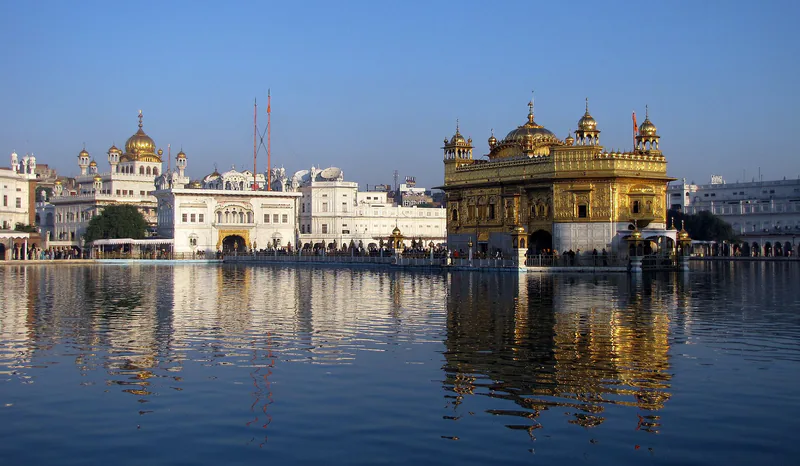
The complex is entered through gateways on its four sides, the principal one being the clock-tower entrance on the north, where visitors remove their shoes, wash their feet and cover their heads. A marble walkway (parikramā) surrounds the pool. The temple itself is reached from the west by a causeway through the Darshani Deori, an ornate gateway. Within the precinct are several shrines, including the ancient jujube trees (ber) associated with Baba Buddha and with the healing story of Dukh Bhanjani Ber, where tradition says a leper was cured by bathing in the pool; the Central Sikh Museum; and the vast langar halls. Pilgrims bathe in the pool, especially at Har ki Pauri, steps on the temple's eastern side.
Destruction and Rebuilding in the Eighteenth Century§
In the eighteenth century the Harmandir Sahib became a focus of conflict between the Sikhs and successive Mughal and Afghan rulers. At times it was occupied by hostile forces; in 1740 the Mughal official Massa Ranghar, who had turned it into a place of revelry, was killed by two Sikhs, an episode commemorated in Sikh memory. The Afghan ruler Ahmad Shah Abdali (Durrani) desecrated the shrine in 1757, and in 1762, after the great slaughter of Sikhs known as the Vaḍḍā Ghallūghārā, "Great Holocaust", he blew up the temple and filled the pool with debris. Sikh tradition remembers Baba Deep Singh, who in 1757 set out to free the shrine and, by tradition, fought on after a mortal wound until he reached its precincts.
After each destruction the Sikhs returned. The present building was begun in 1764 under the leadership of the Sikh misls, with Jassa Singh Ahluwalia among its patrons, and largely completed in the following decades. The confederacies of the period, described in Sikh History, maintained residences (bungās) around the pool, and the city grew as a centre of trade and pilgrimage.
Ranjit Singh's Gilding and the Architecture of the Temple§
The temple's present appearance owes much to Maharaja Ranjit Singh, who took Amritsar in 1802. During his reign the upper storeys were covered with gilded copper plates and the lower walls faced with white marble inlaid with semi-precious stones in floral designs, work carried out by craftsmen from across the Punjab and Kashmir. European visitors began to call it the Golden Temple.

The building is a two-storey structure on a square plan, crowned by a fluted, inverted-lotus dome with smaller kiosks (chhatrīs) at the corners. Its style draws on Mughal and Rajput architecture, with arches, cupolas and painted and mirrored interiors, yet its symbolism is distinctively Sikh: the central dome, the low setting and the open doors all express theological ideas, and the interior frescoes, created mainly in the nineteenth century, depict flowers, animals and scenes of devotion. Art historians regard it as the finest example of the Sikh architectural tradition that developed in the Punjab under the misls and the Sikh kingdom.
Daily Worship at the Harmandir Sahib§
The daily round of worship follows a fixed pattern. In the early hours, the Guru Granth Sahib is brought in procession in a palanquin (pālkī) from its night-time resting place in the Akal Takht complex, carried across the causeway to the sound of hymns, and opened in the sanctum in the ceremony of prakāsh. A passage read at random from the opened scripture becomes the hukamnāmā, the order of the day, which is displayed and widely shared. Teams of musicians (rāgīs) then sing kīrtan from the scripture, in the prescribed ragas, almost continuously until late at night, when the scripture is closed and carried back in the ceremony of sukhāsan. Volunteers wash the floors of the sanctum with milk and water after closing.
The Guru Ka Langar adjoining the complex is one of the largest community kitchens in the world. Volunteers and staff prepare and serve simple vegetarian meals, without charge, to everyone who comes, seated in rows on the floor regardless of status or religion, in accordance with the principles described in Gurdwara, Langar and Sikh Practice. The number of meals served is commonly estimated at fifty thousand to one hundred thousand a day, and more at festivals.
Management, Reform and the Events of 1984§
Under British rule the shrine was administered by hereditary custodians (mahants) and government-appointed managers. The gurdwara reform movement of the 1920s, led by Akali activists, campaigned to place the historic gurdwaras under elected Sikh control, and the Sikh Gurdwaras Act of 1925 entrusted them to the Shiromani Gurdwara Parbandhak Committee (SGPC), which manages the Harmandir Sahib today.
In June 1984 the Indian army launched Operation Blue Star to remove the armed militant leader Jarnail Singh Bhindranwale and his followers, who had fortified the Akal Takht. The assault, carried out during a Sikh martyrdom commemoration when many pilgrims were present, left hundreds or more dead according to differing estimates, severely damaged the Akal Takht and destroyed the Sikh Reference Library with many manuscripts. The event, followed in October 1984 by the assassination of Indira Gandhi and violence against Sikhs in Delhi and elsewhere, remains a profound wound in Sikh memory. The Akal Takht was rebuilt by Sikh volunteer service (kār sevā) in the years that followed. Further operations occurred in 1986 and 1988.
Frequently asked questions§
Can non-Sikhs visit the Golden Temple?§
Yes. The Harmandir Sahib is open to people of every faith. Visitors are asked to cover their heads, remove their shoes, wash their feet, avoid tobacco and alcohol and behave respectfully, and all are welcome to eat in the langar.
Is the Golden Temple made of real gold?§
The upper storeys are covered with copper plates gilded with gold, applied first under Maharaja Ranjit Singh in the nineteenth century and renewed in later restorations. The lower walls are of white marble with inlaid decoration.
Why does the Golden Temple have four doors?§
The four doors express the Sikh teaching that the house of God is open to people from every direction, caste and religion. They contrast with the single entrance typical of older temple traditions in the region.
Sources and further reading§
- The Golden Temple — Patwant Singh, 1988
- The Golden Temple: Past and Present — Madanjit Kaur, 1983
- Amritsar: Mrs Gandhi's Last Battle — Mark Tully & Satish Jacob, 1985
- A History of the Sikhs — Khushwant Singh, 1963
- The Sikhs of the Punjab — J. S. Grewal, 1990
- Sikhism: An Introduction — Nikky-Guninder Kaur Singh, 2011