Sikhism and the Sant Tradition: Kabir, Ravidas and Guru Nanak
Sikhism and the Sant tradition: nirgun bhakti, Kabir, Ravidas, Namdev and Farid in the Guru Granth Sahib, and the debate over Guru Nanak's originality.

The Sant tradition is a loose fellowship of poet-saints of medieval north India, among them Kabir, Ravidas and Namdev, who worshipped a formless God through the remembrance of the divine Name and rejected caste, idol worship and empty ritual. Guru Nanak and the Sikh Gurus shared much of the Sants' language and many of their convictions, and the Guru Granth Sahib preserves hundreds of Sant hymns beside the Gurus' own. How far Sikhism should be understood as part of this tradition, and how far as a new revelation, is one of the central questions in the study of the faith.
Who Were the Sants?§
The word sant (from Sanskrit sat, "true" or "good") came to mean a holy person who has realised the Truth. Scholars use "the Sant tradition" for a group of poet-saints active mainly between the fourteenth and seventeenth centuries in the Hindi- and Punjabi-speaking north and in Maharashtra. Its best-known figures are Namdev (traditionally 1270–1350), a tailor-saint of the Marathi Varkari movement; Kabir, a weaver of Muslim family in Varanasi, whose dates are disputed but who probably lived in the fifteenth century; Ravidas or Raidas, a leatherworker of the same city and period; and, later, Dadu Dayal (1544–1603) of Rajasthan.
The Sants did not form a single organisation. Many came from low or artisan castes, composed in vernacular verse rather than Sanskrit and taught through songs that spread orally. Their poetry is part of the wider bhakti movement, but they are distinguished from devotees of Krishna, Rama or Shiva in their images by their worship of the nirguṇ, God beyond all form and attributes. The essays collected by Karine Schomer and W. H. McLeod in The Sants (1987) remain the standard scholarly introduction.
Core Ideas of Sant Devotion§
Sant poetry returns constantly to a small number of themes. God is one, formless and present within every heart; external worship, pilgrimage, fasting, caste purity and the authority of Brahmin and mullah are useless or harmful when they replace inner devotion. The path to God lies in nām, the remembrance and repetition of the divine Name; in the śabad, the divine Word heard within; and in the guidance of the satguru, the true teacher, who for many Sants is God himself speaking within rather than a human master. The human body is the true temple, and death, ever close, gives urgency to the search.

These themes echo several neighbouring traditions: the devotional Vaishnavism of earlier bhakti, the yogic vocabulary of the Nath ascetics with their talk of the "tenth door" and the "unstruck sound", and the love mysticism of Sufism. Scholars disagree about the relative weight of these influences, and the Sants themselves often mocked yogis, pandits and qazis alike.
The Bhagats in the Guru Granth Sahib§
The clearest link between the Sants and Sikhism is the scripture. When Guru Arjan compiled the Ādi Granth in 1604, he included, alongside the hymns of the Gurus, compositions by fifteen bhagats ("devotees"), whose work, known as bhagat bāṇī, is distributed through the ragas of the Guru Granth Sahib. Kabir is by far the best represented, with several hundred hymns and couplets; others include Namdev, Ravidas, Trilochan, Beni, Dhanna, Jaidev, Sain, Pipa, Sadhna, Ramanand, Parmanand, Surdas, Bhikhan and the Punjabi Sufi Shaikh Farid (d. 1266), whose couplets are among the earliest Punjabi poetry.
Some of these hymns had already been collected in the Goindval manuscripts made under Guru Amar Das, and scholars have traced how the bhagats' verses were selected and, at times, answered: in several places a Guru adds a verse that comments on or qualifies a bhagat's words. The inclusion of saints of low caste and Muslim birth was a deliberate statement. Sikhs read the bhagats' hymns as fully part of the Guru's word, sung and honoured exactly like those of the Gurus.
McLeod's Thesis and the Debate over Guru Nanak§
In Guru Nanak and the Sikh Religion (1968), the New Zealand historian W. H. McLeod argued that Guru Nanak's thought was best understood within the Sant tradition. Nanak's teaching on the formless God, the Name, the Word, the Guru, the futility of ritual and the rejection of caste, McLeod suggested, was the Sant synthesis expressed with unusual coherence and power; what made Sikhism distinct was Nanak's genius for systematic thought and, above all, the community and succession of Gurus he founded.
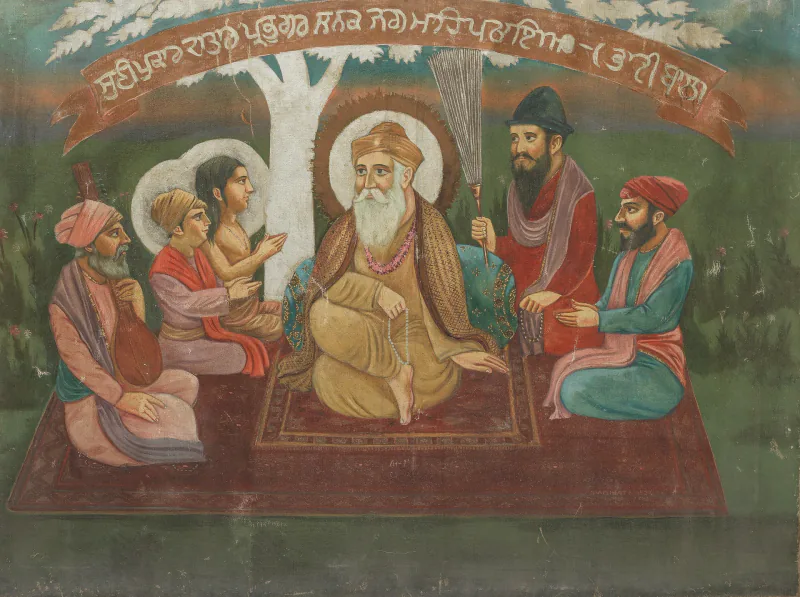
Many Sikh scholars objected strongly. They argued that the thesis reduced Guru Nanak to a product of his environment and overlooked his own testimony to a direct divine commission, told in the janamsakhi account of his experience at the river; that Nanak criticised the Sants' and yogis' ascetic tendencies and taught a distinctive path of the householder, honest work and service; and that Sikh theology of hukam, grace and the five realms, described in Sikh Beliefs, is not found in the same form among the Sants. The debate, which became bound up with wider controversies over Western scholarship of Sikhism in the 1980s and 1990s, has since become more nuanced. Scholars such as Pashaura Singh and Arvind-Pal Singh Mandair acknowledge shared vocabulary while emphasising how the Gurus reworked it, and many now speak of dialogue between the Gurus and the Sants rather than simple derivation.
How the Sikh Path Differed§
Even scholars who stress continuity note significant differences. The Sants were individual poets whose followers organised, if at all, only after their deaths; Guru Nanak deliberately founded a community at Kartarpur with a daily discipline and named a successor, creating a line of ten Gurus over two centuries. The Gurus compiled an authoritative scripture in their own lifetimes and built institutions: the langar, the network of congregations, the city of Amritsar and later the Khalsa. They emphasised the householder life and rejected renunciation more consistently than some Sants. And from the sixth Guru onward, Sikhism developed a political and martial dimension unknown in the Sant tradition. These features, discussed in What Is Sikhism? and Guru Nanak and the Ten Sikh Gurus, gave the Sikh Panth a durability that most Sant movements lacked.
Sant Traditions Today: Kabir Panth, Ravidassias and Sant Mat§
Sant lineages continue to shape religious life in north India and its diaspora. The Kabir Panth, a monastic and lay community claiming descent from Kabir, has centres in Varanasi and central India. Dadu Dayal's followers form the Dadu Panth in Rajasthan. Devotees of Ravidas, many of them from the Dalit communities once called "untouchable", have long honoured him in temples of their own. In the Punjab, many Ravidassias worshipped in gurdwaras and honoured the Guru Granth Sahib, but tensions over caste discrimination grew, and after the killing of a Ravidassia leader in an attack at a temple in Vienna in 2009, the Dera Sachkhand Ballan announced in 2010 a distinct Ravidassia religion with its own scripture, the Amritbāṇī, drawn from Ravidas's verses.
In the nineteenth and twentieth centuries the name Sant Mat, "the teaching of the Sants", was adopted by modern guru-led movements such as the Radhasoami, founded in Agra in 1861, which teach meditation on the inner sound and light under a living master. These movements draw on Kabir and the Sikh scriptures, but mainstream Sikhs regard their doctrine of a living human guru as incompatible with the Sikh teaching that the Guruship rests in the Guru Granth Sahib. The relationship between Sikhism and the Sants thus remains, in different forms, a living question.
Frequently asked questions§
Was Kabir a Sikh?§
No. Kabir lived before or alongside Guru Nanak and was never part of the Sikh community, but many of his hymns were included in the Guru Granth Sahib, and Sikhs honour them as part of the Guru's word. Hindus, Muslims and Sikhs all claim him in different ways.
What is nirgun bhakti?§
Nirgun bhakti is devotion to God "without attributes", beyond all form, approached through the remembrance of the Name and inner experience rather than the worship of images. It is contrasted with sagun bhakti, devotion to God in forms such as Krishna or Rama.
Did Guru Nanak belong to the Sant tradition?§
Scholars disagree. W. H. McLeod argued that Guru Nanak's teaching belongs within the Sant tradition, while many Sikh scholars stress his direct revelation and the distinctive community and theology he founded. Most now acknowledge shared language alongside real differences.
Sources and further reading§
- The Sants: Studies in a Devotional Tradition of India — Karine Schomer & W. H. McLeod (eds.), 1987
- Guru Nanak and the Sikh Religion — W. H. McLeod, 1968
- A Weaver Named Kabir — Charlotte Vaudeville, 1993
- The Bījak of Kabir — Linda Hess & Shukdeo Singh (trans.), 1983
- Songs of the Saints of India — John Stratton Hawley & Mark Juergensmeyer, 1988
- The Guru Granth Sahib: Canon, Meaning and Authority — Pashaura Singh, 2000
- Sikhism: A Guide for the Perplexed — Arvind-Pal Singh Mandair, 2013