Liber XXVII · Sikhism · Chapter I: Gurdwara & Practice
Sikh Kirtan and Gurmat Sangeet: Ragas, Instruments, History
Sikh kirtan, scripture sung to music: the ragas of the Guru Granth Sahib, rababis and ragis, string instruments, harmonium and the Gurmat Sangeet revival.

Kīrtan is the singing of the hymns of the Guru Granth Sahib to music, and it is the heart of Sikh congregational worship. Because the Gurus composed their hymns as songs and the scripture itself is arranged by rāga, the melodic modes of Indian classical music, Sikhs speak of a distinctive musical tradition, Gurmat Saṅgīt, "music according to the Guru's teaching", which reaches from Guru Nanak's companion Bhai Mardana and his rabāb to the ragi ensembles, harmonium and tabla heard in gurdwaras around the world today.
Kirtan in Sikh Teaching§
For Sikhs, kirtan is not an ornament to worship but one of its central forms. The Gurus taught that liberation comes through nām simran, constant remembrance of the divine Name, and singing the Guru's word in company, the sādh saṅgat, is regarded as one of the most powerful ways to practise it. A hymn of Guru Arjan declares that in the present dark age kirtan is pre-eminent among spiritual practices. The listener, as much as the singer, is understood to take part: the sound of gurbāṇī, the Guru's word, is believed to cleanse the mind of ego and turn it towards God. The broader theology of the Name is explained in Sikh Beliefs.
Kirtan is distinguished from pāṭh, the recitation of scripture without music, and from kathā, the spoken exposition of a hymn. All three may form part of a gurdwara programme, as described in Gurdwara, Langar and Sikh Practice, but kirtan usually occupies most of the time.
The Ragas of the Guru Granth Sahib§
When Guru Arjan compiled the Adi Granth in 1604, he arranged it not by author but by musical mode, and the Guru Granth Sahib follows the same plan. After the opening liturgical section, the body of the scripture is divided into 31 main ragas, beginning with Sri Rag and ending with Jaijavanti; counting the mixed and regional variants that are named separately, some scholars give a total of around sixty. Each raga was associated in Indian musical thought with particular moods, seasons and times of day, and many Sikh musicians try to sing hymns in their assigned raga at the appropriate time.
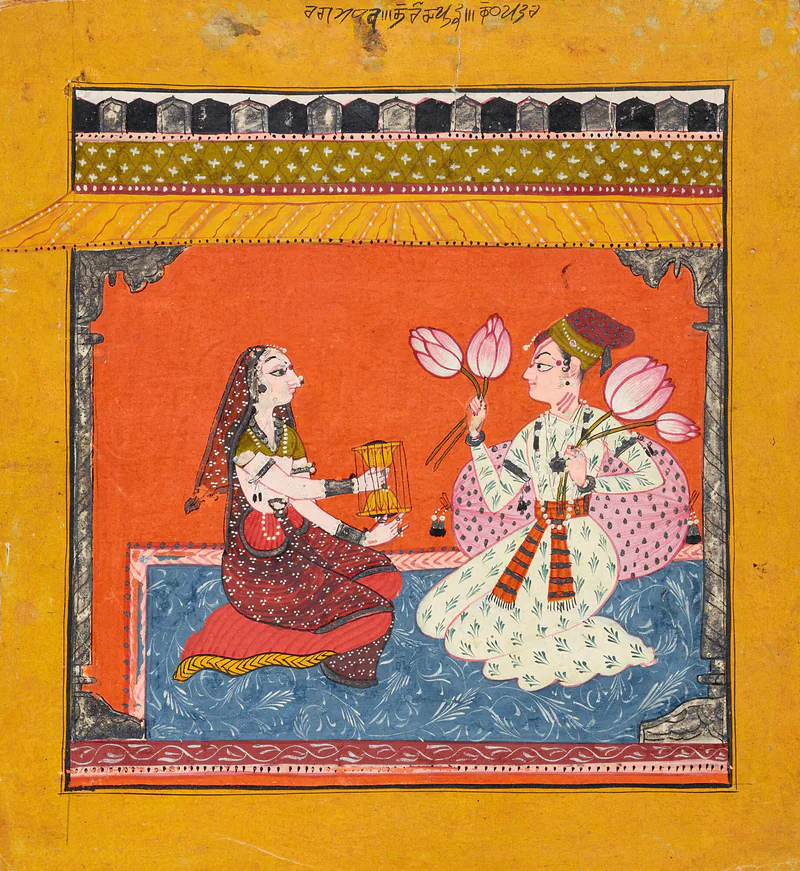
The scripture also carries musical directions. The word rahāu, "pause", marks the refrain that states a hymn's central idea. Headings give a ghar, "house", with a number, whose meaning is debated: it may indicate a rhythmic cycle, a melodic variant or a style of performance. Some long ballads (vārāṅ) specify the folk tune to which they should be sung, and certain hymns are marked paṛtāl, indicating changes of rhythm within the composition. At the end of the volume stands the Rāgmālā, a verse catalogue of ragas and their "wives" and "sons" whose authorship and place in the canon have long been discussed.
Rababis, Ragis and Dhadis: A History of Sikh Musicians§
The janamsakhi narratives of Guru Nanak's life portray him travelling with Bhai Mardana, a Muslim musician of the Mirasi caste who played the rabab, a plucked lute, while the Guru sang. Mardana's descendants and other hereditary musicians, called rababis, continued to serve the Gurus; the ballad of Satta and Balwand in Rag Ramkali, preserved in the scripture, is the work of two such musicians at the court of Guru Arjan. Sikh tradition tells that when these musicians grew proud and withdrew their services, Guru Arjan encouraged ordinary Sikhs to sing kirtan themselves, opening the practice to the whole community.
Over time two broad groups of performers emerged. The rababis, mostly Muslim, held hereditary rights to sing at the Harmandir Sahib and other shrines until the Partition of 1947, when most of these families moved to Pakistan. The ragis, Sikh musicians usually trained in seminaries or by masters, became the chief performers of kirtan in the twentieth century; a typical rāgī jathā has three members, two playing harmonium and one tabla. A third tradition, the ḍhāḍī, is associated by Sikhs with Guru Hargobind, who is said to have welcomed bards singing heroic ballads to the small hourglass drum (ḍhaḍḍ) and the bowed sāraṅgī. Dhadi groups today sing of the Gurus' battles and Sikh martyrs at fairs, gurdwaras and political gatherings.
Instruments: From Rabab and Taus to Harmonium§
Sikh tradition associates particular instruments with particular Gurus. The rabab is linked with Guru Nanak and Mardana; the sarandā, a bowed folk fiddle, is attributed by tradition to Guru Arjan, as is the joṛī, a pair of drums derived from the older barrel drum pakhāvaj; the tāūs, a bowed instrument shaped like a peacock, is credited to Guru Hargobind; and the dilrubā, a lighter bowed instrument, is linked in later tradition with Guru Gobind Singh's time. These string instruments, called tantī sāz, allow the sliding, continuous tones that classical raga singing requires.

The harmonium, a portable reed organ introduced into India by Europeans in the nineteenth century, spread rapidly through Sikh kirtan in the late nineteenth and early twentieth centuries because it was cheap, loud and easy to learn. Its fixed, tempered pitches cannot render the fine intervals of raga music, and for some decades All India Radio refused to broadcast it. Today it is by far the most common instrument in gurdwaras, and the familiar sound of harmonium and tabla has itself become a cherished part of Sikh devotional life.
Kirtan in the Gurdwara: Forms and Occasions§
At the Harmandir Sahib in Amritsar kirtan is sung almost continuously from the early hours of the morning until late at night by teams of ragis in rotation, a practice described in Golden Temple (Harmandir Sahib). In gurdwaras everywhere the morning programme traditionally includes Āsā dī Vār, Guru Nanak's ballad in Rag Asa, sung with interwoven stanzas by Guru Ram Das. Evening worship includes Rahirās, and the day ends with Kīrtan Sohilā. Most services close with six stanzas of Anand Sāhib, Guru Amar Das's song of bliss, before Ardas, the communal prayer.
Other forms of kirtan serve special occasions. Akhaṇḍ kīrtan, "unbroken kirtan", associated especially with the Akhand Kirtani Jatha founded in the circle of Bhai Randhir Singh (1878–1961), continues through the night and often ends in intense, rhythmic repetition of Vāhigurū. Nagar kīrtan, "town kirtan", is a street procession led by the Panj Piare and a float bearing the scripture, with hymn-singing, held on festivals such as Vaisakhi and the anniversaries of the Gurus. Kirtan also accompanies the Anand Karaj wedding, the naming of a child and funerals. Sung recitations of daily prayers such as the Japji Sahib, which itself has no raga, are a separate, recitative tradition.
The Gurmat Sangeet Revival and Kirtan Today§
From the late twentieth century musicians and scholars began a movement to recover the older practice of kirtan. Its advocates argue that hymns should be sung in their prescribed ragas, using traditional compositions and string instruments rather than popular film-style tunes and harmonium. Institutions such as the Jawaddi Taksal at Ludhiana, which has held annual festivals of raga-based kirtan since the early 1990s, university departments of Gurmat Sangeet, and individual musicians who learned from surviving hereditary masters have trained a new generation of performers. Some critics reply that the Gurus' aim was devotion, not musical correctness, and that simple congregational singing must remain open to all.
Recording and broadcasting have transformed kirtan. Live broadcasts from the Harmandir Sahib reach Sikhs across the world on television and online, and recordings by famous ragis are widely shared. Arguments over who may broadcast the Golden Temple's kirtan, and over whether Sikh women may sing kirtan within the Harmandir Sahib, show how closely the tradition is bound up with questions of authority in the Panth.
Frequently asked questions§
What is kirtan in Sikhism?§
Kirtan is the singing of hymns from the Guru Granth Sahib to music, usually by a group of musicians with the congregation listening or joining in. Sikhs regard it as a principal way of remembering the divine Name.
How many ragas are in the Guru Granth Sahib?§
The scripture is arranged into 31 main ragas, from Sri Rag to Jaijavanti. If mixed and regional variants are counted separately, the number rises to around sixty.
Why is the harmonium used in Sikh kirtan?§
The harmonium spread in India from the late nineteenth century because it was affordable, portable and easy to learn. It is now the standard instrument in most gurdwaras, though revivalists promote older string instruments better suited to raga music.
Sources and further reading§
- The Guru Granth Sahib: Canon, Meaning and Authority — Pashaura Singh, 2000
- The Making of Sikh Scripture — Gurinder Singh Mann, 2001
- Dhadi Darbar: Religion, Violence, and the Performance of Sikh History — Michael Nijhawan, 2006
- The Name of My Beloved: Verses of the Sikh Gurus — Nikky-Guninder Kaur Singh, 1995
- Sikhism: A Very Short Introduction — Eleanor Nesbitt, 2005
- The Sikhs: Their Religious Beliefs and Practices — W. Owen Cole & Piara Singh Sambhi, 1978