Liber XXVII · Sikhism · Chapter II: Guru Granth Sahib
Japji Sahib: Guru Nanak's Morning Prayer, Meaning and Structure
Japji Sahib explained: Guru Nanak's morning prayer that opens the Guru Granth Sahib, its Mul Mantar, 38 pauris, key themes, the five realms and its daily use.

Japji Sahib is the hymn of Guru Nanak (1469–1539) that opens the Guru Granth Sahib, the Sikh scripture, and the first prayer that devout Sikhs recite each morning. It consists of the Mul Mantar, a short opening verse, thirty-eight stanzas called pauṛīs and a closing salok, and it sets out in compressed form the whole of Guru Nanak's teaching: one Creator beyond all description, the divine order (hukam), the remembrance of the Name and the soul's ascent toward the "realm of Truth".
The Place of Japji Sahib in the Guru Granth Sahib§
The Guru Granth Sahib is arranged mainly by musical mode, with thirty-one principal ragas each containing hymns of the Gurus and the saints. Japji Sahib stands outside this arrangement, before the first raga, as a prologue to the whole scripture; in the standard printed edition of 1,430 pages it occupies the first eight. Because it carries no raga heading it is not part of the sung repertoire of kīrtan; it is recited, alone or in congregation, in an even voice.
The name means roughly "the revered recitation". The word jap appears as a heading just after the Mul Mantar; the honorifics -jī and Sāhib were added by later usage. Sikh tradition holds that Guru Nanak composed the hymn late in life at Kartarpur, where his community kept a daily rhythm of early prayer, work and shared meals, though the hymn itself gives no date. Its position at the head of the scripture goes back to Guru Arjan's compilation of 1604 and the earlier manuscript collections he used.
Japji is written in a literary language of the Punjab and northern India, with Punjabi, Hindi and Sanskrit-derived vocabulary and some Persian, in the Gurmukhi script. Its verses are terse and highly rhymed, easy to memorise but difficult to translate; many words carry several possible meanings, and commentary has always mattered as much as the text.
The Mul Mantar and the Opening Salok§
Japji begins with the Mul Mantar, the "root formula" that also heads almost every section of the scripture: Ik Oaṅkār, Sat Nām, Kartā Purakh, Nirbhau, Nirvair, Akāl Mūrat, Ajūnī, Saibhaṅ, Gur Prasād, "One Creator; whose Name is Truth; the creative Being; without fear; without enmity; timeless in form; unborn; self-existent; known by the Guru's grace." Each attribute is discussed in Sikh Beliefs: Ik Onkar, Nam Simran, Hukam, Seva.
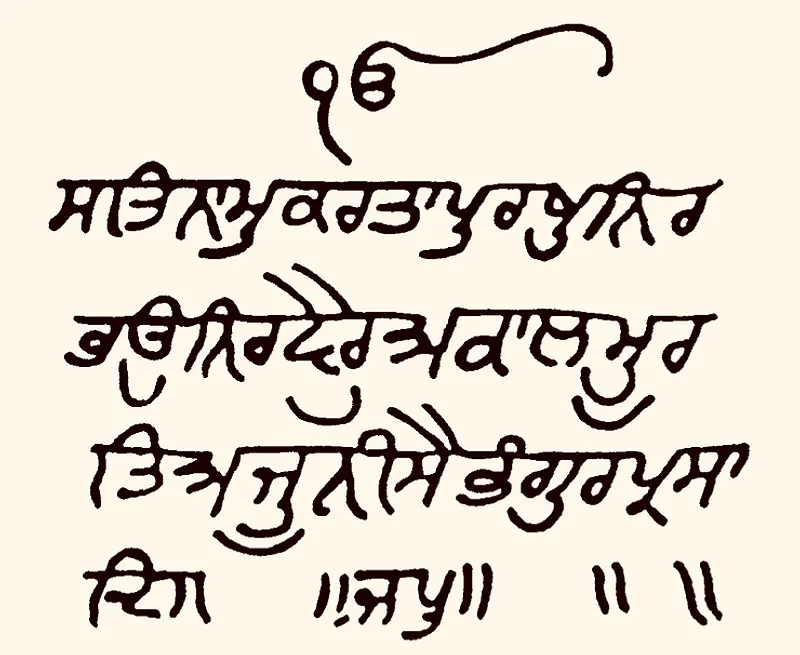
After the heading jap comes a two-line salok: "True in the beginning, true through the ages, true now, and, says Nanak, true for ever." This statement of an unchanging Truth frames everything that follows, from the critique of ritual to the vision of countless worlds.
Themes of the Thirty-Eight Pauris§
The pauris fall into recognisable groups, although Guru Nanak does not label them and commentators divide them slightly differently.
Thought, Silence and the Divine Order (Pauris 1–7)§
The first pauri asks how one may become truthful and break the "wall of falsehood". It rejects four familiar answers: purity does not come from washing a hundred thousand times, inner silence from keeping silent, contentment from piling up goods, or liberation from cleverness. The answer is to walk in the hukam, the divine order "written within" each person. The second pauri expands the idea: all forms, joy and suffering, high and low come into being through hukam, and whoever understands it loses the egoism (haumai) that separates them from God. Pauris 3 to 7 turn to praise, which never exhausts its subject. The fifth states that God cannot be installed like an image or made by human hands; the sixth that pilgrimage bathing has value only if it pleases God.
Listening and Trusting (Pauris 8–15)§
In pauris 8 to 11 each stanza repeats suṇiai, "by listening": by listening to the Name the seeker becomes like the accomplished saints, understands earth and heaven and is freed from the fear of death. Pauris 12 to 15 repeat mannai, "by trusting" or "by accepting": the state of one who has accepted the Name cannot be described, and such a person leads others across. Commentators often read the two series as stages, from attentive hearing to inward conviction.
The Countless and the Immeasurable (Pauris 16–27)§
The sixteenth pauri reinterprets an old Indian image: the mythical bull that supports the earth is dharam, righteousness, "born of compassion". Pauris 17 to 19 open with asaṅkh, "countless": countless are the devotees and the thieves, the scholars and the slanderers. Pauri 21 observes that no pandit, qazi or yogi knows when the world was made, and pauri 22 speaks of "netherworlds beyond netherworlds and skies beyond skies". Pauri 27, So dar, is a vision of the "gate" of God at which the powers of nature, the deities and the saints stand singing; a closely related hymn is recited in the evening prayer.
Discipline, the Five Realms and the Mint (Pauris 28–38)§
Pauris 28 to 31 take up the language of the Nath yogis, with whom Guru Nanak is remembered as debating: their earrings, begging bag, ash and patched cloak become contentment, modesty, meditation and the remembrance of death. Pauris 34 to 37 describe the five khaṇḍs or realms through which the soul rises: duty (dharam khaṇḍ), knowledge (giān khaṇḍ), effort or beauty (saram khaṇḍ), grace (karam khaṇḍ) and Truth (sach khaṇḍ), where the formless One dwells. The final pauri pictures a goldsmith's workshop: self-control the furnace, patience the goldsmith, understanding the anvil, knowledge the hammer, the fear of God the bellows, austerity the fire, and in the crucible of love the Name is minted.
The closing salok begins Pavaṇ guru, pāṇī pitā, mātā dharat mahat: air is the teacher, water the father, the great earth the mother; day and night are nurses in whose lap the world plays, and deeds are read out before the divine judge. A nearly identical salok appears elsewhere under the name of Guru Angad, so many scholars attribute this conclusion to the second Guru.
Japji Sahib in Daily Sikh Practice§
Japji Sahib is the first of the prayers in the Sikh nitnem, the daily discipline set out in the code of conduct, the Sikh Rahit Maryādā. Sikhs are encouraged to rise in the amrit vela, the "ambrosial hours" before dawn, bathe and recite Japji, followed by Jaap Sahib and the other morning prayers. Many recite it from memory; others read it from a small prayer book (guṭkā) handled with respect. A steady recitation takes about twenty minutes.

The hymn also belongs to the community's central rites. It is one of the five banis recited by the Panj Piare while preparing amrit for initiation, as described in The Khalsa and the Five Ks. It opens every akhaṇḍ pāṭh, the unbroken reading of the whole scripture, and in many gurdwaras the morning programme begins with it. Sikhs regard its recitation not as a formula with automatic effects but as nām simran, remembrance of the divine Name, meant to turn the mind toward God at the start of the day and bring life into harmony with hukam.
Interpretation and Translation of Japji§
Because Japji is so concise, it has attracted more commentary than any other Sikh text. Pre-modern commentators of the Udasi and Nirmala schools often read it through the vocabulary of Vedanta, while writers of the Singh Sabha reform movement in the late nineteenth century stressed its distinctiveness from Hindu philosophy. Twentieth-century scholars such as Bhai Vir Singh and Professor Sahib Singh wrote influential Punjabi commentaries, and English translations run from Ernest Trumpp's controversial version of 1877 and Max Arthur Macauliffe's of 1909 to many modern renderings.
Several questions remain open. Readers disagree whether the five realms describe inner experiences, a cosmological map or both, and the word karam can mean "grace" or "action", so translations vary. The hymn's relation to the yogic and devotional milieu of fifteenth-century Punjab, discussed in Sikhism and the Sant Tradition, is debated: some scholars stress shared vocabulary, while many Sikh interpreters stress Guru Nanak's original revelation and his critique of yogic and Brahmanical practice. Translators also face the hymn's language for God, which uses many names and is less gendered in the original than English versions using "He" suggest.
Japji Sahib as a Key to the Scripture§
Japji functions as a summary of the Guru Granth Sahib. The doctrine of hukam, the stress on hearing and accepting the Name, the critique of external ritual and the vision of a vast creation sustained by one Creator recur throughout the hymns of the later Gurus and the bhagats, and Guru Arjan's Sukhmanī and Guru Amar Das's Anand develop themes first set out here. For Sikhs, its place at the head of the scripture means that every later page should be read in its light.
Frequently asked questions§
What does Japji Sahib mean?§
Japji Sahib means roughly "the revered recitation". The core word jap refers to recitation or meditative repetition, and jī and Sāhib are respectful honorifics added by Sikh usage.
How many pauris are in Japji Sahib?§
Japji Sahib contains thirty-eight pauris, framed by the Mul Mantar and an opening salok at the beginning and a closing salok at the end. Together they fill the first eight pages of the standard Guru Granth Sahib.
When should Japji Sahib be recited?§
The Sikh code of conduct asks Sikhs to recite it each morning, ideally in the hours before dawn. It is also recited at Khalsa initiation and at the start of a complete reading of the scripture.
Sources and further reading§
- The Sikh Religion: Its Gurus, Sacred Writings and Authors — Max Arthur Macauliffe, 1909
- The Sacred Writings of the Sikhs — Trilochan Singh, Jodh Singh, Kapur Singh, Bawa Harkishen Singh & Khushwant Singh (trans.), 1960
- Hymns of Guru Nanak — Khushwant Singh (trans.), 1969
- The Name of My Beloved: Verses of the Sikh Gurus — Nikky-Guninder Kaur Singh (trans.), 1995
- Sri Guru Granth Sahib — Gurbachan Singh Talib (trans.), 1984
- The Guru Granth Sahib: Canon, Meaning and Authority — Pashaura Singh, 2000
- Guru Nanak and the Sikh Religion — W. H. McLeod, 1968