Liber XXVII · Sikhism · Chapter V: Sikh Beliefs
Women in Sikhism: Equality, Scripture, History and Debate
Women in Sikhism: Guru Nanak on equality, the feminine in scripture, Mata Khivi, Mai Bhago and Mata Sundari, the name Kaur and debates today.

Sikh teaching holds that women and men are spiritually equal: both have the same divine light, both can attain liberation, and both may lead worship, read the scripture, serve in the langar and be initiated into the Khalsa. The Gurus criticised practices that degraded women, such as the burning of widows and female infanticide, and Sikh history honours women as leaders and warriors. Scholars and Sikh women themselves also discuss how fully these ideals have been realised in a patriarchal Punjabi society.
Guru Nanak's Teaching on Women§
The foundational text is a stanza in Guru Nanak's Āsā dī Vār, sung each morning in gurdwaras. In it the Guru observes that we are conceived and born of woman, betrothed and married to woman, that friendship and the continuation of life come through woman, and that when one woman dies another is sought. "Why call her inferior, from whom kings are born?" he asks, adding that without woman there would be no one at all; only the true Lord is independent of her. The stanza was directed against contemporary ideas of female impurity, especially the belief that childbirth and menstruation made women ritually polluted, which the Gurus rejected elsewhere as superstition: impurity, they taught, lies in greed, falsehood and slander, not in the body.
This teaching belongs within the wider Sikh doctrine that all human beings carry the same divine light (jot), set out in Sikh Beliefs. The Gurus also rejected celibacy and renunciation as a superior path, honouring instead the life of the householder (gṛihasth), in which the spiritual partnership of husband and wife is central. The Sikh wedding hymn of Guru Ram Das, the Lāvāṅ, describes marriage as the union of two souls with each other and with God.
The Feminine in the Guru Granth Sahib§
The language of the Guru Granth Sahib is rich in feminine imagery. The most pervasive is the bridal symbolism of the soul: every human being, male or female, is pictured as a bride (suhāgaṇ) longing for her divine Husband, and the hymns of separation and union draw on the songs of Punjabi women. God is addressed as both mother and father, and the Gurus use the feminine forms of words for the divine word (bāṇī), for wisdom and for the divine order.
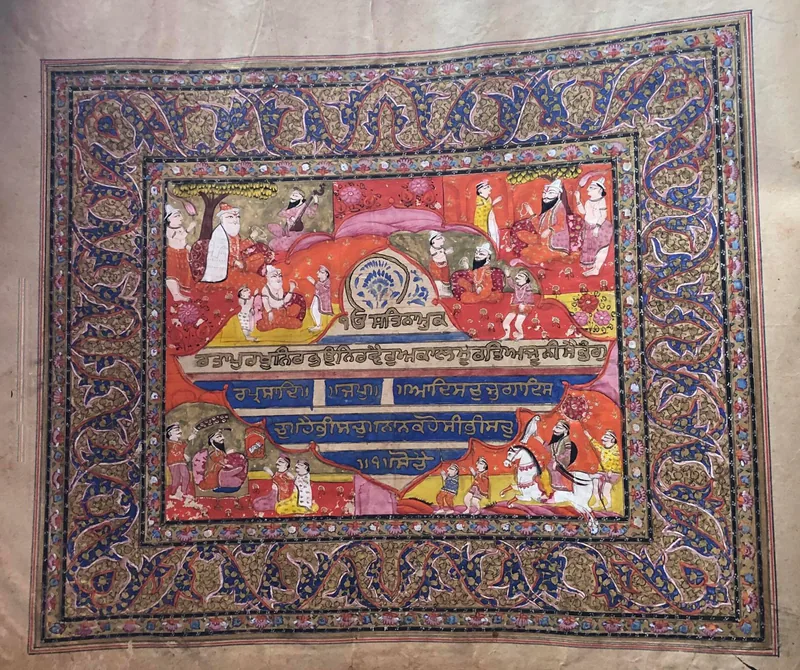
Scholars interpret this imagery in different ways. Nikky-Guninder Kaur Singh, in The Feminine Principle in the Sikh Vision of the Transcendent (1993), argues that the scripture's feminine dimension is fundamental to Sikh theology and offers resources for gender equality. Others note that the same texts use masculine images for God, such as Husband, King and Lord, and that the bridal metaphor places the human soul in a dependent female role. Sikh theologians commonly respond that the scripture's God is beyond gender, described in the Mul Mantar as formless and unborn, and that its gendered images are metaphors.
The Gurus' Reforms and Women in Early Sikh History§
Sikh tradition attributes several reforms affecting women to the Gurus, especially the third Guru, Amar Das (Guru 1552–1574). He is remembered for opposing sati, the burning of widows on their husbands' funeral pyres, for discouraging the veil (pardā) and for permitting widows to remarry. Some traditions say he appointed women among the preachers who supervised the growing community, though historians treat the details cautiously.
Women were prominent from the start. Guru Nanak's elder sister, Bebe Nanaki, is remembered as the first to recognise his spiritual calling. Mata Khivi, wife of the second Guru, Angad, managed the langar at Khadur and is the only woman named in the Guru Granth Sahib, where the bards praise her generous kitchen. Mata Gujri, mother of Guru Gobind Singh, guided the community after her husband's martyrdom and died in captivity with her grandsons at Sirhind. According to tradition, the Guru's wife added sugar crystals to the first amrit in 1699, which Sikhs say sweetened the martial water with compassion; she is honoured as Mata Sahib Kaur, "mother of the Khalsa", and initiated Sikhs regard themselves as her spiritual children.
Mai Bhago, Mata Sundari and Women Leaders§
The best-known woman warrior of Sikh tradition is Mai Bhago (Mata Bhag Kaur), who in 1705 shamed forty Sikhs who had abandoned Guru Gobind Singh into returning, and fought beside them at Khidrana (Muktsar), where the forty fell. She survived and later accompanied the Guru to the Deccan. After the Guru's death in 1708, his widow Mata Sundari became the leading figure of the community for several decades. From Delhi she issued letters of instruction (hukamnāmās) to Sikh congregations, appointed Bhai Mani Singh to Amritsar and helped hold the Panth together in a period of persecution.

Women also wielded political power in the following century. Sada Kaur, head of the Kanhaiya misl after her husband's death, was a decisive ally in the rise of Maharaja Ranjit Singh, her son-in-law. Maharani Jind Kaur, mother of the last Maharaja, Duleep Singh, served as regent in Lahore in the 1840s and became a symbol of resistance to British annexation. In the twentieth century Sikh women took part in the gurdwara reform movement and in the Indian independence struggle, and in 1999 Bibi Jagir Kaur became the first woman president of the Shiromani Gurdwara Parbandhak Committee.
Kaur, the Khalsa and the Sikh Code§
At initiation into the Khalsa, women receive amrit in the same ceremony as men and accept the same Five Ks and code of conduct, as described in The Khalsa and the Five Ks. Sikh women bear the name Kaur, usually understood as "princess", alongside or in place of a family name, as men bear Singh. The early use of Kaur is debated by historians, who note that it became universal only in the nineteenth and twentieth centuries, but today it is a strong marker of Sikh identity, and many Sikh women wear a turban or keski.
The Sikh Rahit Maryādā of 1950 states that women may take part in all religious ceremonies and may read the scripture in congregation. It prohibits killing or neglecting daughters (eighteenth-century codes already condemned the kuṛīmār, "daughter-killer"), rejects marriage arranged for money and discourages women from veiling their faces. The code is generally read as allowing women to serve as granthis and ragis and among the Panj Piare at initiation, though the last has been contested in practice.
Ideals and Practice: Debates in Modern Sikhism§
Scholars have asked how far these ideals shaped everyday life. Doris R. Jakobsh's Relocating Gender in Sikh History (2003) argues that women's roles were progressively narrowed in Sikh historical writing and that colonial-era reformers combined emancipatory rhetoric with Victorian domestic ideals. Others stress the real reforms of the Gurus and the agency of Sikh women in every period. Punjab has long had one of the most unequal sex ratios in India, a fact that Sikh leaders and organisations have condemned as contrary to the faith.
The most visible current debate concerns the Harmandir Sahib in Amritsar. Women may worship there, serve in the langar and clean the complex, but by long custom they do not perform kirtan in the inner sanctum or take part in the nightly procession carrying the scripture to its resting place. Campaigners have called for change since at least the 1990s, and the matter has been discussed repeatedly by Sikh institutions without a final resolution. In many diaspora and Punjabi gurdwaras, women serve as granthis, ragis, committee members and teachers, and Sikh women's organisations and scholars are increasingly prominent in Sikh public life.
Frequently asked questions§
Are men and women equal in Sikhism?§
Sikh teaching holds that men and women are spiritually equal and share the same divine light. Women may lead prayers, read the Guru Granth Sahib, perform kirtan and be initiated into the Khalsa, although debates continue about some roles in practice.
What does Kaur mean?§
Kaur is the name borne by Sikh women, usually translated "princess". It parallels Singh, "lion", the name of Sikh men, and expresses dignity and freedom from caste-based family names.
Who was Mai Bhago?§
Mai Bhago was an eighteenth-century Sikh woman who led forty deserters back to Guru Gobind Singh and fought with them at the battle of Muktsar in 1705. She is honoured as a model of courage and devotion.
Sources and further reading§
- The Feminine Principle in the Sikh Vision of the Transcendent — Nikky-Guninder Kaur Singh, 1993
- Relocating Gender in Sikh History: Transformation, Meaning and Identity — Doris R. Jakobsh, 2003
- Sikhism and Women: History, Texts, and Experience — Doris R. Jakobsh (ed.), 2010
- Sikhism: A Very Short Introduction — Eleanor Nesbitt, 2005
- The Sikhs: Their Religious Beliefs and Practices — W. Owen Cole & Piara Singh Sambhi, 1978
- The Oxford Handbook of Sikh Studies — Pashaura Singh & Louis E. Fenech (eds.), 2014