Liber XIV · Hinduism · Chapter VIII: The Six Schools of Philosophy
Adi Shankara: Life, Works and the Advaita Vedanta Tradition
Adi Shankara, philosopher of Advaita Vedanta: his dates and legendary life, authentic works, teaching on Brahman, atman and maya, the four mathas and legacy.

Adi Shankara, or Shankaracharya, was an Indian philosopher and teacher, usually dated to the early eighth century CE, who gave classical form to Advaita Vedanta, the school of "non-dualism." In commentaries on the Upanishads, the Bhagavad Gita and the Brahma Sutra, he argued that the self (atman) is identical with Brahman, the one absolute reality, and that the world of multiplicity is an appearance produced by ignorance. Tradition credits him with founding monasteries in the four quarters of India and with reviving Vedic religion, and his school became the best-known form of Hindu philosophy in modern times.
Who Was Adi Shankara? Dates and Sources§
Almost everything known about Shankara's life comes from hagiographies called Shankaravijaya or Shankaradigvijaya, "Shankara's conquest of the quarters," written centuries after his death. The most famous of them, traditionally attributed to the fourteenth-century scholar Vidyaranya (Madhava), is now generally dated considerably later. These works preserve memories and legends but cannot be read as biography.
According to tradition, Shankara was born into a Nambudiri Brahmin family at Kaladi, in present-day Kerala. His teacher was Govinda, whose own teacher, Gaudapada, is credited with the Mandukya Karika, an early work of non-dualist Vedanta. The traditional dates of 788–820 CE come from a later monastic chronology; many modern scholars, following Hajime Nakamura and others, place him somewhat earlier, around 700–750, while some monasteries claim much earlier dates. The epithet Adi, "first," distinguishes him from the later heads of monasteries who bear his name as a title.
The Life of Shankara in Tradition§
The hagiographies tell a story of precocious brilliance. Having mastered the Vedas as a boy, Shankara wished to renounce the world, but his widowed mother refused permission. One day, while he was bathing, a crocodile seized his leg; he begged his mother to let him take renunciation before he died, she agreed, and the crocodile let him go. Promising to return for her death rites, he left home, found Govinda on the banks of the Narmada, and was sent to Varanasi to teach.
He then travelled throughout India debating with rivals: Buddhists, Jains, ritualists and followers of other schools. The most famous debate was with Mandana Mishra, a leading scholar of the Mimamsa school of Vedic ritual, judged by Mandana's learned wife Ubhaya Bharati; when Shankara won, Mandana became his disciple, and tradition identifies him with Sureshvara, one of Shankara's main pupils. According to most accounts Shankara died at about the age of thirty-two, many traditions placing his death at Kedarnath in the Himalayas.
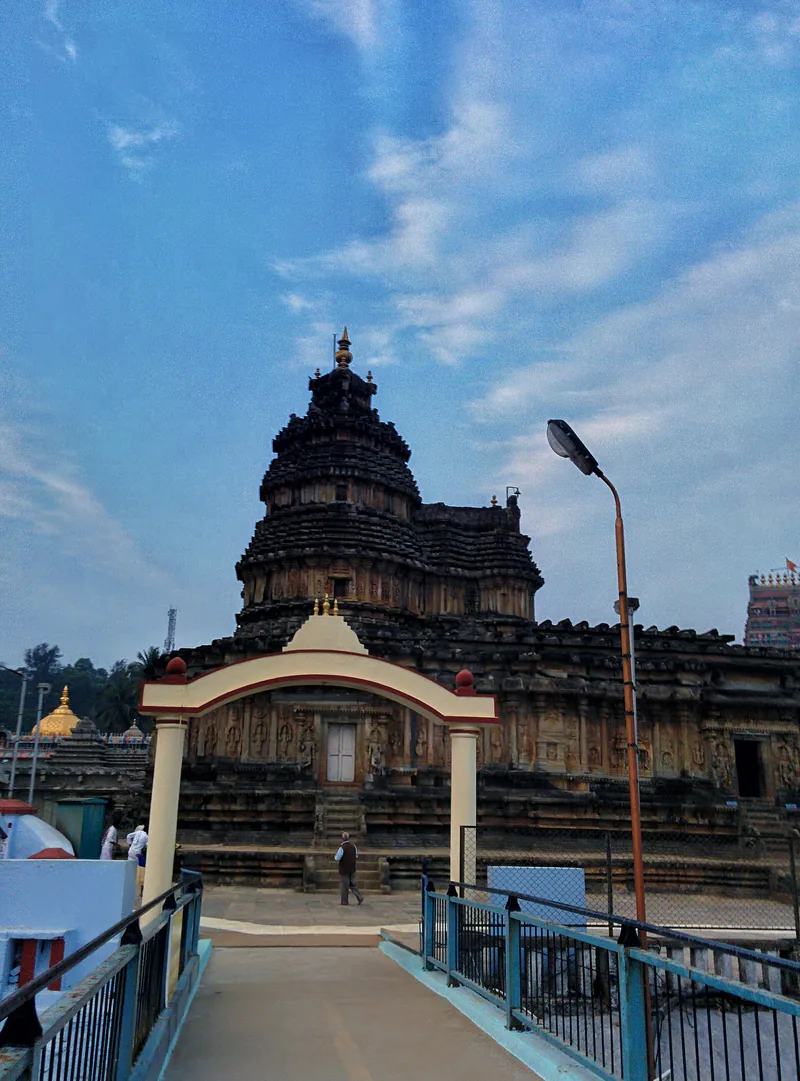
He is credited with establishing four monasteries (mathas): Sringeri in the south, Dvaraka in the west, Puri in the east and Jyotirmath in the north, each linked to one of the Vedas; the Kanchi monastery in Tamil Nadu also claims his foundation. He is also said to have organised the Dashanami, the "ten names" order of renouncers. Historians note that evidence for these institutions dates from much later, and some think they took shape in the centuries after him, but they became the chief carriers of his legacy.
Shankara's Authentic Works§
Hundreds of works bear Shankara's name, and separating his own writings from later attributions is a long-standing problem. Scholars such as Paul Hacker and Sengaku Mayeda developed criteria based on style and terminology. There is broad agreement on the following:
- The Brahma Sutra Bhashya, his commentary on Badarayana's aphorisms, the systematic statement of his philosophy.
- Commentaries on the principal Upanishads, including the Brihadaranyaka, Chandogya, Taittiriya, Aitareya, Katha, Kena, Isha, Prashna and Mundaka.
- The commentary on the Bhagavad Gita, discussed in The Bhagavad Gita.
- The Upadeshasahasri, "a thousand teachings," the only independent treatise widely accepted as his.
Many popular works are of doubtful authorship. The Vivekachudamani, "crest-jewel of discrimination," is widely read as an introduction to Advaita but is regarded by most scholars as later. Hymns such as the Bhaja Govindam and the Goddess hymn Saundaryalahari are traditionally his, though their attribution is debated; the latter is central to the Shri Vidya tradition described in Shaktism.
Shankara's Teaching: Brahman, Atman and Maya§
Shankara's philosophy rests on the Upanishadic great sayings (mahavakyas), above all "you are that" (tat tvam asi) from the Chandogya Upanishad. Brahman, the absolute, is pure being, consciousness and bliss, without parts, qualities or change. The self in each person, when stripped of the body, mind and individuality with which it is falsely identified, is not merely part of Brahman but identical with it. The scriptures behind this teaching are described in The Vedas and Upanishads.
Superimposition and Two Levels of Truth§
Shankara's commentary on the Brahma Sutra opens with an analysis of superimposition (adhyasa): the mistaken attribution of the qualities of one thing to another, as when a rope seen in dim light is taken for a snake. In the same way, the qualities of the body and mind are superimposed on the self, and the self's consciousness is attributed to the body and mind. This beginningless ignorance (avidya) produces the experience of individuality and of a world of many separate things.
To reconcile his non-dualism with ordinary experience and with scriptures that speak of a personal God and a created world, Shankara distinguished two standpoints. From the conventional standpoint (vyavaharika), the world, souls, God (Ishvara) and the law of karma are real and must be respected. From the ultimate standpoint (paramarthika), only Brahman is real. The world is therefore neither simply real nor simply unreal; later Advaitins described it as "indescribable" and called the power that projects it maya.
Knowledge, Not Action§
Because bondage is ignorance, liberation (moksha) can come only through knowledge, the direct realisation of identity with Brahman arising from hearing the scriptures, reflecting on them and contemplating their meaning. Ritual and good works purify the mind and prepare it, but cannot themselves liberate, since action belongs to the realm of ignorance. Shankara therefore valued renunciation highly. One who has realised the truth is liberated while still living (jivanmukta) and continues to live until the karma that produced the present body is exhausted. Comparisons with the other schools are drawn in The Six Schools of Hindu Philosophy.
Rivals, Critics and the Later Advaita Tradition§
Shankara wrote in sharp debate with Buddhist philosophers, whose denial of a permanent self he rejected, and with the ritualist Mimamsa school, whose emphasis on action he subordinated to knowledge. Yet his opponents within Vedanta, especially Vaishnava theologians, accused him of being a "Buddhist in disguise" (prachchhanna bauddha), since his doctrine of the world's unreality and an impersonal absolute seemed close to Mahayana thought. Ramanuja (traditionally 1017–1137) and Madhva (thirteenth century) developed their theistic schools largely in opposition to Advaita, as described in Hinduism and Vedanta.
Shankara's pupils Sureshvara and Padmapada began a long line of Advaita writers. Two sub-schools grew from different explanations of ignorance: the Bhamati school, named after Vachaspati Mishra's commentary, and the Vivarana school, following Prakashatman. Later masters included Vidyaranya, author of the Panchadashi, and Madhusudana Sarasvati, who combined rigorous non-dualism with devotion to Krishna.
Shankara's Legacy in Modern Hinduism§
From the nineteenth century, Advaita Vedanta came to be presented, by Indian reformers and Western admirers alike, as the philosophical essence of Hinduism. Swami Vivekananda's interpretation, discussed in Vivekananda, drew on Shankara while giving new emphasis to service and religious universalism; scholars often call this modern form "Neo-Vedanta." The sage Ramana Maharshi (1879–1950) taught self-enquiry in a strongly non-dual spirit, and many modern teachers of non-duality in the West trace their ideas to Advaita.
The heads of the Shankara monasteries, the Shankaracharyas, remain influential religious leaders, and the Smarta tradition, which worships five deities as forms of the one Brahman, regards Shankara as its founder. His birthday, Shankara Jayanti, is celebrated in spring, and Kaladi and Kedarnath are places of pilgrimage associated with his memory.
Frequently asked questions§
When did Adi Shankara live?§
His dates are uncertain. Tradition gives 788–820 CE, but many scholars place him somewhat earlier, around the late seventh or early eighth century. The sources for his life are hagiographies written centuries later.
What is the main teaching of Adi Shankara?§
Shankara taught that the self (atman) is identical with Brahman, the one absolute reality, and that the world of separate things is an appearance produced by ignorance. Liberation comes through knowledge of this identity.
Did Shankara write the Vivekachudamani?§
Tradition attributes the Vivekachudamani to Shankara, but most modern scholars think it was composed later by a teacher of his school. Works widely accepted as authentic include his commentaries and the Upadeshasahasri.
Sources and further reading§
- A Thousand Teachings: The Upadeśasāhasrī of Śaṅkara — Sengaku Mayeda (trans.), 1979
- Advaita Vedānta: A Philosophical Reconstruction — Eliot Deutsch, 1969
- Śaṅkara and Indian Philosophy — Natalia Isayeva, 1993
- Philology and Confrontation: Paul Hacker on Traditional and Modern Vedānta — Wilhelm Halbfass (ed.), 1995
- Brahma-Sūtra-Bhāṣya of Śrī Śaṅkarācārya — Swami Gambhirananda (trans.), 1965
- A History of Early Vedānta Philosophy — Hajime Nakamura, 1983