Liber XIV · Hinduism · Chapter XII: The Vedas & Upanishads
The Vedas and Upanishads: Hinduism's Oldest Scriptures
The Vedas and Upanishads explained: the four Vedas, their hymns and rituals, oral transmission, dating, the Vedic gods and the principal Upanishads.
The Vedas are the oldest scriptures of Hinduism: four collections of Sanskrit hymns, chants, ritual formulas and spells, together with prose texts that explain the sacrifice and, at their end, the philosophical dialogues known as the Upanishads. Hindus regard them as shruti, "what was heard," an eternal revelation perceived by ancient seers, and most scholars date their composition to roughly 1500–300 BCE, with the oldest hymns of the Rigveda usually placed around 1500–1200 BCE.
What the Veda Is: Revelation, Authority and Language§
Veda means "knowledge." In Hindu tradition it refers to a body of texts that no human being composed: the seers (rishis) to whom hymns are attributed are said to have "seen" or "heard" them rather than invented them. The philosophical school of Mimamsa developed this into the doctrine that the Veda is apaurusheya, "not of personal origin," eternal and without author, while other schools held it to be the word of God. Either way, acceptance of Vedic authority became the traditional test of orthodoxy, the line that separated the Hindu philosophical schools from Buddhism, Jainism and the materialists.
The Vedas are composed in Vedic Sanskrit, an older form of the language later standardised by the grammarian Panini (usually dated to about the fourth century BCE). Their study was traditionally reserved for "twice-born" men of the upper three classes, and in practice for Brahmins. As a result, most Hindus have revered the Veda as the ultimate source of authority without knowing its content, while drawing their working religion from the epics, the Puranas and devotional literature.
The Four Vedas and Their Contents§
The Rigveda§
The Rigveda, the oldest and most important collection, contains 1,028 hymns arranged in ten books (mandalas). Books two to seven, the "family books," each associated with a lineage of poets, are generally considered the oldest; the first and tenth books are later. The hymns praise the gods in elaborate poetic language and were recited by the hotri priest at the sacrifice. Among the most famous are the hymn to the cosmic Person (Purusha Sukta, 10.90), from whose sacrificed body the world and the four social classes arise, and the creation hymn (Nasadiya Sukta, 10.129), which ends by wondering whether even the highest overseer knows how the world began.
The Samaveda and Yajurveda§
The Samaveda consists largely of verses drawn from the Rigveda and set to melodies for the udgatri priest to chant during the soma sacrifice; it is the root of Indian musical tradition. The Yajurveda contains the prose formulas (yajus) muttered by the adhvaryu, the priest who performed the manual work of the ritual. It survives in two branches: the "Black" Yajurveda, in which formulas and explanations are mixed, and the "White" Yajurveda, which separates them.
The Atharvaveda§
The Atharvaveda was accepted as the fourth Veda only gradually. Much of it consists of spells and charms for healing, long life, protection against demons and sorcerers, love, victory and the prosperity of house and herd, along with hymns of high speculation. It is a precious window onto everyday religion and magic in ancient India, and parallels with the protective rites discussed in Protective Magic and Amulets and Talismans are often drawn by historians of religion.
The Four Layers of Each Veda§
Each Veda grew through layers. The samhita is the core collection of verses or formulas. The brahmanas, such as the vast Shatapatha Brahmana, are prose manuals explaining the meaning and power of each ritual act through chains of correspondences. The aranyakas, "forest books," treat especially esoteric or dangerous rites. The upanishads close the corpus. Each Veda was also transmitted in several recensions (shakhas), handed down by different priestly schools.
The Vedic Gods and the Sacrifice§
Vedic religion was centred on the fire sacrifice (yajna). Offerings of butter, grain, milk and the pressed juice of the soma plant were poured into fire and carried by Agni, the fire god, to the gods, who were invited to sit on the sacrificial grass and feast. In return they were asked for cattle, sons, long life, victory and rain. The solemn public rites (shrauta), requiring three fires and several priests, ranged from daily offerings to the year-long royal horse sacrifice (ashvamedha); simpler domestic rites (grihya) were performed by the householder at a single fire.
The most frequently praised god is Indra, the warrior king who slays the serpent Vritra and releases the waters. Agni is priest, messenger and household fire; Soma is both the sacred plant and its divinised drink, whose botanical identity is unknown and still debated by scholars. Varuna and Mitra guard rita, the cosmic and moral order that later thought would call dharma. Ushas is the dawn, Surya the sun, Rudra a fierce healer who later merges into Shiva, and Vishnu a lesser god whose three strides measure the universe. Many of these deities have cognates among other Indo-European peoples, especially in Iran. For their later history, see Hindu Gods and Goddesses.
The best-known Vedic verse in living Hinduism is the Gayatri mantra (Rigveda 3.62.10), a prayer to the sun god Savitri for the illumination of thought. It is recited daily by many Hindus and imparted at the sacred-thread initiation.
Oral Transmission and the Auxiliary Sciences§
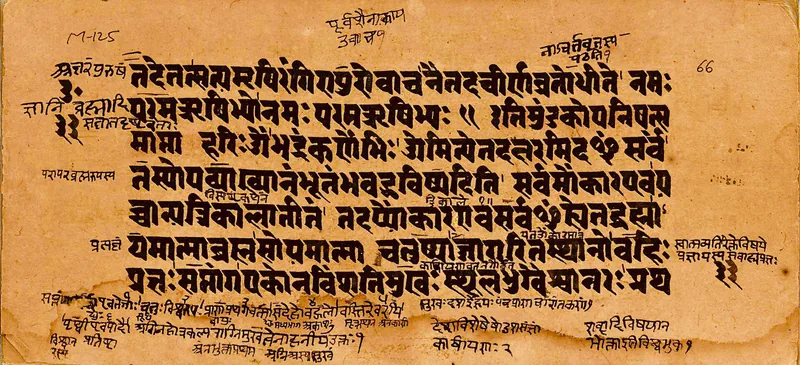
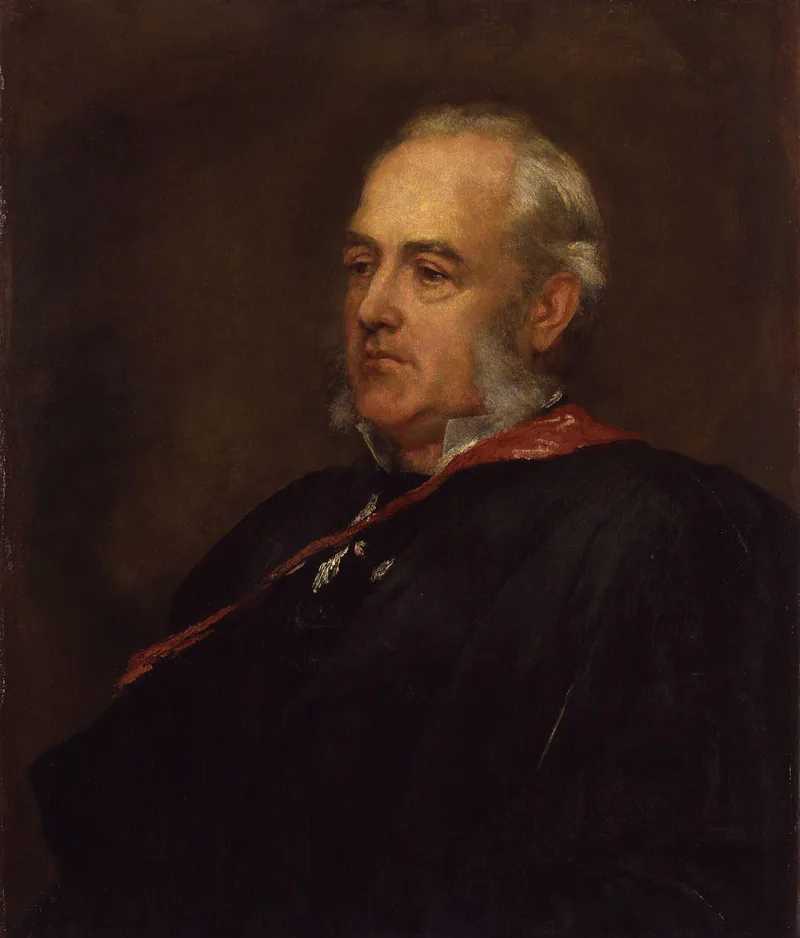
For most of their history the Vedas were not books. They were memorised syllable by syllable, with their pitch accents, by Brahmin boys trained over many years. To guard against corruption, reciters learned each text in several patterns: as continuous text, word by word (padapatha), in overlapping pairs, and in complex interwoven sequences such as the ghanapatha. The result is a transmission of astonishing accuracy, and UNESCO recognised the tradition of Vedic chanting as part of humanity's intangible cultural heritage in 2003. Writing came much later; most surviving manuscripts are less than a thousand years old, and the first printed edition of the Rigveda, with the medieval commentary of Sayana, was published by Max Müller between 1849 and 1874.
Six auxiliary disciplines (vedangas) grew up to protect the Veda and perform its rites correctly: phonetics, metre, grammar, etymology, ritual procedure, and jyotisha, the calendrical astronomy that determined the right time for sacrifice. The later art of horoscopy described in Vedic Astrology took its name from this last science, although its horoscopic methods owe much to Hellenistic astrology.
The Upanishads: Dating, Texts and Teachers§
The Upanishads form the last layer of the Vedic corpus and are therefore called Vedanta, "the end of the Veda." The word is often explained as "sitting down near" a teacher, and later as secret or hidden teaching. Tradition knows more than two hundred texts with the name, and a later canon counts 108, but scholars recognise about thirteen principal Upanishads. The oldest, the prose Brihadaranyaka and Chandogya, are usually dated to roughly the seventh to sixth centuries BCE, probably before the Buddha. Others, such as the Taittiriya, Aitareya and Kaushitaki, followed, and then verse Upanishads such as the Kena, Katha, Isha, Shvetashvatara and Mundaka, with the Prashna, Maitri and short Mandukya among the latest.
The Upanishads are dialogues and teachings rather than treatises. The sage Yajnavalkya debates rivals at the court of King Janaka and is questioned by the learned woman Gargi; he teaches his wife Maitreyi that the self is what makes everything dear. Uddalaka Aruni teaches his son Shvetaketu, with examples of salt dissolved in water and a seed of the banyan tree, that the subtle essence of all things is the self, ending with the refrain "you are that" (tat tvam asi). In the Katha Upanishad the boy Nachiketas extracts the secret of death from Yama, the god of the dead, who compares the self to a rider in the chariot of the body.
Key Ideas of the Upanishads§
The Upanishads shift the focus from external sacrifice to knowledge. Their central teaching is that atman, the innermost self, is grounded in or identical with brahman, the single reality behind all things, and that this knowledge liberates. They contain the earliest clear statements of the doctrine of karma and rebirth, presented at first as a new and even secret teaching, and they meditate on breath, the syllable Om and the states of waking, dream and deep sleep. The Shvetashvatara Upanishad identifies the absolute with a personal Lord, Rudra-Shiva, pointing towards later devotional theism.
Because the Upanishads do not speak with one voice, later thinkers read them in different ways: as teaching strict non-duality, qualified non-duality or eternal difference between soul and God. Those schools are explained in Hinduism and Vedanta, and the ideas of karma and liberation in Dharma, Karma, Samsara and Moksha. The Upanishads reached Europe through Dara Shikoh's Persian translation of 1657 and its Latin version by Anquetil-Duperron (1801–02), which Arthur Schopenhauer famously admired.
Frequently asked questions§
How old are the Vedas?§
Their date is debated, but most scholars place the oldest hymns of the Rigveda around 1500–1200 BCE, the other Vedic collections and the Brahmanas in the following centuries, and the principal Upanishads between about 700 BCE and the early centuries CE. Many Hindus regard the Vedas as eternal and therefore without a date of origin.
What is the difference between the Vedas and the Upanishads?§
The Upanishads are part of the Vedas: they are the final layer attached to each Vedic collection. While the earlier layers are mostly hymns and ritual instructions, the Upanishads are philosophical and contemplative, concerned with the self, brahman, karma and liberation.
Which Veda is the oldest?§
The Rigveda is the oldest. Much of the Samaveda and part of the Yajurveda reuse its verses, and the Atharvaveda was accepted as a Veda later, although parts of its contents may be very old.
How many Upanishads are there?§
Over two hundred texts bear the title, and a traditional list names 108. Scholars usually regard about thirteen as the principal or "early" Upanishads, on which the classical commentators wrote.
Sources and further reading§
- The Rigveda: The Earliest Religious Poetry of India — Stephanie W. Jamison & Joel P. Brereton (trans.), 2014
- The Rig Veda: An Anthology — Wendy Doniger O'Flaherty (trans.), 1981
- Upaniṣads — Patrick Olivelle (trans.), 1996
- The Early Upaniṣads: Annotated Text and Translation — Patrick Olivelle, 1998
- The Hymns of the Rigveda — Ralph T. H. Griffith (trans.), 1889
- Hymns of the Atharva-Veda — Maurice Bloomfield (trans.), 1897
- The Religion and Philosophy of the Veda and Upanishads — Arthur Berriedale Keith, 1925