Liber XIV · Hinduism · Chapter IV: Gods & Goddesses
Hindu Gods and Goddesses: The Major Deities Explained
Hindu gods and goddesses explained: one God and many deities, the trimurti, Vishnu, Shiva, Devi, Ganesha, Lakshmi, Hanuman, village gods and images.

Hinduism worships a great many gods and goddesses, from the Vedic deities of fire, storm and dawn to the great gods Vishnu and Shiva, the Goddess in her many forms, and countless local and village deities. Most Hindus nevertheless understand these deities as forms, aspects or servants of a single supreme reality, and each worshipper usually devotes himself or herself to one chosen deity while honouring others. The most widely worshipped today include Vishnu and his avatars Krishna and Rama, Shiva, the goddesses Durga, Kali, Lakshmi and Sarasvati, Ganesha and Hanuman.
One and Many: How Hindus Understand the Divine§
A Rigveda hymn (1.164.46) declares that the one being is called by many names, Indra, Mitra, Varuna, Agni and others, by those who know. This idea, developed by the Upanishads and later theologians, lies behind the characteristic Hindu way of relating to the divine. A Vaishnava will say that all gods are subordinate to Vishnu or are his aspects; a Shaiva will say the same of Shiva; a Shakta of the Goddess; and an Advaita Vedantin will regard all personal gods as appearances of the formless brahman. Scholars have used words such as henotheism, the worship of one god at a time as supreme, or "polycentric" theism, to describe this pattern; no single Western label fits it well.
In practice, a Hindu family typically worships a chosen deity (ishta-devata), a family or lineage deity (kula-devata) and the guardian deity of the village or neighbourhood, and will also pray to Ganesha before any undertaking, to Lakshmi for prosperity and to Sarasvati for learning. Smarta Hindus, following a practice traditionally attributed to Shankara, worship five deities together: Shiva, Vishnu, the Goddess, Surya and Ganesha.
The Vedic Gods and Their Transformation§
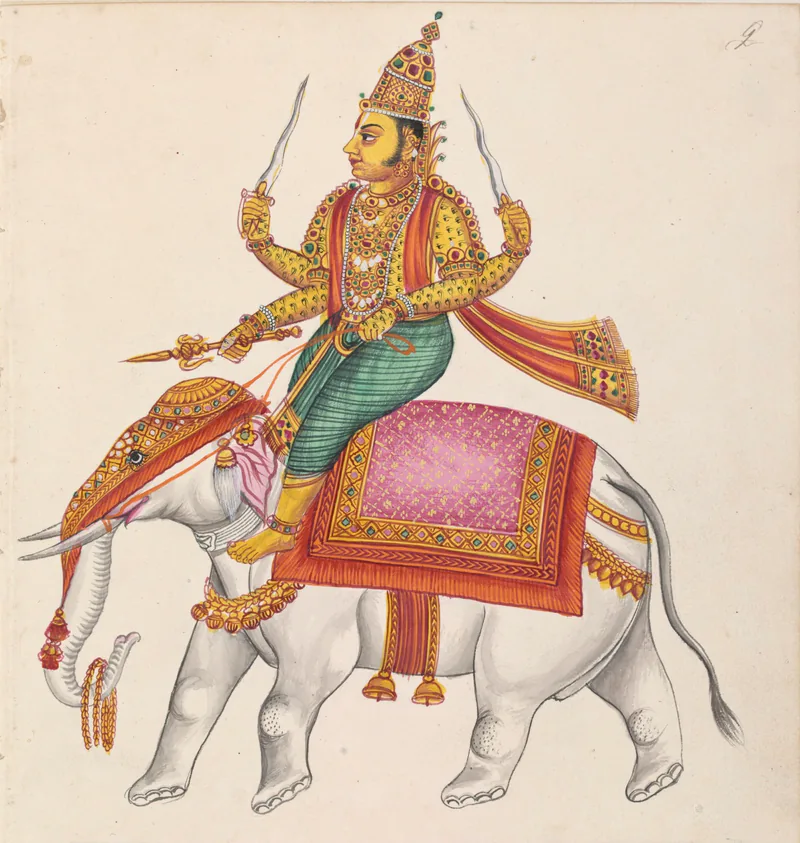
The gods of the Rigveda were largely powers of nature and of the sacrifice: Indra the storm and warrior king, Agni the fire, Soma the sacred drink, Varuna and Mitra guardians of cosmic order, Surya the sun, Ushas the dawn and Vayu the wind. The Vedas count thirty-three of them, divided among earth, atmosphere and sky. Over the following centuries most declined in importance. Indra survives as king of a heaven subordinate to the great gods; Agni remains essential in every ritual fire; Yama rules the dead. Two minor Vedic figures rose to supremacy: Vishnu, who measured the universe in three strides, and Rudra, the fierce archer who became Shiva. Their history is traced in The Vedas and Upanishads.
The Trimurti and the Great Gods§
Several Puranas present a triad (trimurti) in which Brahma creates the world, Vishnu preserves it and Shiva destroys it at the end of each cycle. The image is famous, but it is a theological summary rather than the basis of worship: Brahma has almost no temples (the best known is at Pushkar in Rajasthan), and Vaishnavas and Shaivas each regard their own god as performing all three functions.
Vishnu§
Vishnu, the preserver, is usually shown four-armed and dark blue, holding a conch, a discus, a mace and a lotus, and resting on the serpent Shesha or riding the eagle Garuda. He descends to earth as avatars to restore dharma, above all as Rama and Krishna, who are themselves among the most beloved of all Hindu deities. His consort is Lakshmi. His worship is the subject of Vaishnavism.
Shiva§
Shiva is at once the great ascetic meditating on Mount Kailasa, the householder with his wife Parvati and sons Ganesha and Skanda, and the cosmic dancer Nataraja. He wears the crescent moon and the river Ganga in his matted hair, carries a trident and drum, has a third eye in his forehead and rides the bull Nandi. He is worshipped above all in the aniconic form of the linga. See Shaivism.
Devi, the Goddess§
The Goddess (Devi, Mahadevi) is worshipped both as the consort and power (shakti) of the male gods and, in the Shakta tradition, as the supreme deity herself. Her forms range from the gentle Parvati to the warrior Durga, who rides a lion and slays the buffalo demon, and the fearsome Kali, black, garlanded with heads and standing on Shiva. See Shaktism.
Other Major Deities of Hinduism§
Ganesha and Skanda§
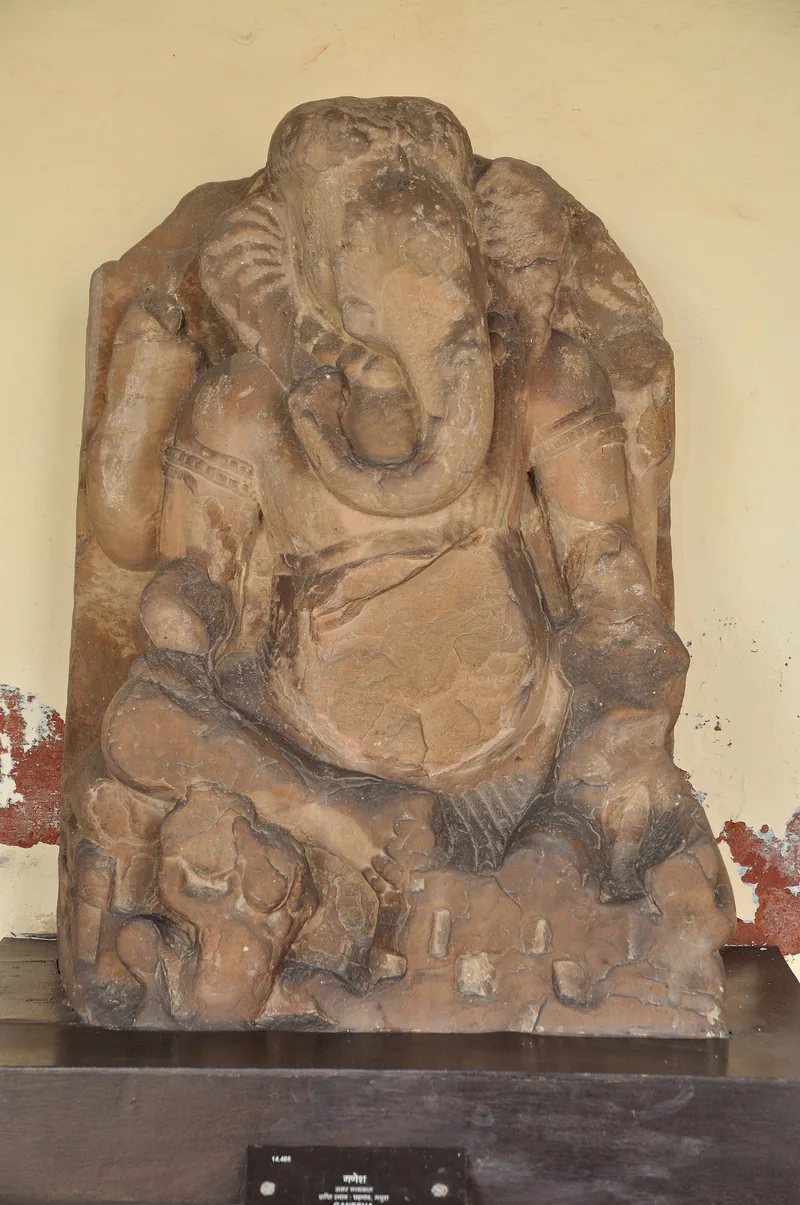
Ganesha, the elephant-headed son of Shiva and Parvati, is perhaps the most universally worshipped Hindu deity. As lord of beginnings and remover of obstacles he is invoked at the start of rites, journeys, books and businesses. His pot belly, single tusk, sweets and mouse mount are instantly recognisable, and the Puranas offer several stories of how he received his elephant head, the best known being that Shiva beheaded him without knowing him and replaced the head with that of an elephant. His brother Skanda, also called Kartikeya or Subrahmanya, is a youthful war god who in Tamil Nadu, as Murugan, became the most popular deity of the Tamil people.
Lakshmi, Sarasvati and Parvati§
Lakshmi, goddess of fortune, prosperity and beauty, rises from the churned ocean of milk and becomes Vishnu's consort; she is worshipped especially at Diwali. Sarasvati, goddess of learning, music and speech, originally a sacred river of the Rigveda, is shown in white with a stringed vina, seated on a lotus or with a swan; students and artists honour her at the festival of Vasant Panchami. Parvati, daughter of the Himalaya, wins Shiva through her austerities and is the gentle form of the Goddess. Together the three are sometimes called the tridevi, consorts of the three gods of the trimurti.
Hanuman§
Hanuman, the monkey hero of the Ramayana, embodies strength, courage and selfless devotion to Rama. He is worshipped across India, often on Tuesdays and Saturdays, as a protector against danger, illness and evil spirits, and the Hindi hymn Hanuman Chalisa, traditionally attributed to the sixteenth-century poet Tulsidas, is among the most frequently recited of all Hindu prayers. See The Mahabharata, Ramayana and Bhagavad Gita.
Surya and the Nine Planets§
The sun god Surya had major temples in medieval India, most famously at Konark in Odisha (thirteenth century), built as a gigantic stone chariot. He heads the nine planetary deities (navagraha), Sun, Moon, Mars, Mercury, Jupiter, Venus, Saturn and the lunar nodes Rahu and Ketu, who are worshipped in many temples to avert the harmful influences described in Vedic Astrology.
Village Gods, Local Goddesses and Regional Deities§
Alongside the pan-Indian gods, rural Hinduism has always centred on local deities (grama-devata) who protect a village or region. Many are goddesses connected with disease, rain and fertility, such as Mariamman in Tamil Nadu, associated historically with smallpox, or Shitala in north India. Others are deified heroes, ancestors, serpent deities (nagas) and guardians of boundaries. Their worship has often been conducted by non-Brahmin priests and has historically included offerings that orthodox temples reject, including, in some places, blood sacrifice, a practice now restricted by law in several Indian states. Over the centuries many local deities were absorbed into the great traditions as forms of Shiva, Vishnu or the Goddess: Jagannath of Puri is worshipped as Krishna, Vithoba of Pandharpur as Vishnu, and Ayyappan of Sabarimala as the son of Shiva and Vishnu in his female form Mohini.
Images, Iconography and the Presence of God§
Hindus worship deities in consecrated images (murti), made of stone, metal, wood or clay according to rules laid down in the Agamas and treatises on iconography. A ritual of installation and the opening of the eyes invites the deity to dwell in the image, which is thereafter treated as a living presence: woken, bathed, dressed, fed and put to rest. The essential act of worship is darshan, seeing the deity and being seen. Many Hindus also worship aniconic forms, such as the Shiva linga, the shalagrama stone of Vishnu or the abstract diagram (yantra) of the Goddess.
Iconography is a precise visual language. Multiple arms display a deity's powers and hold identifying weapons and emblems; hand gestures (mudras) grant protection or boons; each god has an animal mount (vahana): Garuda for Vishnu, Nandi for Shiva, the lion for Durga, the mouse for Ganesha, the peacock for Skanda and the swan for Sarasvati. For the wider history of such emblems see Religious Symbols and, for comparison with other pantheons, Gods and Goddesses.
Frequently asked questions§
How many gods are there in Hinduism?§
The Vedas speak of thirty-three gods, and a popular saying speaks of thirty-three crore, or 330 million, which simply expresses that the divine forms are innumerable. Most Hindu theologians add that all these forms point to one supreme reality.
Who is the supreme god in Hinduism?§
It depends on the tradition. Vaishnavas regard Vishnu (often as Krishna) as supreme, Shaivas Shiva, and Shaktas the Goddess, while Advaita Vedanta sees the impersonal brahman as the ultimate reality behind every deity.
Why do Hindu gods have many arms?§
Multiple arms and heads are a visual way of expressing a deity's superhuman power and different functions. Each hand typically holds an emblem or makes a gesture that identifies the god and indicates what he or she grants or destroys.
Why is Ganesha worshipped first?§
According to Puranic stories, Shiva granted Ganesha the privilege of being honoured before all other gods. As remover of obstacles and lord of beginnings, he is invoked at the start of ceremonies, journeys and new ventures so that they proceed without hindrance.
Sources and further reading§
- Hindu Goddesses: Visions of the Divine Feminine in the Hindu Religious Tradition — David Kinsley, 1986
- Darśan: Seeing the Divine Image in India — Diana L. Eck, 1981
- The Presence of Śiva — Stella Kramrisch, 1981
- Elements of Hindu Iconography — T. A. Gopinatha Rao, 1914
- Hindu Mythology, Vedic and Purāṇic — W. J. Wilkins, 1882
- The Camphor Flame: Popular Hinduism and Society in India — C. J. Fuller, 1992