Liber XIV · Hinduism · Chapter IV: Gods & Goddesses
Ganesha: The Elephant-Headed Hindu God of Beginnings
Ganesha, the elephant-headed Hindu god: his origins, birth myths, iconography, the Ganapatya tradition, Ganesh Chaturthi and his worship beyond India.

Ganesha, also called Ganapati or Vinayaka, is the elephant-headed Hindu god of beginnings, wisdom and auspicious success, honoured as the remover of obstacles and invoked before almost every rite, journey or new undertaking. Son of Shiva and Parvati in the Puranic stories, he rose from a group of obstacle-making spirits to become one of the most widely loved deities in Hinduism, with his own theological tradition, great festivals and a following that extends to Buddhists, Jains and Hindus far beyond India.
Who Is Ganesha? Names, Roles and Place in the Pantheon§
Ganesha holds a unique position among Hindu gods. He is rarely the main deity of a temple, yet his image stands at the entrance of countless temples, homes and shops, and his name opens prayers, wedding invitations and manuscripts; the formula Shri Ganeshaya namah, "homage to Lord Ganesha," traditionally heads a written text. Whatever the chosen deity, Ganesha is honoured first.
His many names describe his roles. Ganapati and Ganesha both mean "lord of the ganas," the hosts of attendants who surround Shiva. Vighneshvara means "lord of obstacles." Vinayaka is the name most used in south India, where he is also affectionately called Pillaiyar, "the noble child." Other epithets describe his appearance: Ekadanta, "one-tusked," and Lambodara, "pot-bellied."
He is also lord of intellect and learning, invoked by students, writers and merchants opening new account books. Among the Smarta Hindus who worship five deities together (panchayatana puja), Ganesha is one of the five, alongside Shiva, Vishnu, the Goddess and Surya, as described in Hindu Gods and Goddesses.
Origins of Ganesha: From Vinayaka Spirits to Puranic God§
The historical origins of Ganesha are debated. A verse of the Rigveda (2.23.1) addresses a "lord of hosts" (ganapati), and it is still recited in his worship, but in its original context it refers to Brahmanaspati, lord of sacred speech, not to an elephant-headed god. Some scholars have looked for his roots in folk cults of elephant spirits or of yakshas, the potbellied nature spirits of early Indian religion, but these links remain speculative.
More concrete evidence comes from the household manuals (grihyasutras) and the law book of Yajnavalkya, which describe Vinayakas: spirits who possess people and cause obstacles and misfortune, and who must be pacified with offerings. Many historians think that these malevolent figures were gradually unified into a single Vinayaka who, once properly worshipped, could be relied on to withhold the obstacles he controlled. This would explain the double character of the mature Ganesha as lord of obstacles who both creates and removes them.
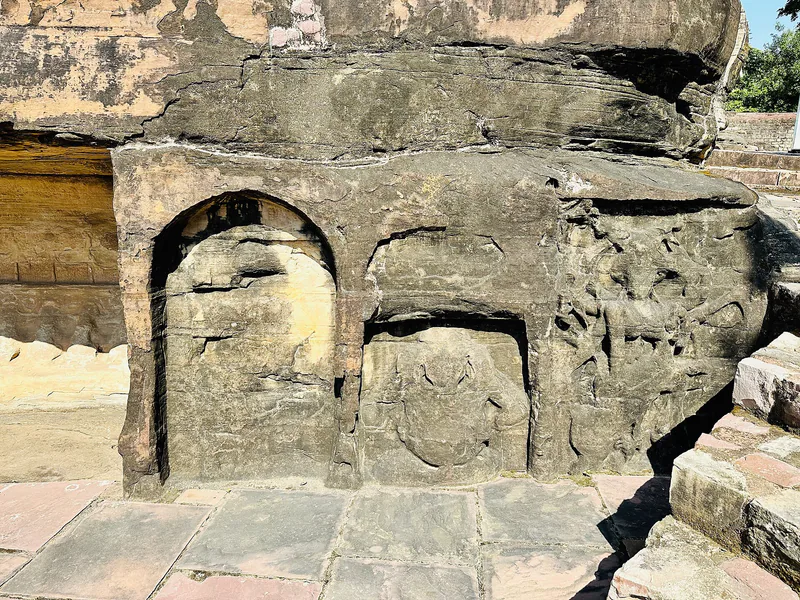
Images of an elephant-headed god appear in the early centuries CE, and by the Gupta period, roughly the fourth to sixth centuries, Ganesha had acquired his classic form; a relief at the Udayagiri caves in Madhya Pradesh, usually dated to the early fifth century, is among the earliest securely dated examples. Over the following centuries the Puranas incorporated him into the family of Shiva and Parvati and made him the god to be worshipped first.
Birth Stories and the Myth of the Elephant Head§
The Puranas tell several stories of Ganesha's birth, a variety typical of Hindu mythology, as explained in The Puranas.
Parvati's Son and Shiva's Anger§
The most popular version, told in the Shiva Purana, relates that Parvati, wanting a guardian of her own while she bathed, fashioned a boy from the paste she had rubbed from her body and set him at her door. When Shiva returned and was refused entry by the stranger, a battle followed in which Shiva cut off the boy's head. Parvati's grief and fury threatened the universe, and Shiva promised to restore her son: his attendants brought back the head of the first creature they found, an elephant, and the boy was revived, made leader of Shiva's hosts and granted the right to be worshipped before all the gods.
Other Versions§
In the Brahmavaivarta Purana, the infant's head is burned or severed by the glance of the planet Shani (Saturn), who had been cursed so that his gaze destroyed what he looked upon, and Vishnu replaces it with an elephant's. Other stories explain his single tusk: he broke it to hurl at the moon, which had laughed at him, or used it as a pen when he served as scribe for the sage Vyasa, who dictated the Mahabharata. The scribe episode is a late addition absent from the critical edition of the epic, but it made Ganesha a patron of writing; see The Mahabharata, Ramayana and Bhagavad Gita.
A much-loved tale tells of a contest between Ganesha and his brother Skanda to circle the world. Skanda set off on his peacock, while Ganesha simply walked around his parents, declaring that they were his whole world, and won the prize, a sweet or a mango in different tellings.
Ganesha Iconography: Tusk, Belly, Mouse and Sweets§
Ganesha's image is among the most recognisable in Indian art. He has an elephant's head on a short human body with a large belly, often wrapped with a snake as a belt. He usually has four arms, holding an elephant goad (ankusha) and a noose (pasha), his broken tusk and a bowl of sweets, most often the dumpling called modaka, of which he is said to be especially fond; one hand may make the gesture of protection. His mount (vahana) is a mouse or rat, often shown at his feet nibbling a sweet.
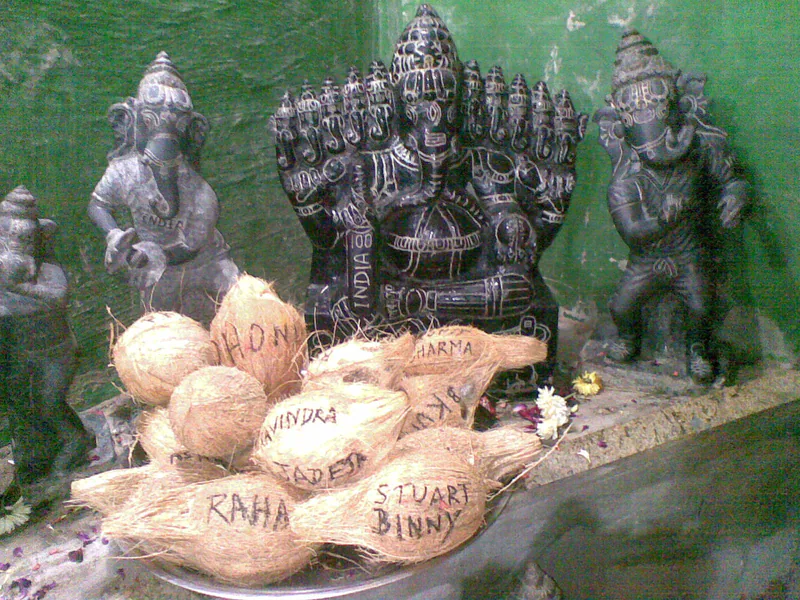
Commentators explain the goad and noose as his power to drive devotees forward and restrain them, and the large belly as containing the universe; the mouse is read as a tamed demon or as desire brought under control. Whether the trunk turns to the left or right is also significant in popular belief, a right-turning trunk being considered more powerful and demanding stricter worship.
Ganesha's marital status differs by region. In much of north and west India he is married to Siddhi ("success") and Buddhi ("intellect"), or to Riddhi and Siddhi, and in some traditions has two sons, Shubha and Labha, "auspiciousness" and "profit." In south India he is generally regarded as a lifelong bachelor. Dancing, child and many-headed forms appear in temple sculpture, and tantric texts describe fierce forms such as Ucchishta Ganapati, worshipped in esoteric settings described in Tantra in Hinduism.
The Ganapatya Tradition and Ganesha Scriptures§
For most Hindus Ganesha is a beloved subordinate deity, but the Ganapatyas worship him as the supreme God, the source of the universe from whom Brahma, Vishnu and Shiva derive. The tradition seems to have taken shape in the late first millennium and was strongest in Maharashtra.
Its principal scriptures are two late Puranas devoted to him, the Ganesha Purana and the Mudgala Purana, usually dated between about the twelfth and seventeenth centuries, though their dating is uncertain. The Ganesha Purana contains the Ganesha Gita, a reworking of the Bhagavad Gita in which Ganesha takes Krishna's place as teacher. The short Ganapati Atharvashirsha, a late text in the style of an Upanishad, identifies Ganesha with Brahman, the absolute, and with the sacred syllable Om; it is widely recited in Maharashtra.
The most important Ganapatya centre is the circuit of eight shrines in Maharashtra called the Ashtavinayaka, with Morgaon as its chief temple. The saint Morya Gosavi, whose dates are uncertain but who is generally placed in the sixteenth or seventeenth century, founded a line of hereditary custodians at Chinchwad near Pune, believed by devotees to embody Ganesha himself.
Ganesh Chaturthi and the Worship of Ganesha Today§
Ganesha is worshipped in the course of almost every Hindu ritual, and devotees honour him especially on the fourth lunar day (chaturthi) of each fortnight; the waning-moon fourth, Sankashti Chaturthi, is a day of fasting for the removal of difficulties.
His great festival, Ganesh Chaturthi, falls on the fourth day of the bright fortnight of Bhadrapada, in August or September. Families install a clay image of Ganesha in the home, worship it for one and a half to eleven days, and then carry it in procession to be immersed in a river, lake or the sea (visarjana). In 1893 the nationalist Bal Gangadhar Tilak promoted the festival in Pune as a public celebration, with large images in neighbourhood pavilions, partly to bring people together across caste lines at a time when political gatherings were restricted. In Mumbai it now draws crowds of millions. Environmental concern has encouraged a return to unpainted clay images. The festival is set within the wider ritual year in Hindu Temples, Rituals and Festivals.
In modern chakra literature Ganesha is often assigned to the root centre, as described in Muladhara, a link not standard in the older tantric texts.
Ganesha Beyond Hinduism§
Ganesha's appeal crossed religious boundaries. Jains honour him as a guardian of prosperity, and Buddhist art in Nepal and Tibet shows Vinayaka both as an obstacle-maker trampled by fierce protectors and as a protector himself. In Japan, the esoteric Buddhist schools described in Esoteric Buddhism in Japan worship a dual form called Kangiten, the "god of bliss," usually kept hidden from view. Fine images survive from Java and Cambodia, and in Thailand he is honoured as a patron of the arts.
In the diaspora Ganesha is often the first deity installed in a new temple. In September 1995 reports that his images were "drinking" offered milk spread across India and the diaspora within a day; scientists pointed to capillary action, while many devotees saw a sign of divine presence.
Frequently asked questions§
Why does Ganesha have an elephant head?§
According to the best-known Puranic story, Shiva beheaded the boy whom Parvati had created to guard her door, not knowing who he was, and then restored him to life with the head of an elephant. Theologians interpret the elephant head as a sign of wisdom and of power to clear obstacles, as an elephant clears a path through the forest.
Is Ganesha married?§
It depends on the region. In much of north and west India he is married to Siddhi and Buddhi (or Riddhi and Siddhi), personifications of success and intellect, while in south India he is usually considered a bachelor.
When is Ganesh Chaturthi celebrated?§
Ganesh Chaturthi falls on the fourth day of the waxing moon in the month of Bhadrapada, usually in late August or September. The festival lasts from one and a half to eleven days and ends with the immersion of the images in water.
Sources and further reading§
- Ganeśa: Lord of Obstacles, Lord of Beginnings — Paul B. Courtright, 1985
- Ganesh: Studies of an Asian God — Robert L. Brown (ed.), 1991
- Gaṇapati: Song of the Self — John A. Grimes, 1995
- Hindu Myths: A Sourcebook Translated from the Sanskrit — Wendy Doniger O'Flaherty, 1975
- The Hindu Religious Tradition — Thomas J. Hopkins, 1971