Liber XIV · Hinduism · Chapter III: The Epics & the Bhagavad Gita
The Mahabharata, Ramayana and Bhagavad Gita Explained
A guide to the Hindu epics: the Mahabharata and Ramayana, their stories, dating and retellings, and the Bhagavad Gita's teaching on duty, action and devotion.

The Mahabharata and the Ramayana are the two great Sanskrit epics of India, vast narrative poems that took shape between roughly 400 BCE and 400 CE and have shaped Hindu religion, ethics and art ever since. The Mahabharata tells of a catastrophic war between two branches of a royal family and contains the Bhagavad Gita, the dialogue in which Krishna teaches the warrior Arjuna how to act rightly; the Ramayana tells the story of Prince Rama, his wife Sita and the defeat of the demon king Ravana.
The Epics as Scripture: Itihasa and Smriti§
In Hindu classification the epics belong to smriti, "remembered" tradition, rather than to the revealed Veda. Yet they have been far more influential in daily religious life. The Mahabharata calls itself a "fifth Veda," open to women and to all classes who were excluded from Vedic study, and tells its listeners that whatever is found here may be found elsewhere, but what is not here is nowhere. Through recitation, storytelling, temple sculpture, dance, theatre and, since the 1980s, television, the epics have given Hindus their most familiar images of gods, heroes and moral dilemmas.
Modern scholars see both epics as the product of long growth. Bardic tales of heroes were reworked by Brahmin editors, who added genealogies, theology, sermons on dharma and devotion to Vishnu. Dating is uncertain and contested, but a formative period from about the fourth century BCE to the fourth century CE is widely accepted for both, with the Ramayana's first and last books generally regarded as later additions. Some scholars argue for a more deliberate composition over a shorter period.
The Mahabharata: Story and Structure§
The Mahabharata, "the great tale of the Bharatas," is traditionally said to have been composed by Vyasa, who is also a character in it, and written down by the elephant-headed god Ganesha. It is traditionally reckoned at 100,000 verses (the critical text is somewhat shorter) in eighteen books (parvans), with an appendix, the Harivamsha, on Krishna's lineage and childhood. A critical edition based on hundreds of manuscripts was produced at the Bhandarkar Oriental Research Institute in Pune between 1933 and 1966.
The Pandavas and the Kauravas§
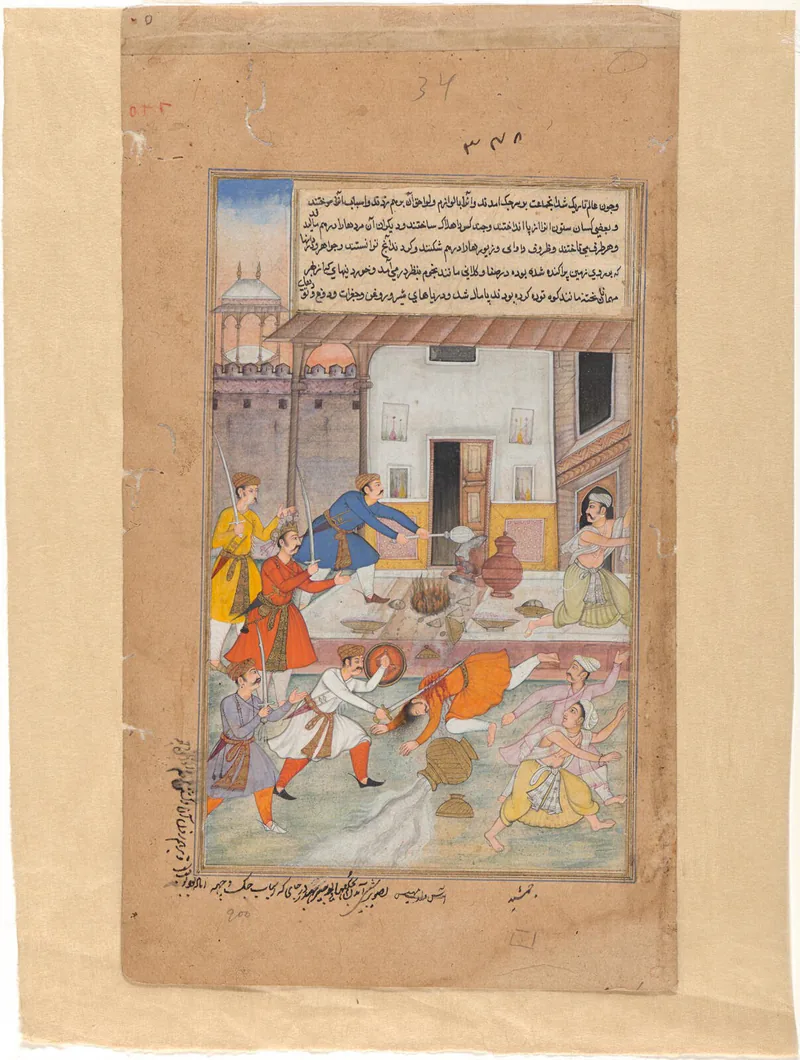
The story concerns two sets of cousins of the Kuru dynasty. The five Pandava brothers, Yudhishthira, Bhima, Arjuna, Nakula and Sahadeva, are the sons of King Pandu, fathered by gods; all five marry Draupadi. Their rivals are the hundred Kauravas, sons of the blind king Dhritarashtra, led by the eldest, Duryodhana. In a rigged game of dice Yudhishthira gambles away his kingdom, his brothers, himself and finally Draupadi, who is dragged into the assembly hall and humiliated. The Pandavas are exiled for thirteen years.
The War at Kurukshetra§
When the Kauravas refuse to return their kingdom, the two sides meet at Kurukshetra in an eighteen-day war that draws in all the kings of India. The Pandavas, advised by their cousin Krishna, win, but only by stratagems that violate the warrior code, and almost everyone dies, including revered elders such as Bhishma and the teacher Drona, and Karna, who is secretly the Pandavas' eldest brother. After the war Bhishma, dying on a bed of arrows, instructs Yudhishthira at length on dharma, kingship and liberation. The epic closes with the death of Krishna and the final journey of the Pandavas towards heaven, where Yudhishthira refuses to abandon the dog that has followed him.
The poem also contains famous embedded stories, among them Nala and Damayanti and Savitri, who wins back her husband's life from Yama, the god of death. Its persistent question is how to act when every choice involves harm, captured in the refrain that dharma is subtle.
The Ramayana: Rama, Sita and Ravana§
The Ramayana, "Rama's journey," is attributed to Valmiki, revered as the first poet (adi-kavi). It contains about 24,000 verses in seven books (kandas). Rama, eldest son of King Dasharatha of Ayodhya, is about to be crowned when his stepmother Kaikeyi claims two boons and has him exiled for fourteen years. He goes to the forest with his wife Sita and his brother Lakshmana. There Ravana, the ten-headed king of the demons (rakshasas) of Lanka, lures Rama away with a golden deer and carries off Sita.
Rama allies with the monkey king Sugriva. His minister Hanuman leaps across the sea to Lanka, finds Sita, and sets the city on fire with his burning tail. The monkey army builds a bridge to the island, and Rama kills Ravana in battle. Sita proves her purity by an ordeal of fire, and the couple return to Ayodhya, where Rama's just reign (Ramarajya) became a lasting ideal. In the final book, widely regarded as a later addition, Rama banishes the pregnant Sita because of public gossip; she gives birth to twin sons in Valmiki's hermitage and finally returns into the earth from which she was born. This ending has been debated by poets, reformers and feminist readers for centuries.
Many Ramayanas§
The story exists in hundreds of tellings. Among the most important are Kamban's Tamil Iramavataram (usually dated to the twelfth century), the Bengali version of Krittibas, and the Ramcharitmanas of Tulsidas, composed in the Awadhi dialect of Hindi from 1574, which is the scripture of devotion to Rama for millions in north India. Jain and Buddhist versions retell the story in their own terms, and the epic spread to Southeast Asia as the Thai Ramakien, the Javanese Kakawin Ramayana and the reliefs of Prambanan and Angkor Wat. In northern India the annual dramatic cycle of the Ramlila, culminating in the burning of Ravana's effigy at Dussehra, keeps the story alive in public performance.
The Bhagavad Gita: Krishna's Teaching to Arjuna§
The Bhagavad Gita, "Song of the Lord," forms chapters 23–40 of the sixth book of the Mahabharata in the critical edition and is usually dated between about the second century BCE and the second century CE. As the armies face each other, Arjuna sees his kinsmen and teachers on the opposing side and lays down his bow. His charioteer Krishna answers him in eighteen chapters that move from consolation to the highest theology.
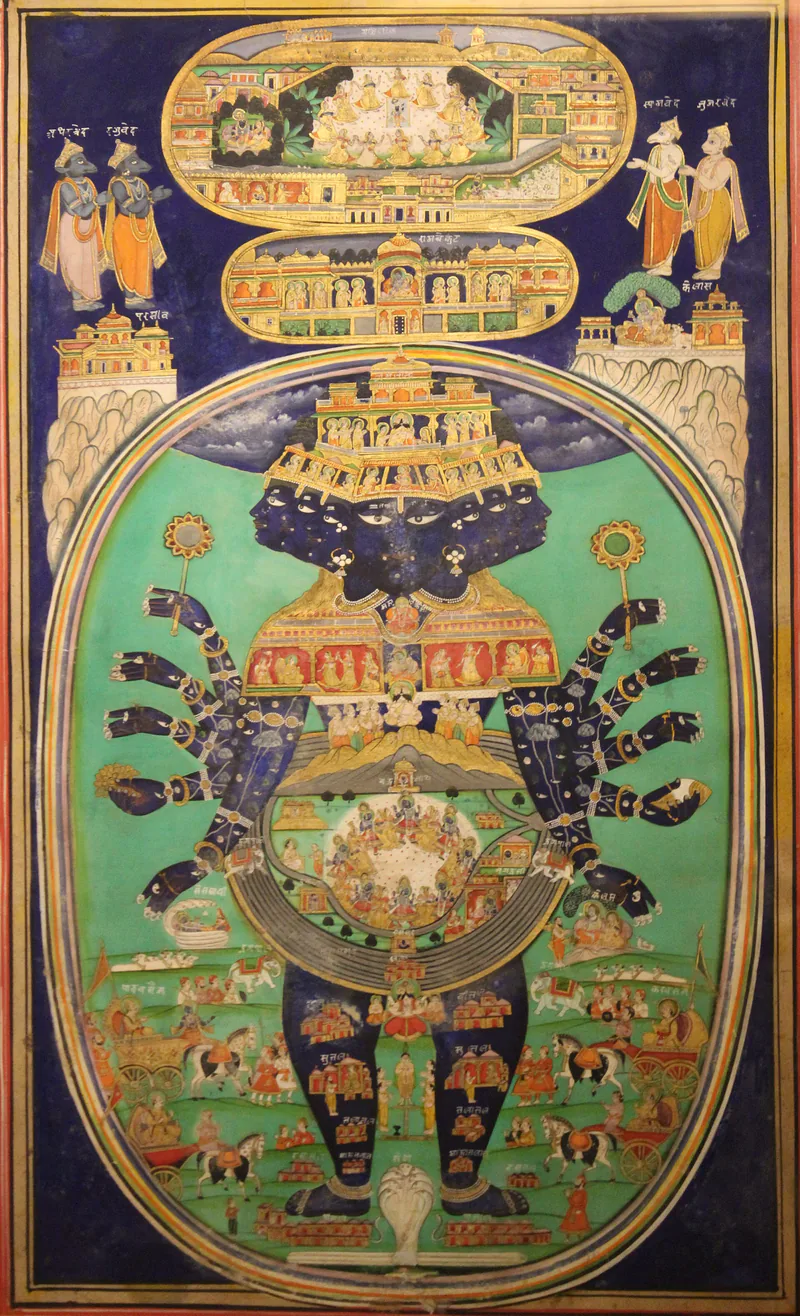
Krishna first teaches that the self is eternal: it is not killed when the body is killed, but passes on as one changes worn-out clothes. He then urges Arjuna to perform his own duty (svadharma) as a warrior, acting without attachment to the fruits of action; work done as an offering does not bind. He sets out the disciplines of action (karma yoga), knowledge (jnana yoga), meditation and, above all, loving devotion (bhakti). In the eleventh chapter Krishna reveals his universal form, containing all worlds and devouring the warriors as time itself; Arjuna, terrified, begs him to return to his gentle human shape. The final chapter asks the hearer to abandon all other duties and take refuge in Krishna alone.
Commentaries and Modern Readings§
The Gita became one of the three foundations of Vedanta, and Shankara, Ramanuja and Madhva each read it in support of their own school, as described in Hinduism and Vedanta. The Marathi saint Jnaneshvar retold it in a celebrated commentary in 1290. It was the first Sanskrit work translated directly into English, by Charles Wilkins in 1785, and Edwin Arnold's verse rendering The Song Celestial (1885) brought it to a wide Victorian readership. In the independence era Bal Gangadhar Tilak read it as a call to action, and Mohandas Gandhi, who translated it into Gujarati as Anasaktiyoga, "the yoga of non-attachment," read it daily as a guide to selfless action and non-violence. Its doctrine of action and devotion is discussed further in Dharma, Karma, Samsara and Moksha and The Bhakti Movement.
Krishna, Rama and the Theology of the Avatars§
Both epics, in their final form, present their heroes as incarnations (avatara) of Vishnu who descend to restore dharma when it declines, an idea stated explicitly in the Gita. This made the epics central to Vaishnava devotion: Rama is worshipped as the ideal king and Krishna as the supreme God, as explained in Vaishnavism. Hanuman, the devoted servant of Rama, became one of the most widely worshipped deities in India, and the Mahabharata's heroes and heroines, including Draupadi, receive cults of their own, especially in Tamil Nadu.
Frequently asked questions§
Which is older, the Ramayana or the Mahabharata?§
Hindu tradition places the events of the Ramayana in an earlier age than those of the Mahabharata, which itself retells Rama's story. Scholars find that both epics grew over the same broad period, roughly 400 BCE to 400 CE, and that their oldest layers are difficult to date relative to each other.
Is the Bhagavad Gita part of the Mahabharata?§
Yes. It forms eighteen chapters of the sixth book, the Bhishma Parvan, set just before the battle of Kurukshetra. It circulated independently from an early date and is treated as a scripture in its own right.
Why is the Mahabharata so long?§
It grew over centuries as a repository of stories, genealogies, law, philosophy and devotion added to an older tale of war. Its compilers seem to have intended it as an encyclopaedia of dharma, and it describes itself as containing everything worth knowing.
Sources and further reading§
- The Mahābhārata — J. A. B. van Buitenen (trans.), 1973
- The Rāmāyaṇa of Vālmīki: An Epic of Ancient India — Robert P. Goldman (trans.), 1984
- The Bhagavad-Gita: Krishna's Counsel in Time of War — Barbara Stoler Miller (trans.), 1986
- The Song Celestial — Edwin Arnold (trans.), 1885
- The Bhagavad Gita: A Biography — Richard H. Davis, 2015
- The Sanskrit Epics — John Brockington, 1998
- Rethinking the Mahābhārata — Alf Hiltebeitel, 2001
- The Ramayana: A Shortened Modern Prose Version of the Indian Epic — R. K. Narayan, 1972