Liber XIV · Hinduism · Chapter III: The Epics & the Bhagavad Gita
The Bhagavad Gita: Teachings, Structure and Commentaries
The Bhagavad Gita explained: its setting, date and eighteen chapters, its teaching on action, knowledge and devotion, and its great commentators and readers.

The Bhagavad Gita, "the Song of the Lord," is a 700-verse dialogue in eighteen chapters in which the god Krishna instructs the warrior Arjuna on the battlefield of Kurukshetra, just before the great war of the Mahabharata. Probably composed between about the second century BCE and the second century CE, it teaches that one should do one's duty without attachment to its results, that the true self is eternal, and that loving devotion to God is the highest path; it is the most widely read and most frequently commented-on of all Hindu scriptures.
Setting, Authorship and Date of the Bhagavad Gita§
The Gita occupies chapters 23 to 40 of the Bhishma Parvan, the sixth book of the Mahabharata, in the critical edition. It is narrated by Sanjaya, who has been granted divine sight, to the blind king Dhritarashtra, father of the Kaurava princes. As the two armies face each other, Arjuna, the greatest warrior of the Pandavas, asks his charioteer Krishna to drive between the lines. Seeing his teachers, cousins and elders ready to fight, he is overcome by grief, refuses to kill his kin and lays down his bow. Krishna's reply is the Gita. The wider story is told in The Mahabharata, Ramayana and Bhagavad Gita.
Tradition attributes the epic, and so the Gita, to the sage Vyasa. Modern scholars generally date the text to the last centuries BCE or the first centuries CE, noting that it presupposes the Upanishads, Samkhya philosophy and early yoga, and that it responds to the renunciant movements of Buddhism and Jainism. Some have argued that it grew in layers, with a theistic devotional layer added to an earlier teaching; others defend its unity as a carefully composed work. The question remains open.
The Eighteen Chapters: Structure of the Dialogue§
Each chapter ends with a colophon calling it a "yoga," for example "the yoga of Arjuna's despair" (chapter 1) or "the yoga of knowledge" (chapter 2). A traditional division, followed by several commentators, groups the chapters into three sets of six:
- Chapters 1–6 focus on the self and on action. After Arjuna's despair, chapter 2 introduces the eternal self and the steady-minded sage; chapters 3–5 teach selfless action and its relation to renunciation; chapter 6 describes meditation.
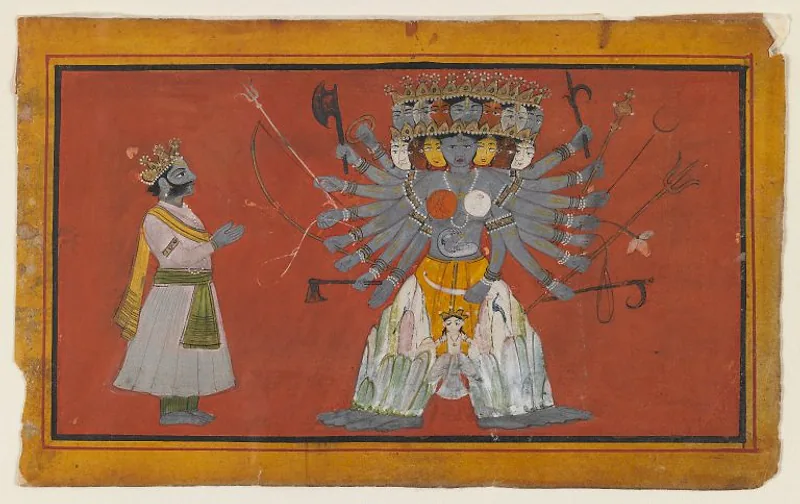
- Chapters 7–12 focus on God and devotion. Krishna reveals his nature as the source of all things, and in chapter 11 grants Arjuna a vision of his cosmic form (vishvarupa), blazing with countless faces and devouring the warriors; chapter 12 praises the devotee.
- Chapters 13–18 focus on knowledge and synthesis: the field and the knower of the field, the three qualities (gunas) of nature, the supreme person, divine and demonic temperaments, kinds of faith, and a final summary in chapter 18, after which Arjuna takes up his bow.
The vulgate text has 700 verses. A Kashmiri recension, commented on by Abhinavagupta, has some additional verses and variant readings.
Key Teachings: The Self, Duty and Action Without Attachment§
The Eternal Self§
Krishna first answers Arjuna's grief by teaching that the self (atman) is never born and never dies. As a person discards worn-out clothes and puts on new ones, the embodied self passes from body to body. Those who grieve over death therefore grieve over what is not real in the deepest sense; the doctrines of rebirth and liberation behind this teaching are explained in Dharma, Karma, Samsara and Moksha.
Svadharma and Selfless Action§
Krishna then appeals to Arjuna's own duty (svadharma) as a warrior: a just war is his obligation, and it is better to perform one's own duty imperfectly than another's well. The most famous teaching follows (2.47): one has a right to action alone, never to its fruits. Action as such cannot be abandoned, since nature compels every being to act; what binds is desire for results. Action performed as an offering, without selfish motive, does not bind. This is karma yoga, and the Gita presents Krishna himself as the model, since he acts constantly for the welfare of the world though he has nothing to gain.
The Avatar§
In chapter 4 Krishna declares that whenever dharma declines and adharma rises, he brings himself forth age after age to protect the good and destroy evildoers (4.7–8). This is the classic statement of the doctrine of divine descents (avatara) central to Vaishnavism.
The Paths of Knowledge, Meditation and Devotion§
The Gita does not present a single method but integrates several. Knowledge (jnana) of the distinction between the self and nature, and of the self's identity with Brahman, burns away the effects of action. Meditation, described in chapter 6, requires a steady seat, controlled senses and a mind fixed on the self, like a lamp in a windless place. Its relation to classical yoga is explored in Yoga Philosophy and Samadhi.

Above all, the Gita teaches devotion (bhakti) to a personal God who is both the transcendent source of the world and lovingly present to his devotees. Even a leaf, a flower, a fruit or water offered with love is accepted (9.26), and the path is open, the text says, to women and to members of lower classes as well as to Brahmins. In chapter 15 Krishna calls himself the supreme person (purushottama), beyond both the perishable and the imperishable. The final teaching (18.66), which Sri Vaishnavas call the "ultimate verse," urges Arjuna to abandon all dharmas and take refuge in Krishna alone, who will free him from all sins. The Gita thus laid foundations for the devotional movements described in The Bhakti Movement.
Classical Commentaries on the Gita§
Because Vedanta treats the Gita, the Upanishads and the Brahma Sutra as its three foundations (prasthanatraya), every major Vedantic teacher commented on it.
- Shankara (c. eighth century) wrote the earliest surviving commentary. Reading the Gita in the light of non-dualism, he argued that action purifies the mind but that liberation comes only through knowledge, which ultimately requires renunciation; see Adi Shankara.
- Ramanuja (traditionally 1017–1137) read it as teaching devotion to a personal Lord of whom souls and the world are the body, and saw surrender (prapatti) as the culmination.
- Madhva (thirteenth century) used it to support his dualist theology of the eternal difference between God and souls.
- Abhinavagupta wrote a short commentary from the perspective of Kashmiri non-dual Shaivism.
- Jnaneshvar retold and explained the Gita in Marathi verse in 1290, in the Jnaneshvari, one of the founding works of Marathi literature.
Later commentators include Shridhara Svamin and Madhusudana Sarasvati, who combined Advaita with intense devotion to Krishna.
The Bhagavad Gita in the Modern World§
The Gita was the first Sanskrit work translated directly into English, by Charles Wilkins in 1785, with a preface by Warren Hastings, Governor-General of Bengal. It was admired by German Romantics and by the American Transcendentalists Ralph Waldo Emerson and Henry David Thoreau, and the Theosophical Society promoted it widely. Edwin Arnold's verse translation The Song Celestial (1885) reached a large audience; Gandhi first read the Gita in that version as a law student in London.
In India the Gita became a charter for public action. Bal Gangadhar Tilak, imprisoned in Mandalay, wrote Gita Rahasya (published 1915), arguing that its message is energetic action rather than renunciation. Gandhi called it his "spiritual dictionary," translated it into Gujarati as Anasaktiyoga, "the yoga of non-attachment," and read Arjuna's battle as an allegory of the inner struggle, consistent with non-violence. Sri Aurobindo's Essays on the Gita presented it as a synthesis of yogas. Swami Vivekananda, the Ramakrishna Mission and, from 1966, the Hare Krishna movement, whose founder A. C. Bhaktivedanta Swami Prabhupada published Bhagavad-Gita As It Is, spread it worldwide.
The text has also been criticised. B. R. Ambedkar argued that it defends the hierarchy of the four classes, and others have questioned how a text set on a battlefield can be read as a gospel of non-violence. The physicist J. Robert Oppenheimer famously recalled a line from the vision of chapter 11, in which Krishna declares himself Time, the destroyer of worlds, after the first atomic test in 1945, a sign of how far the Gita had travelled.
Frequently asked questions§
How many chapters and verses are in the Bhagavad Gita?§
The standard text has eighteen chapters and 700 verses. Most verses are spoken by Krishna, with others by Arjuna, Sanjaya and Dhritarashtra. A Kashmiri recension contains a few additional verses.
What is the main message of the Bhagavad Gita?§
Its best-known teaching is that one should perform one's duty without attachment to the results, offering all actions to God. It also teaches the immortality of the self and presents knowledge, meditation and, above all, loving devotion to Krishna as paths to liberation.
Does the Bhagavad Gita encourage violence?§
Its setting is a war, and Krishna urges Arjuna to fight a war regarded as just and as his duty. Interpreters differ: some read it literally as a defence of righteous war, while Gandhi and many others read the battlefield as an allegory of the moral struggle within each person.
Sources and further reading§
- The Bhagavad-Gita: Krishna's Counsel in Time of War — Barbara Stoler Miller (trans.), 1986
- The Bhagavadgītā in the Mahābhārata — J. A. B. van Buitenen (trans.), 1981
- The Bhagavad Gita: A Biography — Richard H. Davis, 2015
- The Universal Gītā: Western Images of the Bhagavad Gītā — Eric J. Sharpe, 1985
- The Bhagavad Gita — Laurie L. Patton (trans.), 2008
- Essays on the Gita — Sri Aurobindo, 1922