Liber XVIII · Jainism · Chapter V: Mahavira & the Tirthankaras
Parshvanatha: The 23rd Tirthankara and the Serpent Canopy
Parshvanatha, the 23rd Jain Tirthankara: his life in Varanasi, the serpent Dharanendra and Padmavati, the four vows, his historicity and his temples.

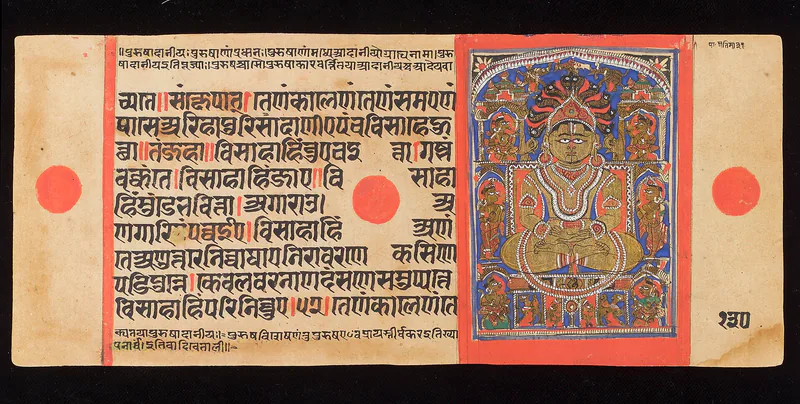
Parshvanatha, or Parshva, is the twenty-third Tirthankara ("ford-maker") of Jainism and the immediate predecessor of Mahavira. Jain tradition places his life in Varanasi about 250 years before Mahavira, and many historians accept that he was a real teacher of the early first millennium BCE. In art he is instantly recognisable by the hood of a many-headed serpent spread above his head, recalling the story of the snake king Dharanendra who sheltered him during his meditation.
Parshva in the Sequence of the Tirthankaras§
Jains believe that in each half of the cosmic cycle twenty-four Tirthankaras appear in our region of the world to re-establish the path to liberation, as explained in Mahavira and the 24 Tirthankaras and Jain Cosmology. Most of the earlier Tirthankaras are assigned immense lifespans and stand at vast distances of time from one another. Parshva is different: tradition gives him a human lifespan of one hundred years and places his liberation only 250 years before that of Mahavira, which yields traditional dates of roughly 877–777 BCE. If, as many historians now think, Mahavira lived later than the traditional date, Parshva would belong correspondingly later.
His emblem (lanchana) is the snake, his colour dark blue or green, and his attendant deities are the yaksha Dharanendra (also called Parshva) and the yakshi Padmavati, discussed in Jain Gods: Yakshas and Yakshis.
The Life of Parshvanatha According to Jain Tradition§
Birth and youth in Varanasi§
Parshva was born in Varanasi to King Ashvasena and Queen Vama. Like every Tirthankara's mother, Vama saw auspicious dreams before his birth; one account explains his name by her having seen a black serpent crawling at her side (parshva) during the pregnancy. The traditions differ about his youth: Shvetambara accounts say he married a princess, Prabhavati, while Digambaras hold that he remained unmarried.
The burning log§
The best-known episode of his youth concerns an ascetic named Kamatha who practised the austerity of the "five fires," sitting among four fires under the burning sun. Parshva, with his supernatural knowledge, perceived that a pair of snakes was trapped in one of the burning logs. He had the log split open and the dying snakes heard the salutation to the five supreme beings — the formula preserved in the Navkar Mantra. They were reborn as Dharanendra, king of the serpent deities, and his consort Padmavati. Kamatha, humiliated, nursed his anger.
Renunciation, the storm and omniscience§
At the age of thirty Parshva renounced the world. While he stood in meditation, Kamatha, now reborn as a god called Meghamalin, attacked him with a terrible storm and flood, intending to drown him. Dharanendra came to his aid, spreading his many hoods over the meditating Parshva as a canopy, while in many versions Padmavati raised him on a lotus or held an umbrella above him. Parshva remained unmoved, neither resisting nor resenting the attack, and soon afterwards attained omniscience. Tradition links the episode with Ahicchatra ("serpent canopy") in northern India. After seventy years of teaching he attained liberation on the summit of Sammeta Shikhara in present-day Jharkhand, still called Parasnath Hill after him and described in Jain Temples and Pilgrimage.
Ten births of enmity§
Jain biographies trace the conflict back through ten lives. In the first, Parshva's soul was Marubhuti and Kamatha was his elder brother, who killed him; in subsequent births as animals, kings and gods, Kamatha repeatedly harmed him while Parshva's soul answered with forbearance. The cycle illustrates Jain teaching on karma and on the way unresolved hatred binds souls together across lifetimes. The most famous Sanskrit treatment is Bhavadeva's Parshvanathacharitra of the thirteenth century, which Maurice Bloomfield summarised in English in 1919.
Was Parshvanatha a Historical Figure?§
Many scholars accept that Parshva was historical, and Hermann Jacobi was among the first to argue the case in the nineteenth century. The main evidence comes from the Jain canon itself:
- The Acaranga Sutra states that Mahavira's parents were followers of Parshva.
- The Uttaradhyayana Sutra (chapter 23) records a meeting between Keshi, a monk of Parshva's tradition, and Gautama, Mahavira's chief disciple, at which they reconcile differences between the two communities' rules on vows and clothing.
- The Bhagavati Sutra mentions monks of Parshva's lineage who joined Mahavira's order.
Buddhist texts also attribute a "fourfold restraint" (catuyama-samvara) to the Jain teacher, a term that fits the Jain memory of Parshva's teaching better than Mahavira's. Historians therefore suggest that Mahavira reformed an existing ascetic community rather than founding a new religion. Others caution that the canonical accounts were composed long afterwards, and that the evidence proves the existence of a tradition associated with Parshva rather than the details of his life.
The Fourfold Restraint and Mahavira's Reform§
According to the Uttaradhyayana, Parshva taught four vows: non-violence, truthfulness, not stealing and non-possession, with sexual restraint understood as part of non-possession. Mahavira made celibacy a separate fifth vow, a change explained in the dialogue between Keshi and Gautama: people of Parshva's time were straightforward and wise and needed fewer explicit rules, while those of Mahavira's age were more devious and needed everything spelt out. The same dialogue contrasts the clothed monks of Parshva with the unclothed discipline associated with Mahavira — a passage that Shvetambaras and Digambaras later read in different ways in their debates about ascetic nudity, described in Digambara and Shvetambara Jainism.
Parshvanatha in Art and Iconography§
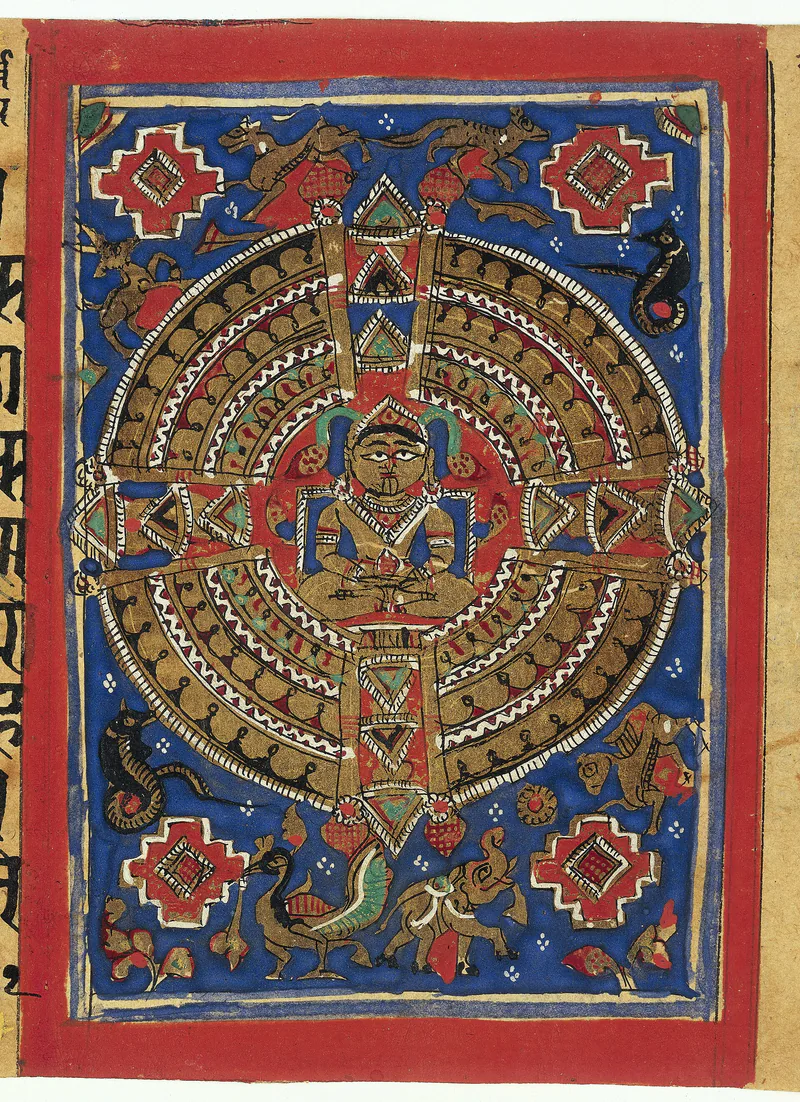
Images of Parshva are among the earliest Jain sculptures: stone figures from Kushan-period Mathura, in the first centuries CE, already show the serpent hood. He is usually shown standing in the posture of "abandoning the body" (kayotsarga) or seated in meditation, with a canopy of seven snake hoods; some images show nine, eleven or more. He can be distinguished from the seventh Tirthankara, Suparshva, who is often shown with five hoods or a single hood. In larger compositions the coils of Dharanendra form a seat or backrest, and Padmavati and Dharanendra stand at his sides.
Paintings in illustrated Kalpa Sutra manuscripts, described in The Jain Agamas, show his birth, his renunciation and the storm of Meghamalin, and the theme of the serpent-sheltered meditator has echoes in the Buddhist image of the Buddha protected by the serpent Mucalinda, an independent tradition discussed in Life of the Buddha.
Devotion to Parshvanatha and His Great Temples§
Parshva is the most widely worshipped Tirthankara in temple practice, and devotion to him is closely bound up with the cult of Padmavati, who is believed to protect his worshippers and grant worldly help. Many celebrated images bear epithets describing their miraculous character: Chintamani ("wish-jewel") Parshvanatha, Shankheshvara Parshvanatha in northern Gujarat, Stambhana Parshvanatha at Khambhat, Godiji Parshvanatha, and Antariksha ("in the air") Parshvanatha at Shirpur in Maharashtra, an image said to hover slightly above its base, long the subject of a dispute between Shvetambaras and Digambaras. Shvetambara tradition counts 108 famous Parshvanatha shrines.
Popular hymns to Parshva include the Uvasaggaharam Stotra ("hymn that removes calamities"), attributed to Bhadrabahu, and the Sanskrit Kalyanamandira Stotra, attributed by Shvetambaras to Siddhasena Divakara and by Digambaras to Kumudachandra. Both are recited for protection and well-being as well as for spiritual merit.
Frequently asked questions§
Who was Parshvanatha?§
He was the twenty-third Tirthankara of Jainism, born in Varanasi to King Ashvasena and Queen Vama according to tradition. He lived about 250 years before Mahavira and is regarded by many scholars as a historical teacher.
Why does Parshvanatha have a snake over his head?§
The hood recalls the serpent king Dharanendra, whom Parshva had saved in a previous existence as a snake. When the god Meghamalin attacked the meditating Parshva with a storm, Dharanendra spread his hoods over him as a shelter.
What did Parshvanatha teach?§
Jain sources say he taught the fourfold restraint: non-violence, truthfulness, not stealing and non-possession. Mahavira later added celibacy as a separate fifth vow.
Where did Parshvanatha attain liberation?§
Tradition places his liberation on Sammeta Shikhara in Jharkhand, a mountain now commonly called Parasnath Hill and one of the holiest Jain pilgrimage sites.
Sources and further reading§
- The Life and Stories of the Jaina Savior Parçvanatha — Maurice Bloomfield, 1919
- Jaina Sutras — Hermann Jacobi (trans.), 1884
- The Jains — Paul Dundas, 1992
- The Jaina Path of Purification — Padmanabh S. Jaini, 1979
- Jaina Iconography — Jyotindra Jain & Eberhard Fischer, 1978
- Framing the Jina: Narratives of Icons and Idols in Jain History — John E. Cort, 2010