Buddhist Symbols: The Dharma Wheel, Lotus, Stupa and Bodhi Tree
Buddhist symbols explained: the dharma wheel, lotus, Bodhi tree, footprints and stupa, the eight auspicious symbols, the swastika, vajra and Buddhist flag.

The main Buddhist symbols are the dharma wheel, which stands for the Buddha's teaching; the lotus, for purity and awakening; the Bodhi tree, for the Buddha's enlightenment; his footprints; and the stupa, the relic mound that represents the Buddha's presence and his final nirvana. Many of these signs were used to represent the Buddha himself in the earliest Buddhist art, and they were later joined by the eight auspicious symbols, ritual objects such as the vajra, and a modern Buddhist flag.
From Aniconic Signs to the Buddha Image§
The oldest surviving Buddhist sculpture, on the railings and gateways of stupas at Bharhut and Sanchi in central India (second to first century BCE), tells scenes from the life of the Buddha without showing him in human form. Where we would expect his figure, we find an empty throne under a parasol, a pair of footprints, a tree, a wheel or a horse without a rider. Images of the Buddha in human form appear only around the first century CE, in the regions of Gandhara and Mathura.
Art historians long explained this as deliberate "aniconism": the Buddha, having passed beyond the world, could not or should not be depicted. In 1990 the art historian Susan Huntington challenged this view, arguing that many such reliefs show pilgrims worshipping at sacred places rather than the Buddha himself. The debate continues, but either way these signs became the foundation of Buddhist visual language, as the comparative survey of religious symbols shows. The Buddha's bodily marks, such as the urna between the brows, have their own symbolism, discussed in the urna and inner sight.
The Dharma Wheel (Dharmachakra)§
The wheel (dharmachakra, Pali dhammacakka) is the most widespread emblem of Buddhism. Its meaning comes from the Buddha's first sermon at the Deer Park near Varanasi, traditionally titled the "Setting in Motion of the Wheel of the Dharma". The image draws on older Indian ideas of the chakravartin, the "wheel-turning" universal monarch whose sovereignty spreads in every direction like a rolling wheel: the Buddha is a spiritual sovereign whose teaching spreads in the same way.

Later commentators gave the parts of the wheel further meanings. Its eight spokes are most often linked to the Noble Eightfold Path; the hub to moral discipline, the spokes to wisdom and the rim to concentration; and wheels with twelve or twenty-four spokes to the links of dependent origination. These interpretations vary between traditions. In Tibet, a golden wheel flanked by two deer, recalling the Deer Park, crowns the roofs of monasteries. The wheel on the national flag of India derives from the pillars of the emperor Ashoka, whose lion capital at Sarnath once carried a large stone wheel.
The Lotus and the Bodhi Tree§
The lotus (padma) grows from the mud of ponds yet flowers unstained above the water. In Buddhist texts it illustrates how an awakened being lives in the world without being defiled by it, and how beings, like lotuses at different depths, are at different stages of readiness to hear the teaching. Buddhas and bodhisattvas are shown seated or standing on lotus thrones; the Lotus Sutra takes its name from the flower; and in Pure Land imagery beings are reborn from lotuses. Later traditions, especially in Tibet, associate lotuses of different colours with different qualities, though such schemes are not uniform.
The Bodhi tree, a pipal or sacred fig (Ficus religiosa), marks the place where the Buddha attained awakening at Bodh Gaya. Its heart-shaped leaves appear in early reliefs as a sign of the awakening itself. Descendants of the tree are venerated at Bodh Gaya and at Anuradhapura in Sri Lanka, and Bodhi trees are planted in monastery grounds across South and Southeast Asia. The sites connected with these symbols are described in Buddhist pilgrimage sites of the Buddha.
The footprints of the Buddha (buddhapada) are another ancient sign of his presence on earth. Carved examples often bear a wheel on each sole and, in later Southeast Asian versions, rows of auspicious marks. A natural depression on the summit of Sri Pada (Adam's Peak) in Sri Lanka is venerated by Buddhists as the Buddha's footprint, and by Hindus, Muslims and Christians as the footprint of Shiva or Adam.
The Stupa and Its Many Forms§
The stupa began as a hemispherical burial mound. According to the texts, the Buddha's relics were divided after his cremation and enshrined in such mounds, and the stupa became the central monument of Buddhist devotion. A classic Indian stupa has a solid dome (anda, "egg") on a base, a small railed enclosure on top (harmika), and a mast bearing tiers of parasols, symbols of honour. A railing and gateways enclose a path for walking around the monument clockwise, keeping it on one's right, the most basic act of Buddhist worship. The Great Stupa at Sanchi, begun in the third century BCE, is the best-preserved early example.
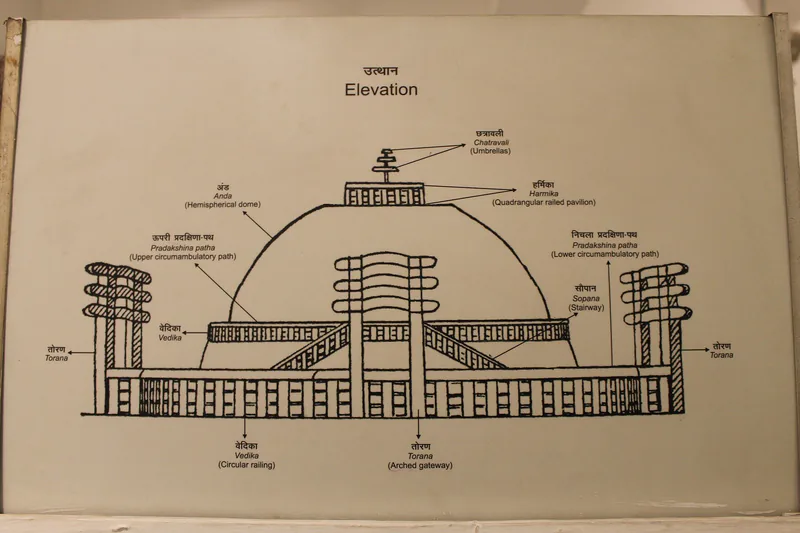
As Buddhism spread, the stupa took new forms: the bell-shaped dagoba of Sri Lanka, the tiered pagoda of China, Korea and Japan, the chedi of Thailand and the chorten of Tibet. Later Buddhist thought read the stupa as a symbol of the Buddha's awakened body and of the cosmos; in Tibetan chortens and in the Japanese five-element stupa (gorinto), stacked shapes correspond to earth, water, fire, wind and space. The monument of Borobudur in Java, built around 800 CE, combines the stupa with a cosmic diagram. Adrian Snodgrass's study of stupa symbolism traces these layers in detail.
The Eight Auspicious Symbols and the Swastika§
In Tibetan, Nepalese and Chinese Buddhism, a set of eight auspicious symbols (ashtamangala) is painted on walls, embroidered on banners and offered in ritual. In the usual Tibetan list they are the precious parasol, the pair of golden fish, the treasure vase, the lotus, the white right-coiling conch, the endless knot, the victory banner and the wheel. They are explained as offerings made to the Buddha at his awakening and as images of qualities of the teaching — the conch, for example, proclaiming the Dharma, and the endless knot expressing the interdependence of all things. Similar sets of auspicious signs are found in Jain and Hindu traditions, a reminder that Buddhism shared much of its visual vocabulary with other Indian religions.
The swastika (svastika, "conducive to well-being") is an ancient Indian sign of good fortune. In Buddhist art it can appear on the Buddha's chest or feet, and in East Asia the form 卍, read wan in Chinese and manji in Japanese, is a common mark of Buddhist temples, including on Japanese maps. Its twentieth-century appropriation by National Socialism has made it painful to Western viewers, but in Asia it keeps its Buddhist meaning.
Ritual Objects, the Buddhist Flag and Modern Symbols§
In Vajrayana Buddhism, the vajra, a sceptre representing the indestructible "diamond" or thunderbolt of awakening, is held in the right hand during ritual together with a bell in the left. The pair symbolises the union of compassionate method and wisdom. Prayer flags, prayer wheels, rosaries of 108 beads and the cosmic diagrams called mandalas belong to the same world of practice.
The international Buddhist flag is a modern creation. It was designed in Colombo, Sri Lanka, in 1885 by a committee of Buddhist leaders, with suggestions from the American Theosophist Henry Steel Olcott, whose role in the Sri Lankan revival is told in Theosophy in India. Its stripes of blue, yellow, red, white and orange are said to represent the colours of the aura that shone from the Buddha after his awakening. It was adopted by the World Fellowship of Buddhists in 1950 and is now flown at Buddhist events worldwide. In Zen, the ink-brushed circle, enso, has become a widely recognised symbol of the awakened mind.
Frequently asked questions§
What is the main symbol of Buddhism?§
The dharma wheel is the most widely used symbol of Buddhism as a whole, representing the Buddha's teaching set in motion at his first sermon. The lotus and the image of the seated Buddha are almost as common, and the stupa is the central Buddhist monument.
What do the eight spokes of the dharma wheel mean?§
They are most often interpreted as the eight elements of the Noble Eightfold Path: right view, intention, speech, action, livelihood, effort, mindfulness and concentration. Other interpretations exist, and wheels with different numbers of spokes are also found.
Why is there a swastika on Buddhist temples?§
The swastika is an ancient Indian sign of good fortune that Buddhism shares with Hinduism and Jainism. In East Asia it marks Buddhist temples and sacred texts. It has no connection with the Nazi use of the sign, which appropriated it in the twentieth century.
Sources and further reading§
- The Encyclopedia of Tibetan Symbols and Motifs — Robert Beer, 1999
- The Handbook of Tibetan Buddhist Symbols — Robert Beer, 2003
- Buddhist Symbols in Tibetan Culture — Dagyab Rinpoche, 1995
- The Symbolism of the Stupa — Adrian Snodgrass, 1985
- Buddhist Art and Architecture — Robert E. Fisher, 1993
- The Art of Ancient India: Buddhist, Hindu, Jain — Susan L. Huntington, 1985