Liber VIII · Eastern Mysticism · Chapter X: The Third Eye
The Urna and Inner Sight in Buddhism: The Brow and the Divine Eye
The urna between the Buddha's brows, its light in Mahayana sutras and art, the five eyes and the divine eye, and three-eyed deities of Vajrayana Buddhism.

The ūrṇā (Pali uṇṇā) is the small curl of white hair between the Buddha's eyebrows, one of the thirty-two marks of a "great man" in Buddhist tradition, shown in art as a dot, a raised circle or an inset jewel. It is often called the Buddha's "third eye", but Buddhist texts treat it as a sign of perfection and a source of light rather than an eye. Buddhist ideas of inner sight are expressed instead in teachings on the "divine eye", the "eye of wisdom" and the "eye of the dharma", and in the three-eyed deities of Vajrayāna art.
The Urna: One of the Thirty-Two Marks of a Great Man§
Early Buddhist texts describe the bodily signs of a mahāpuruṣa, a "great man" destined to become either a universal monarch or a fully awakened buddha. The Lakkhaṇa Sutta of the Dīgha Nikāya lists thirty-two such marks, including wheels on the soles of the feet, a golden complexion, a long tongue, and between the eyebrows a tuft of soft white hair like cotton. The text explains each mark as the fruit of particular virtuous deeds in the Buddha's former lives, so that the body of a buddha is itself a record of moral perfection.
The ūrṇā should not be confused with the uṣṇīṣa, the rounded protuberance on the top of the Buddha's head, which is another of the thirty-two marks and is often interpreted as a sign of transcendent wisdom. In Chinese the ūrṇā is called baihao ("white hair"), in Japanese byakugō, and in Tibetan mdzod spu. The lists of marks also passed into Mahāyāna literature, where they became part of the meditative visualisation of a buddha's body. For the wider doctrinal background see core teachings of Buddhism.
Light from Between the Brows in Mahayana Sutras§
Mahāyāna scriptures transformed the ūrṇā into a source of cosmic light. In the opening chapter of the Lotus Sūtra, the Buddha, seated in meditation on Vulture Peak, emits a ray of light from the white tuft between his eyebrows that illuminates eighteen thousand worlds to the east, revealing their buddhas, bodhisattvas and beings in every realm of rebirth. The bodhisattva Maitreya asks what this sign means, and Mañjuśrī explains that former buddhas sent out the same light before preaching this very sūtra. The light from the brow is thus a sign of revelation: it shows what ordinary sight cannot see.
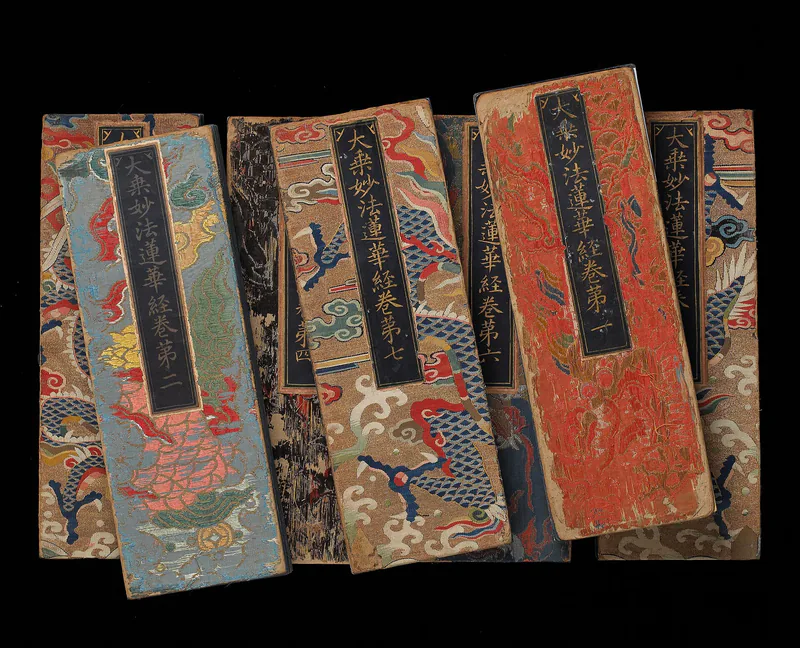
Similar scenes appear in other Mahāyāna sūtras, and the ūrṇā became central to Pure Land meditation. The Contemplation Sūtra (Guan Wuliangshou jing), a text of debated Central Asian or Chinese origin, instructs the practitioner who wishes to visualise Amitābha Buddha to begin with the white hair between his brows; when it is seen clearly, the other marks will appear of themselves. Here the ūrṇā is the doorway into the whole vision of the Buddha. See Pure Land Buddhism and Mahāyāna Buddhism.
The Urna in Buddhist Art: From Gandhara to Japan§
When images of the Buddha began to be made around the first century CE, in the Gandhāran region of the north-west and at Mathurā in northern India, sculptors had to decide how to show the marks. The ūrṇā appears on many early images as a small raised dot or circle on the brow, sometimes as a small hollow that may once have held an inlay. In later Indian, Southeast Asian and East Asian art it became standard, carved as a curl, painted as a dot or inset with rock crystal or another precious material that catches the light, as in many Japanese images.
The importance of the face and eyes in Buddhist images is shown by "eye-opening" rites. In 752 the colossal bronze Buddha of Tōdai-ji in Nara was consecrated in an eye-opening ceremony performed by the Indian monk Bodhisena, in which the eyes were painted in with a great brush. Comparable rites of consecration exist in Tibetan and Southeast Asian Buddhism, where painting or uncovering the eyes is the final act that turns an image into a living presence.
The Five Eyes: Kinds of Buddhist Seeing§
Buddhist texts describe sight in graded forms. A well-known list of "five eyes" appears in Mahāyāna sources such as the Diamond Sūtra, which affirms that the Tathāgata possesses all of them:
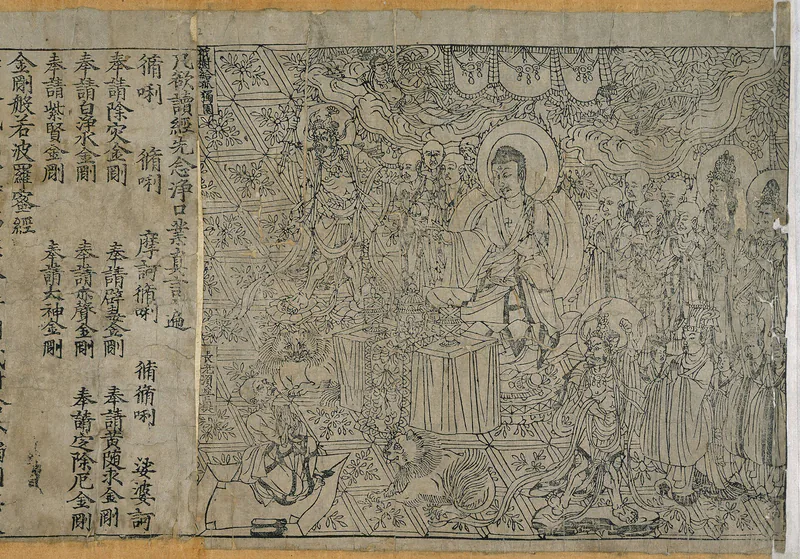
- The physical eye (māṃsa-cakṣus), ordinary sight.
- The divine eye (divya-cakṣus), which sees beyond ordinary distances and perceives beings dying and being reborn according to their deeds.
- The wisdom eye (prajñā-cakṣus), which sees that all things are empty of fixed self-nature.
- The dharma eye (dharma-cakṣus), the eye of the bodhisattva that knows the teachings and the needs of beings.
- The buddha eye (buddha-cakṣus), which sees all things completely.
Pali texts have a parallel list that differs in detail. In every version only the first is a physical organ; the others are capacities of a trained or awakened mind. None is located specifically on the forehead, although later popular writing sometimes equates the divine eye with the third eye.
The Divine Eye and the Eye of Dharma in Meditation§
The divine eye has a definite place in early Buddhist accounts of meditation. The Sāmaññaphala Sutta describes how a monk who has reached the fourth level of meditative absorption (jhāna) can direct his purified mind to various higher knowledges (abhiññā), among them the divine eye, "purified and surpassing the human", by which he sees beings passing away and reappearing according to their actions. In accounts of the Buddha's awakening, this knowledge arose in the second watch of the night, after the recollection of his own past lives and before the knowledge of the destruction of the defilements that constituted awakening itself.
The tradition is careful to rank these powers. The divine eye and the other "mundane" knowledges are possible for non-Buddhist yogins too, and they do not by themselves liberate. Buddhaghosa's fifth-century Visuddhimagga gives detailed methods for developing them but treats them as by-products of concentration. What liberates is insight. When the Buddha's first disciple, Kauṇḍinya, understood the first sermon, the texts say that "the dustless, stainless eye of the dharma" arose in him: he saw that whatever has the nature to arise also has the nature to cease. This dharma eye, the first glimpse of awakening, is the Buddhist "opening of the eye" par excellence, and it has nothing to do with visions.
Three-Eyed Deities and Watching Eyes in Vajrayana§
In tantric or Vajrayāna Buddhism the vertical third eye is common. Wrathful protectors such as Mahākāla, Yamāntaka and Palden Lhamo, and meditational deities such as Vajrayoginī and Hevajra, are usually shown with three eyes, signifying knowledge of past, present and future or awareness that sees through the three realms. White Tārā has seven eyes, on her forehead, palms and soles, to show her compassionate watchfulness. These images belong to a visualisation practice in which the meditator imagines himself or herself as the deity; the third eye is an attribute of the enlightened form being assumed. See Vajrayāna Buddhism.
The great stupas of Swayambhunath and Boudhanath in the Kathmandu Valley carry painted eyes on all four sides of the square block above the dome, looking out in every direction. Between and above them are a curled sign, often explained locally as the Nepali numeral one and so a symbol of unity, and a dot or third eye. Tibetan painters likewise paint the eyes of a deity last, as an act of consecration.
The Urna, the Third Eye and Western Interpretation§
Western popular writing often calls the ūrṇā the Buddha's "third eye" and links it to the ājñā chakra and the pineal gland. This is understandable, given its position, but it merges several distinct ideas. The ūrṇā is a hair, a mark of merit and a source of light; the divine eye is a knowledge without location; the third eyes of tantric deities belong to a visual language shared with Hindu iconography. The Western image of a Tibetan "third eye" opened by surgery, popularised in 1956 by the hoax author known as Lobsang Rampa, has no basis in Tibetan practice; it is examined in Theosophy, Lobsang Rampa and the Western third eye.
Chan and Zen traditions offer a final perspective. Dōgen's great work is titled Shōbōgenzō, "Treasury of the True Dharma Eye", after a Chan legend, first recorded in the Song dynasty, in which the Buddha silently holds up a flower and transmits the "true dharma eye" to his disciple Mahākāśyapa. For these traditions, the eye that matters is awakened mind itself. On the comparative picture, see the third eye: history and meaning.
Frequently asked questions§
What is the dot on the Buddha's forehead?§
It is the ūrṇā, a curl of white hair between the eyebrows that is one of the thirty-two marks of a buddha. In sculpture it is shown as a dot, a raised curl or an inset jewel, and in Mahāyāna sūtras it emits light that reveals other worlds.
Did the Buddha have a third eye?§
Buddhist texts do not describe the ūrṇā as an eye. They do speak of a "divine eye" and other kinds of higher seeing developed through meditation, and many tantric Buddhist deities are depicted with a third eye on the forehead.
What are the five eyes in Buddhism?§
They are the physical eye, the divine eye, the wisdom eye, the dharma eye and the buddha eye, a list found in the Diamond Sūtra and other sources. Only the first is a physical organ; the others are capacities of an increasingly awakened mind.
What is the difference between the urna and the ushnisha?§
The ūrṇā is the white tuft between the eyebrows; the uṣṇīṣa is the protuberance on the crown of the head. Both are among the thirty-two marks of a great man.
Sources and further reading§
- The Long Discourses of the Buddha: A Translation of the Digha Nikaya — Maurice Walshe, 1987
- The Lotus Sutra — Burton Watson, 1993
- The Path of Purification (Visuddhimagga) — Buddhaghosa, 1956
- Mahayana Buddhism: The Doctrinal Foundations — Paul Williams, 1989
- Indo-Tibetan Buddhism: Indian Buddhists and Their Tibetan Successors — David Snellgrove, 1987
- The Princeton Dictionary of Buddhism — Robert E. Buswell Jr. and Donald S. Lopez Jr., 2014
- The Encyclopedia of Tibetan Symbols and Motifs — Robert Beer, 1999