Liber IV · Buddhism · Chapter IX: Theravada
Buddhaghosa and the Visuddhimagga: The Path of Purification
Buddhaghosa and the Visuddhimagga explained: the fifth-century commentator, his Path of Purification, its forty meditation subjects and its role in Theravada.

Buddhaghosa was an Indian monk of the fifth century CE who settled in Sri Lanka and became the most important commentator in Theravada Buddhism. His Visuddhimagga, "The Path of Purification", is a comprehensive manual of Buddhist doctrine and meditation organised around virtue, concentration and wisdom, and it has served for some fifteen centuries as the standard Theravada account of the path to nirvana.
Buddhaghosa: The Life of a Commentator§
What is known of Buddhaghosa comes chiefly from a late source, the continuation of the Sri Lankan chronicle known as the Culavamsa, compiled many centuries after his time, and from brief remarks in his own works. According to the chronicle, he was born a brahmin near the site of the Buddha's awakening at Bodh Gaya, learned in the Vedas and skilled in debate, and was converted to Buddhism by an elder named Revata. Learning that the Buddhist commentaries survived complete only in Sinhala, he travelled to Sri Lanka during the reign of King Mahanama, usually dated to the early fifth century, and lodged at the Mahavihara, the "Great Monastery" of Anuradhapura.
The chronicle relates that the elders tested him by giving him two verses on which to comment. In response he composed the Visuddhimagga. Twice, the story goes, the gods hid his manuscript to prove his learning, and twice he wrote it again; when the three copies were compared they agreed word for word. Satisfied, the elders gave him access to their commentaries. The story is legend, but it captures how later Theravadins saw him: as a faithful transmitter of tradition rather than an innovator. A later Burmese tradition claimed him as a native of lower Burma, and he has been honoured throughout the Theravada world.
The Commentaries and the Mahavihara Tradition§
Buddhaghosa's main work was to render into Pali the older commentaries (atthakatha) that had been preserved in Sinhala, editing and harmonising them. The works most securely attributed to him include the Samantapasadika on the monastic code, commentaries on the four principal collections of discourses — the Sumangalavilasini, Papañcasudani, Saratthappakasini and Manorathapurani — and commentaries on parts of the Abhidhamma such as the Atthasalini. Other commentaries, including those on the Dhammapada and the Jataka, were later attributed to him, but most scholars think they were produced by others in the same period.
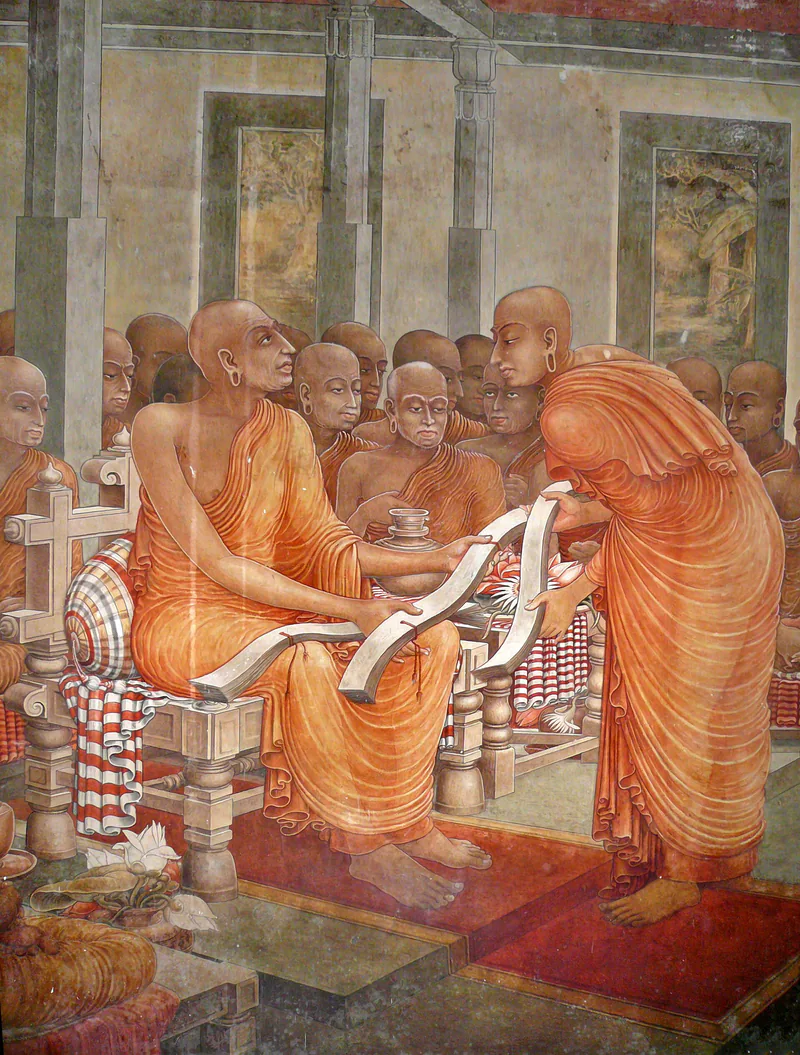
The effect of this work was to fix the interpretation of the Pali Canon according to the lineage of the Mahavihara. In Buddhaghosa's day the Mahavihara had rivals in Anuradhapura, notably the Abhayagiri monastery, which was more open to Mahayana ideas. The eventual triumph of the Mahavihara, confirmed by royal reforms in the twelfth century, made Buddhaghosa's commentaries the authoritative lens through which Theravadins read the canon. Successors such as Dhammapala continued the work.
An earlier manual with a very similar structure, the Vimuttimagga ("Path of Freedom") attributed to Upatissa, survives in a sixth-century Chinese translation. Buddhaghosa appears to know and occasionally to disagree with views found in it, which suggests that he drew on an existing genre of path manuals and reshaped it according to Mahavihara orthodoxy.
The Structure of the Visuddhimagga§
The Visuddhimagga is built as a long commentary on a single verse from the Connected Discourses, in which the Buddha says that a wise monk, established in virtue and developing mind and understanding, can disentangle the "tangle" of craving within and without. Buddhaghosa reads the verse as naming the three trainings, which give the book its three parts:
- Virtue (sila, chapters 1–2): the purity of moral conduct and monastic discipline, including thirteen optional ascetic practices (dhutanga) such as living at the foot of a tree, eating one meal a day or wearing robes made from discarded rags.
- Concentration (samadhi, chapters 3–13): the cultivation of meditative absorption and the powers that may follow from it.
- Wisdom (pañña, chapters 14–23): the understanding of the aggregates, sense bases, elements, the Four Noble Truths and dependent origination, and the insight knowledges that culminate in awakening.
Within this frame the work also follows the "seven purifications" drawn from the Rathavinita Sutta, in which a series of chariots carries a king from one place to the next: purification of virtue, of mind, of view, by overcoming doubt, by knowledge of what is and is not the path, by knowledge of the way, and finally by knowledge and vision itself. Each purification serves the next, as each chariot carries the traveller only to the following stage.
The Forty Meditation Subjects and the Jhanas§
The concentration section is the most detailed account of meditation in classical Theravada, and is often consulted in discussions of meditation in Asian traditions generally. Buddhaghosa lists forty meditation subjects (kammatthana):
- ten kasinas, coloured or elemental discs — earth, water, fire, air, blue, yellow, red, white, light and space — used as objects of gaze and then visualised;
- ten kinds of foulness, the stages of a decaying corpse, traditionally contemplated in charnel grounds;
- ten recollections, including those of the Buddha, the Dharma, the Sangha, death, the body and breathing;
- the four "divine abodes" of loving-kindness, compassion, sympathetic joy and equanimity;
- the four formless attainments, the perception of the repulsiveness of food, and the analysis of the four elements.
He advises the teacher to match subjects to the student's temperament: foulness for those inclined to greed, loving-kindness for those inclined to hatred, breathing for the restless, the recollection of the Buddha for the devout. Through these practices the meditator develops "access" concentration and then the meditative absorptions (jhanas), whose factors he analyses with care.
Chapters twelve and thirteen describe the supernormal powers (abhiñña) that can follow mastery of the fourth jhana: multiplying the body, passing through walls, walking on water and travelling through the air, the "divine ear", knowledge of others' minds, recollection of past lives, and the "divine eye" that sees beings dying and being reborn according to their karma. Buddhaghosa presents these as real but secondary attainments, and the tradition consistently warns that they can become obstacles if pursued for their own sake. His account belongs with wider Indian discussions of meditative powers, compared in yoga philosophy and samadhi.
Wisdom, Insight and the Stages of Awakening§
The third part turns from calm to insight. Buddhaghosa analyses experience into the five aggregates, twelve sense bases and eighteen elements, and devotes the long seventeenth chapter to dependent origination, giving the classic explanation of its twelve links across three lifetimes.
He then sets out a progression of insight knowledges (ñana): seeing mind and matter as distinct, discerning their conditions, perceiving the rise and fall of phenomena, seeing their dissolution, experiencing them as fearful, dangerous and to be escaped, reaching equanimity towards all formations, and finally the moment of "change of lineage" in which the mind takes nirvana as its object. This breakthrough, the path moment, occurs four times in the career of a practitioner, marking the four stages of awakening: stream-entry, once-returning, non-returning and arahantship. The Visuddhimagga thus offers a complete map from the first moral precepts to final liberation.
The Visuddhimagga in Modern Theravada§
For centuries the Visuddhimagga was studied in the monasteries of Sri Lanka, Burma, Thailand, Laos and Cambodia, often with sub-commentaries and vernacular translations, as part of the scholarly curriculum of monastic life. In the nineteenth and twentieth centuries it gained new importance. Burmese teachers such as Ledi Sayadaw and Mahasi Sayadaw built lay meditation movements around its stages of insight, and the Pa Auk tradition teaches its concentration practices, including the kasinas, in detail. The Thai forest tradition, by contrast, has sometimes favoured direct reading of the suttas and the guidance of living teachers.
The book entered Western languages through Pe Maung Tin's translation for the Pali Text Society (1923–1931) and Bhikkhu Ñanamoli's translation of 1956, which remains standard. It is now a focus of debate among practitioners and scholars: some argue that its systematic account of jhana and insight differs from the earlier discourses, while others defend it as a faithful elaboration. Scholars such as Maria Heim have also drawn attention to Buddhaghosa as a subtle thinker on intention, emotion and the reading of scripture, rather than merely a compiler.
Frequently asked questions§
What does Visuddhimagga mean?§
Visuddhimagga is Pali for "The Path of Purification". The title refers to the purification of the mind from defilements, achieved through virtue, concentration and wisdom, which Buddhaghosa presents as the path to nirvana.
When did Buddhaghosa live?§
Buddhaghosa is usually dated to the first half of the fifth century CE. Sri Lankan tradition places his arrival in the reign of King Mahanama of Anuradhapura, though the exact dates of that reign, and of Buddhaghosa's life, are uncertain.
What are the forty meditation subjects?§
They are the forty objects of meditation listed in the Visuddhimagga: ten kasinas, ten stages of foulness, ten recollections, four divine abodes, four formless states, the perception of the repulsiveness of food and the analysis of the elements. Teachers assign them according to the student's temperament.
Is the Visuddhimagga part of the Pali Canon?§
No. It is a post-canonical work, a commentarial manual composed around 800 to 900 years after the Buddha. In Theravada countries it nevertheless carries great authority as the standard interpretation of the canon's teachings on practice.
Sources and further reading§
- The Path of Purification (Visuddhimagga) — Buddhaghosa, 1956
- The Path of Freedom (Vimuttimagga) — Upatissa, 1961
- The Forerunner of All Things: Buddhaghosa on Mind, Intention, and Agency — Maria Heim, 2014
- Pali Literature — K. R. Norman, 1983
- Theravada Buddhism: A Social History from Ancient Benares to Modern Colombo — Richard Gombrich, 1988
- Theravada Buddhism: Continuity, Diversity, and Identity — Kate Crosby, 2014