Liber IV · Buddhism · Chapter IX: Theravada
Emperor Ashoka and the Spread of Buddhism: Edicts and Legend
Emperor Ashoka and Buddhism: the Kalinga war, his edicts on Dhamma, stupas and the Third Council, Mahinda's mission to Sri Lanka, and the Ashoka legend.

Ashoka (reigned c. 268–232 BCE) was the third emperor of the Maurya dynasty of India, whose rule over most of the subcontinent made him the most powerful patron early Buddhism ever had. His inscriptions, carved on rocks and pillars, describe his remorse after a bloody war and his commitment to Dhamma, a moral law of non-violence and tolerance; Buddhist chronicles add that he sponsored a council of monks and sent missionaries abroad, including to Sri Lanka, where Theravada Buddhism took root.
Ashoka and the Maurya Empire§
The Maurya dynasty was founded around 321 BCE by Chandragupta, who built an empire across northern India in the generation after Alexander the Great's invasion of the north-west. His son Bindusara extended it, and Ashoka, Bindusara's son, succeeded him around 268 BCE after what Buddhist sources describe as a struggle among the princes. From the capital at Pataliputra, modern Patna, Ashoka ruled territory stretching from Afghanistan to Bengal and deep into the south.
For centuries Ashoka was remembered only through Buddhist texts. Modern knowledge of the historical emperor began in 1837, when the British scholar James Prinsep deciphered the Brahmi script of inscriptions issued by a king called Devanampiya Piyadasi, "Beloved of the Gods, of Gracious Mien". The identification of this king with the Ashoka of Buddhist tradition, long suspected, was confirmed in 1915 when an inscription found at Maski in southern India was shown to name him as Ashoka.
The Kalinga War and Ashoka's Conversion§
The most famous of Ashoka's inscriptions, the thirteenth Major Rock Edict, looks back on the conquest of Kalinga, on India's east coast, in the eighth year after his consecration. It records that 150,000 people were deported, 100,000 killed and many times that number died, and it expresses the king's deep regret for the suffering of the conquered, including the pious people of every sect. Ashoka declares that the best conquest is conquest by Dhamma, and he names five Hellenistic kings, among them rulers of Syria, Egypt and Macedonia, as recipients of his Dhamma envoys. Strikingly, this edict was not inscribed in Kalinga itself; there Ashoka set up separate edicts urging his officials to treat the population justly.

In a Minor Rock Edict, Ashoka states that he had been a Buddhist lay follower (upasaka) for more than two and a half years without much zeal, but that after drawing close to the monastic community (Sangha) for over a year he had become ardent. Historians generally see his turn to Buddhism as gradual rather than a sudden conversion, and note that the edicts never mention Buddhism in his account of Kalinga. Later Buddhist legend dramatised the change, depicting a cruel "Fierce Ashoka" transformed into the "Righteous Ashoka".
The Edicts of Ashoka and the Meaning of Dhamma§
Ashoka's inscriptions fall into several groups: fourteen Major Rock Edicts, several Minor Rock Edicts, seven Pillar Edicts and a few others, found at more than thirty sites. Most are in Prakrit dialects in Brahmi script; in the north-west they use the Kharoshthi script, and near Kandahar in Afghanistan they appear in Greek and Aramaic. They are personal in tone, often speaking in the king's own voice.
The Dhamma they promote is a broad public ethic rather than a statement of Buddhist doctrine. The edicts urge obedience to parents, generosity to Brahmins and ascetics, kindness to servants and slaves, truthfulness and moderation. Ashoka restricted the killing of animals, beginning with his own kitchens, banned certain sacrifices and festive gatherings, and listed protected species. He records planting shade trees and digging wells along roads and providing medical care for humans and animals. He created a new class of officials, the "Dhamma ministers", to promote welfare and harmony among all religious groups, and the twelfth Rock Edict asks people to honour other sects, since by doing so they honour their own.
A few inscriptions are explicitly Buddhist. One, found at Bairat in Rajasthan, addresses the Sangha and recommends seven texts for monks, nuns and lay followers to study; scholars have tried to identify them with passages in the Pali Canon. The so-called Schism Edicts, at Sarnath, Sanchi and Kaushambi, warn that monks or nuns who divide the Sangha are to be made to wear white robes and leave the community.
Stupas, Pillars and the Third Buddhist Council§
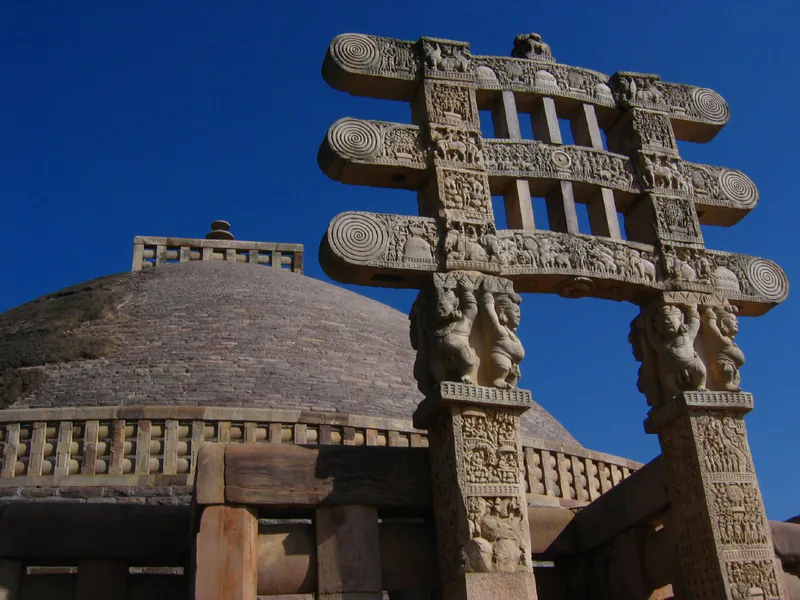
Ashoka's patronage left a physical mark on the Buddhist landscape. He erected polished sandstone pillars, some topped with animal capitals, at sites linked to the Buddha's life; the pillar at Lumbini records his visit in the twentieth year of his reign and the reduction of the village's taxes, as described in Buddhist pilgrimage sites of the Buddha. The core of the Great Stupa at Sanchi and its pillar date from his reign. Buddhist legend says he opened the original relic mounds and redistributed the Buddha's relics into 84,000 stupas — a symbolic number, but one that reflects the real spread of relic shrines in this period, whose meaning is discussed in Buddhist symbols.
The Pali chronicles of Sri Lanka, the Dipavamsa and the later Mahavamsa, add that the Sangha had become corrupted by monks who joined for the sake of royal support. Ashoka, they say, invited the elder Moggaliputta Tissa to purify it, and a Third Council was held at Pataliputra around 250 BCE, at which dissenters were expelled, the teaching of the Vibhajjavada ("doctrine of analysis") was affirmed and the Kathavatthu, a book of the Abhidhamma refuting heterodox views, was compiled. Northern Buddhist sources and Ashoka's own inscriptions do not mention this council, and many historians regard it as an event within the lineage that became Theravada, rather than an assembly of all Buddhists.
Missions Abroad: Mahinda, Sanghamitta and Sri Lanka§
According to the same chronicles, after the council monks were sent to nine regions inside and beyond India, including Gandhara, the Himalayan region and Suvannabhumi, the "Land of Gold", which Burmese and Thai tradition identify with their own countries. The most consequential mission went to Sri Lanka under Mahinda, described as Ashoka's son, who converted King Devanampiya Tissa of Anuradhapura. Mahinda's sister, the nun Sanghamitta, followed, founding the island's order of nuns and bringing a cutting of the Bodhi tree under which the Buddha attained awakening. The Sri Maha Bodhi tree at Anuradhapura, venerated as that cutting, is regarded as one of the oldest historically recorded trees in the world.
How much of this account is historical is debated. The edicts confirm that Ashoka sent envoys abroad and mention Tamraparni, probably Sri Lanka, but say nothing of Mahinda. Still, archaeology confirms that Buddhism reached Sri Lanka early, and the story of royal missionaries became the founding narrative of Sri Lankan Buddhism and of the close bond between monarchy and Sangha described in Buddhist monastic life.
Ashoka in Legend and Memory§
Two great bodies of legend developed around Ashoka. The Pali chronicles present him as the ideal patron who purified the Sangha. The Sanskrit Ashokavadana, probably compiled in the second century CE, tells how, in a former life, he was a small boy who offered a handful of dust to the Buddha as if it were food, and so was destined to rule; how he built a torture prison before his conversion by a monk who could not be harmed; how he was guided by the monk Upagupta; and how, at the end of his life, stripped of power by his ministers, he could give the Sangha only half a myrobalan fruit. The historian of religion John Strong has shown how these stories explored the relation between kingship, merit and the Dharma.
Ashoka became the model of the righteous Buddhist ruler, the dhammaraja, for kings in Sri Lanka, Burma, Thailand and beyond, and was invoked by Chinese emperors who patronised Buddhism. In modern India, his lion capital from Sarnath was adopted as the national emblem in 1950, and the twenty-four-spoked wheel from his pillars stands at the centre of the national flag. For the history of the religion as a whole, see What is Buddhism?.
Frequently asked questions§
Why is Ashoka important in Buddhism?§
Ashoka was the first great ruler to patronise Buddhism on an imperial scale. His support for monasteries, stupas and missions helped turn a regional movement into a religion spread across India and beyond, and later Buddhists remembered him as the model of a righteous king.
Did Ashoka really convert after the Kalinga war?§
His own thirteenth Rock Edict expresses remorse for the Kalinga war and a commitment to Dhamma, and another edict says he became a zealous lay Buddhist. Most historians see a gradual development rather than a single conversion, and the dramatic transformation of "Fierce Ashoka" belongs to later legend.
Where can Ashoka's edicts be seen today?§
Inscriptions survive at sites across India, Nepal, Pakistan and Afghanistan, including Girnar in Gujarat, Dhauli in Odisha, Lumbini in Nepal and Sarnath. Several pillars and the Sarnath lion capital are preserved on site or in museums.
Sources and further reading§
- Asoka and the Decline of the Mauryas — Romila Thapar, 1961
- The Legend of King Asoka: A Study and Translation of the Asokavadana — John S. Strong, 1983
- Ashoka in Ancient India — Nayanjot Lahiri, 2015
- Ashoka: The Search for India's Lost Emperor — Charles Allen, 2012
- Reimagining Asoka: Memory and History — Patrick Olivelle, Janice Leoshko and Himanshu Prabha Ray (eds.), 2012
- Ashoka: Portrait of a Philosopher King — Patrick Olivelle, 2023
- The Mahavamsa, or the Great Chronicle of Ceylon — Wilhelm Geiger (trans.), 1912