Liber IV · Buddhism · Chapter II: Buddhist Cosmology
Maitreya, the Future Buddha: Prophecy, Art and Millenarian Hope
Maitreya, the future Buddha: his place in Buddhist cosmology, the Tushita heaven, Mahayana devotion, his images, the Laughing Buddha and millenarian hopes.

Maitreya (Pali Metteyya, "the Benevolent One") is the bodhisattva who, according to Buddhist tradition, will be the next buddha of our world, appearing in a distant future when the teaching of the present Buddha, Shakyamuni, has been forgotten. Recognised by every major school, he is believed to wait in the Tushita heaven, and his expected coming has inspired devotion, monumental art and, at times, millenarian movements that hoped to hasten a new age.
Maitreya in the Pali Canon and Early Buddhism§
Buddhist tradition teaches that buddhas arise one after another across immense spans of time, each rediscovering the path after the previous teaching has vanished, as described in Buddhist cosmology. Shakyamuni was preceded by earlier buddhas and will be followed by Maitreya.
The only reference to Metteyya in the Pali discourses comes in the Cakkavatti-sihanada Sutta (Digha Nikaya 26), a sermon on moral decline and renewal. It describes how human morality and lifespan will dwindle until people live only ten years, followed by a violent collapse; the survivors will then turn to virtue, and lifespan will grow again to 80,000 years. In that age a righteous universal monarch named Sankha will rule from the city of Ketumati, on the site of Varanasi, and the Buddha Metteyya will appear, leading a community of monks numbering in the thousands. Later Pali works, notably the Anagatavamsa ("Chronicle of the Future"), expanded the prophecy with details of his birth, renunciation and awakening.
A popular legend links the two buddhas directly. Before his death the Buddha's disciple Mahakashyapa is said to have entered meditation inside a mountain, holding Shakyamuni's robe, to hand it on to Maitreya when he comes. The story expresses the idea of an unbroken succession of teachers across the ages.
The Tushita Heaven and the Coming Age of Maitreya§
Like Shakyamuni before his last birth, Maitreya is believed to reside in the Tushita ("Contented") heaven, one of the heavens of the desire realm, where bodhisattvas spend their penultimate life. In the Sutra on the Descent of Maitreya and related texts, preserved in Sanskrit fragments and several Chinese versions, his world is described as an age of abundance: the earth is level and fertile, people live long and peaceful lives, and the Dharma is taught again at three great assemblies under a "dragon-flower" tree, where countless beings attain awakening.
Two forms of hope grew from these texts. One looked to rebirth in Tushita now, in Maitreya's presence, so as to descend with him and hear his teaching. The other looked forward to his eventual descent to earth. In fourth- and fifth-century China, the scholar-monk Daoan and his circle vowed to be reborn in Tushita, and the pilgrim Xuanzang is reported to have shared the aspiration. For several centuries this devotion rivalled the cult of Amitabha's paradise, until the latter, described in Pure Land Buddhism, became dominant in East Asia.
The timescale of Maitreya's arrival in traditional calculations is vast — one widely repeated figure is 5,670 million years after Shakyamuni's death. In the hands of later movements, however, this distant future could be brought dramatically closer.
Maitreya in Mahayana Sutras and Devotion§
In Mahayana scriptures Maitreya appears frequently as a bodhisattva in the Buddha's audience. At the opening of the Lotus Sutra he asks Manjushri to explain the miraculous light the Buddha has emitted, and in other sutras he is a model of the bodhisattva who has completed the path and awaits only the right moment for buddhahood.
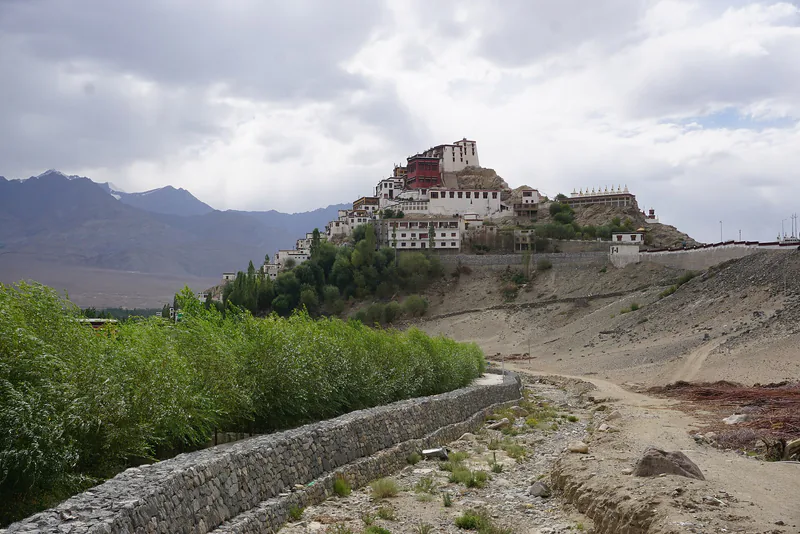
He also has a special place in philosophy. According to tradition, Asanga, a founder of the Yogacara school, received five treatises from Maitreya in the Tushita heaven, which Tibetan Buddhism still studies under his name. In Tibet, Maitreya (Jampa) is honoured in festivals in which his image is carried around monasteries, an act believed to hasten his coming, and many monasteries house large statues of him.
Maitreya in Art: Pensive Bodhisattvas, Giant Statues and the Laughing Buddha§
Maitreya is one of the earliest bodhisattvas to be represented in sculpture. In the art of Gandhara and Mathura in the first centuries CE he appears as a princely figure, often holding a water flask, the attribute of a Brahmin ascetic. Later he is frequently shown seated on a throne with both legs hanging down, a posture associated with his readiness to descend into the world.
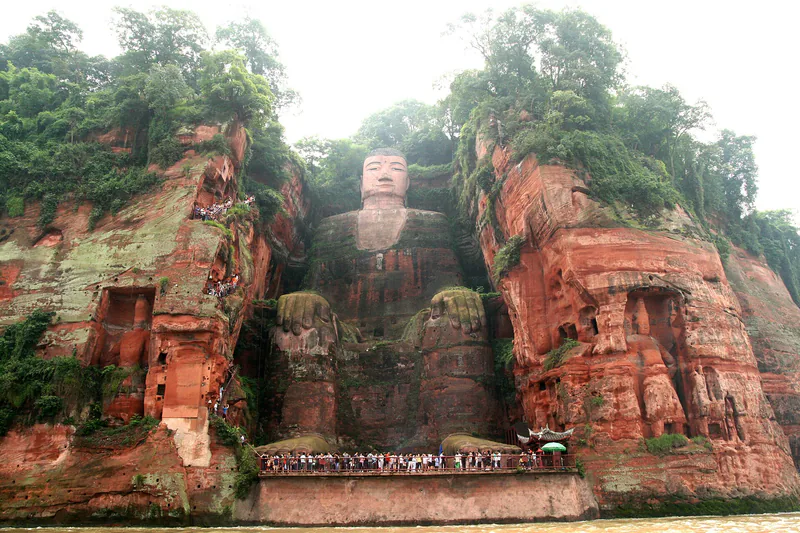
In sixth- and seventh-century Korea and Japan, a group of serene "pensive bodhisattvas", seated with one leg crossed over the other and a finger raised to the cheek, are commonly identified as Maitreya; the gilt-bronze examples in the National Museum of Korea and the wooden figure at Koryuji in Kyoto are among the most celebrated works of Buddhist art. Giant images expressed his cosmic stature: the Leshan Giant Buddha in Sichuan, carved into a cliff in the eighth century, represents Maitreya, and a monumental gilded statue was erected at Tashilhunpo monastery in Tibet in the early twentieth century.
The most familiar image of Maitreya in Chinese culture is quite different. Budai ("Hemp Sack"), an eccentric monk of the early tenth century who wandered with a cloth bag, came to be regarded as an incarnation of Maitreya after his death. His jovial, pot-bellied figure — the "Laughing Buddha" — greets visitors at the entrance hall of many Chinese temples and became a popular symbol of contentment and abundance, as noted in the survey of Chinese gods and popular religion.
Millenarian Movements in China and Korea§
Because Maitreya's age promised a renewed and just world, his name could become a banner for those who believed the present order corrupt. In 515 a monk named Faqing led a rebellion in northern China proclaiming that a new buddha had appeared. The Empress Wu Zetian, who founded her own dynasty in 690, was presented by supporting monks as a ruler foretold in Buddhist scripture, and associated with Maitreya.
From the Song dynasty onward, movements that later authorities grouped under the name "White Lotus" combined Maitreya expectation with other beliefs. In 1351 the Red Turban rising, one of whose leaders proclaimed that Maitreya had descended, helped to bring down the Mongol Yuan dynasty; the founder of the Ming dynasty rose to power through its armies, though he later suppressed such sects. Imperial governments thereafter treated Maitreya teachings as subversive, and further uprisings, including the White Lotus Rebellion of 1796–1804, invoked his coming. Historians stress that "White Lotus" was often a label applied by officials rather than the name of one organised religion.
In Korea, the warlord Gung Ye, who founded a short-lived kingdom around 901, proclaimed himself Maitreya, and Maitreya (Mireuk) beliefs later fed into popular and new religious movements.
Maitreya in Japan and in Modern Religion§
In Japan, Maitreya (Miroku) was connected with mountain religion and with Kukai, the founder of Shingon Buddhism, who according to legend did not die in 835 but entered eternal meditation on Mount Koya to await Miroku's descent. In the Edo period the idea of a "world of Miroku", a time of renewal and plenty, appeared in popular religion and in the cult of Mount Fuji.
In the twentieth century the figure was adopted outside Buddhism. The Theosophical Society taught that the "Lord Maitreya" was the World Teacher who would manifest through a human vehicle, a role in which Theosophical leaders cast the young Jiddu Krishnamurti until he renounced it in 1929, as told in Krishnamurti and the Order of the Star. Several Chinese and Vietnamese new religions also speak of a coming age associated with Maitreya. Within Buddhism, modern teachers often interpret Maitreya ethically, as a call to cultivate the loving-kindness (maitri) from which his name derives.
Frequently asked questions§
Who is Maitreya in Buddhism?§
Maitreya is the bodhisattva who, according to Buddhist tradition, will become the next buddha of our world after Shakyamuni's teaching has disappeared. He currently resides in the Tushita heaven. All the main Buddhist traditions recognise him, though they emphasise him differently.
Is the Laughing Buddha the same as Maitreya?§
In Chinese tradition, yes, in a sense. The Laughing Buddha is Budai, a tenth-century Chan monk later believed to have been an incarnation of Maitreya. He is distinct from the historical Buddha, Shakyamuni, with whom he is sometimes confused in the West.
When will Maitreya come?§
Traditional texts place his coming in the very distant future, after a long decline and renewal of human life; one common figure is billions of years after Shakyamuni. Millenarian movements in China and elsewhere claimed his advent was imminent, but mainstream Buddhist teaching does not set a near date.
Sources and further reading§
- Maitreya, the Future Buddha — Alan Sponberg and Helen Hardacre (eds.), 1988
- Once Upon a Future Time: Studies in a Buddhist Prophecy of Decline — Jan Nattier, 1991
- Folk Buddhist Religion: Dissenting Sects in Late Traditional China — Daniel L. Overmyer, 1976
- Millenarian Rebellion in China: The Eight Trigrams Uprising of 1813 — Susan Naquin, 1976
- The Long Discourses of the Buddha: A Translation of the Digha Nikaya — Maurice Walshe, 1995
- Buddhist Cosmology: Philosophy and Origins — Akira Sadakata, 1997