Liber IV · Buddhism · Chapter II: Buddhist Cosmology
Buddhist Hells and Hungry Ghosts: Naraka, Pretas and Yama
Buddhist hells and hungry ghosts explained: the hot and cold narakas, Yama and the Ten Kings, the pretas, Mulian and the Ghost Festival, and hells in art.

In Buddhist cosmology the hells (Sanskrit naraka, Pali niraya) and the realm of hungry ghosts (preta, Pali peta) are two of the lowest destinations of rebirth, into which beings fall as a result of harmful actions. Unlike the eternal hell of some other religions, Buddhist hells are temporary, however long: when the karma that led there is exhausted, the being is reborn elsewhere. Hungry ghosts, tormented by insatiable hunger and thirst, became the focus of some of the most widespread rituals in Asian Buddhism.
Hells and Ghosts in the Buddhist Cosmos§
Buddhist cosmology describes a cycle of rebirth (samsara) through several realms: gods, humans, animals, hungry ghosts and hell beings, to which many traditions add the demigods (asuras). Rebirth in any realm is the result of karma, intentional action; the process is explained in the teaching of dependent origination. Hells result above all from violence and hatred, the ghost realm from greed and miserliness, and the animal realm from delusion.
Three features distinguish Buddhist ideas of hell. First, no god sends beings there; their own actions bring them. Second, punishment is not eternal: lifespans in hell are reckoned in staggering numbers of years, but they end. Third, the purpose of hell teachings was largely moral and soteriological — to make beings fear wrongdoing and seek release from samsara altogether. Comparison with other traditions' beliefs about death is offered in reincarnation and the afterlife.
The Hot and Cold Hells: Naraka in Buddhist Texts§
The early discourses already describe hell in vivid terms. In the Balapandita Sutta and the Devaduta Sutta of the Middle Length Discourses, the Buddha tells of wrongdoers seized by hell wardens, pierced with stakes, forced to climb trees of thorns and plunged into rivers of caustic water, and he says that the suffering of hell exceeds anything that can be described by comparison.
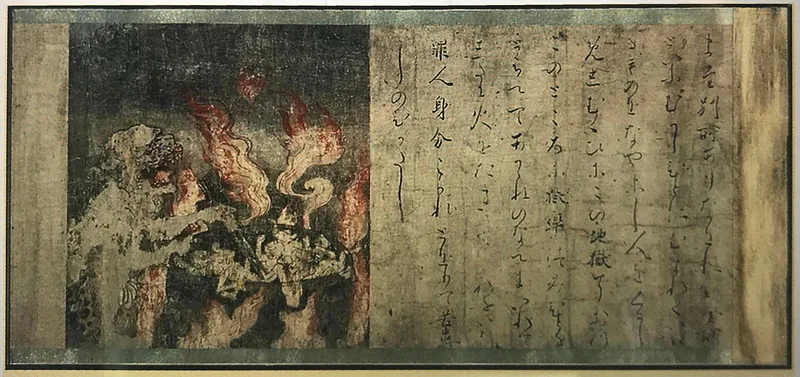
Scholastic texts systematised these images. The Abhidharmakosha of Vasubandhu and later Mahayana works describe eight great hot hells stacked one below another beneath the continent of Jambudvipa, the human world. Their names evoke their torments: the Reviving Hell, where beings are cut to pieces and revived again; the Black Line Hell, where they are sawn along lines; the Crushing Hell, the Howling and Great Howling Hells, the Hot and Very Hot Hells, and lowest of all Avichi, the "Uninterrupted", reserved for the gravest offences, such as killing one's parents or an arhat or wounding a buddha. Each great hell is surrounded by subsidiary hells.
Mahayana and Sarvastivada sources add eight cold hells, in which beings freeze among icy mountains; their names describe stages of frostbite, from blisters to skin splitting open like a blue, a red and finally a great red lotus. Some texts also mention "ephemeral" hells found in ordinary places such as rocks, rivers or trees. In the Theravada world the fourteenth-century Thai treatise Traiphum Phra Ruang, "The Three Worlds of King Ruang", gave an influential vernacular description of the hells within a whole cosmology.
Yama and the Judgement of the Dead§
Yama, a figure inherited from Vedic religion, where he was the first mortal to die, appears in Buddhist texts as king of the dead. In the Devaduta Sutta he questions each wrongdoer about the five "divine messengers" — a newborn child, an old person, a sick person, a criminal being punished and a corpse — asking whether he failed to take these signs of impermanence and karma to heart. Yama is less a tyrant than an instrument of karma; one text even has him wishing to be reborn as a human and hear the Dharma.
In China, Yama (Yanluo Wang) became one of the Ten Kings of purgatory described in the Scripture on the Ten Kings, a Chinese composition of around the ninth or tenth century studied by Stephen Teiser. The dead pass before a king on each of the seven seventh days after death, then at one hundred days, one year and three years, and the living perform rites at each stage to help them through the courts. This bureaucratic purgatory, with its judges, clerks and ledgers of deeds, merged Buddhist karma with Chinese administrative imagination and spread to Korea, Vietnam and Japan, where Yama is called Enma. The bodhisattva Kshitigarbha (Dizang, Japanese Jizo), who vowed not to attain buddhahood until the hells are emptied, became the great saviour of beings in these realms.
Hungry Ghosts: The Realm of the Pretas§
The Sanskrit word preta originally meant "departed" — the spirits of the dead who, in Vedic religion, depended on offerings from their descendants. Buddhism redefined them as a realm of rebirth for the greedy and stingy. Texts and paintings depict hungry ghosts with swollen bellies and mouths or throats as narrow as a needle's eye, so that they can never satisfy their hunger; food may turn to fire or filth as they approach it.

The Pali Petavatthu, "Stories of the Departed", a collection in the Khuddaka Nikaya, tells how individual ghosts came to their state — often through miserliness or deceiving monks — and how relatives relieved them by making offerings to the monastic community and dedicating the merit to them. The Tirokudda Sutta pictures ghosts standing outside walls and at crossroads, returning to their former homes and waiting for their relatives to remember them. These texts underpin the practice of transferring merit to the dead that remains central in Theravada funerals and memorial rites; in Cambodia, for example, the fifteen-day festival of Pchum Ben is devoted to feeding ancestral and wandering spirits. Buddhist ideas of ghosts are placed beside those of other cultures in ghosts and hauntings.
Mulian, the Ghost Festival and Feeding the Dead§
The most famous Buddhist ghost story is that of Maudgalyayana, known in China as Mulian, one of the Buddha's chief disciples and renowned for his supernormal powers. According to the Yulanpen Sutra, he used his divine sight to find his dead mother reborn as a hungry ghost; when he offered her food, it burst into flames. The Buddha told him that she could be saved only through the combined power of the monastic community, so on the fifteenth day of the seventh month, at the end of the monks' rainy-season retreat, Mulian made offerings to the sangha on her behalf. Scholars debate whether this sutra was composed in China, and the meaning of its title, rendered in Sanskrit as Ullambana, is uncertain.
The story became the charter of the Ghost Festival, celebrated in China from at least the sixth century and still observed across East Asia; in Japan it developed into Obon, when the spirits of ancestors are welcomed home. Popular retellings, such as the Mulian transformation texts found at Dunhuang, depicted Mulian's descent through the hells in dramatic detail and became the basis of folk opera. Esoteric Buddhism added elaborate rites for feeding hungry ghosts with consecrated food, mantras and hand gestures, such as the Chinese "flaming mouth" ritual and the Japanese segaki, performed by monks on behalf of all wandering dead.
Hell Imagery in Art, Preaching and Modern Interpretation§
Hell has always been a powerful subject for Buddhist art. On the Tibetan Wheel of Life the hell and ghost realms occupy the lower segments. In Japan the monk Genshin's Ojoyoshu (985), a founding work of Pure Land Buddhism, opened with a harrowing description of the hells, and twelfth-century handscrolls of hells and hungry ghosts, now national treasures, show ghosts lurking unseen among the living. Later, travelling nuns used painted "Kumano mandalas" of the ten realms to preach to women and villagers. In Thailand and Laos the legend of the monk Phra Malai, who visits the hells and heavens and returns with messages for the living, is recited at weddings and funerals, and some modern Thai temples maintain "hell gardens" of painted sculptures as moral instruction.
Buddhist thinkers have long read these realms on more than one level. Many traditional teachers treat them as real places of rebirth; others, ancient and modern, also interpret them as states of mind — hatred as a burning hell, compulsive craving as the life of a hungry ghost — while insisting that the two readings need not exclude each other. In contemporary Asia the hells remain present in funerary rites, festivals and popular culture, while the image of the hungry ghost has entered modern psychology and literature as a metaphor for addiction and unappeasable desire.
Frequently asked questions§
Is Buddhist hell eternal?§
No. In all Buddhist traditions rebirth in hell lasts only until the karma that caused it is exhausted, after which the being is reborn in another realm. The periods described are extremely long, but they are finite, and the bodhisattva Kshitigarbha is believed to work for the release of beings there.
What is a hungry ghost in Buddhism?§
A hungry ghost (preta) is a being reborn into a realm of constant hunger and thirst, usually as a result of greed or miserliness. Hungry ghosts are pictured with huge bellies and tiny mouths, and Buddhists help them through offerings and the dedication of merit.
Who is Yama in Buddhism?§
Yama is the king of the dead, who examines beings after death and assigns them to the hells according to their deeds. Inherited from Vedic religion, he became in China one of the Ten Kings of purgatory and in Japan the judge Enma.
What is the Ghost Festival?§
The Ghost Festival, held on the fifteenth day of the seventh lunar month, is an East Asian Buddhist festival for feeding hungry ghosts and honouring ancestors. It is based on the story of Mulian rescuing his mother, and in Japan it developed into the Obon festival.
Sources and further reading§
- The Middle Length Discourses of the Buddha — Bhikkhu Ñāṇamoli & Bhikkhu Bodhi, 1995
- The Ghost Festival in Medieval China — Stephen F. Teiser, 1988
- The Scripture on the Ten Kings and the Making of Purgatory in Medieval Chinese Buddhism — Stephen F. Teiser, 1994
- Three Worlds According to King Ruang: A Thai Buddhist Cosmology — Frank E. Reynolds & Mani B. Reynolds, 1982
- Thai Tellings of Phra Malai: Texts and Rituals Concerning a Popular Buddhist Saint — Bonnie Pacala Brereton, 1995
- Buddhist Cosmology: From Single World System to Pure Land — W. Randolph Kloetzli, 1983