Liber XXVI · Shinto · Chapter VIII: Shugendo
Kumano Sanzan and the Kumano Kodō: Japan's Sacred Pilgrimage
The Kumano Sanzan shrines and Kumano Kodō pilgrimage: Kumano Gongen, imperial pilgrims, yamabushi, Kumano nuns, Nachi Falls and the Kii routes.

The Kumano Sanzan, "the three mountains of Kumano", are three great shrines in the forested south of the Kii Peninsula: Kumano Hongū Taisha, Kumano Hayatama Taisha and Kumano Nachi Taisha. Joined by the network of mountain paths known as the Kumano Kodō, they formed for a thousand years one of Japan's most important pilgrimages, visited by retired emperors, warriors, commoners and the mountain ascetics of Shugendō, and their combined worship of kami and buddhas made Kumano a symbol of salvation open to all.
The Three Grand Shrines of Kumano§
Kumano Hongū Taisha, the "main shrine", lies inland on the Kumano River. Until 1889 it stood on a sandbank called Ōyunohara at the meeting of three rivers; after a catastrophic flood its surviving halls were moved to a nearby hill, and a vast steel torii, over thirty metres high and erected in 2000, now marks the old site. Its principal deity is Ketsumimiko no ōkami, identified with the storm god Susanoo.
Kumano Hayatama Taisha stands near the river mouth in the town of Shingū, the "new shrine", whose name implies an older place of worship nearby on the sacred rock of Kamikura, where a great boulder is still revered and where a torch-bearing fire festival is held each February. Its principal deity, Kumano Hayatama no ōkami, is identified with Izanagi.
Kumano Nachi Taisha rises on the slopes above the Nachi waterfall, which drops some 133 metres and is itself worshipped as a kami. The shrine's principal deity, Kumano Fusumi no ōkami, is identified with Izanami. Beside it stands the Buddhist temple Seigantoji, with its three-storeyed pagoda framing the falls, one of the most famous views in Japan. Each shrine honours all twelve Kumano deities, so that a visit to one is in some sense a visit to all.
Kumano in Myth: Land of the Dead and the Three-Legged Crow§
In the classical myths Kumano lies at the edge of the world. A variant tradition in the Nihon shoki says that the creator goddess Izanami, after her death, was buried at Arima village in Kumano, and the great rock of Hana no Iwaya on the coast is honoured as her tomb; her story is told in Izanagi and Izanami. Remote, mountainous and fronting the open Pacific, Kumano was imagined as a borderland between this world and the next, a place where the spirits of the dead gathered.
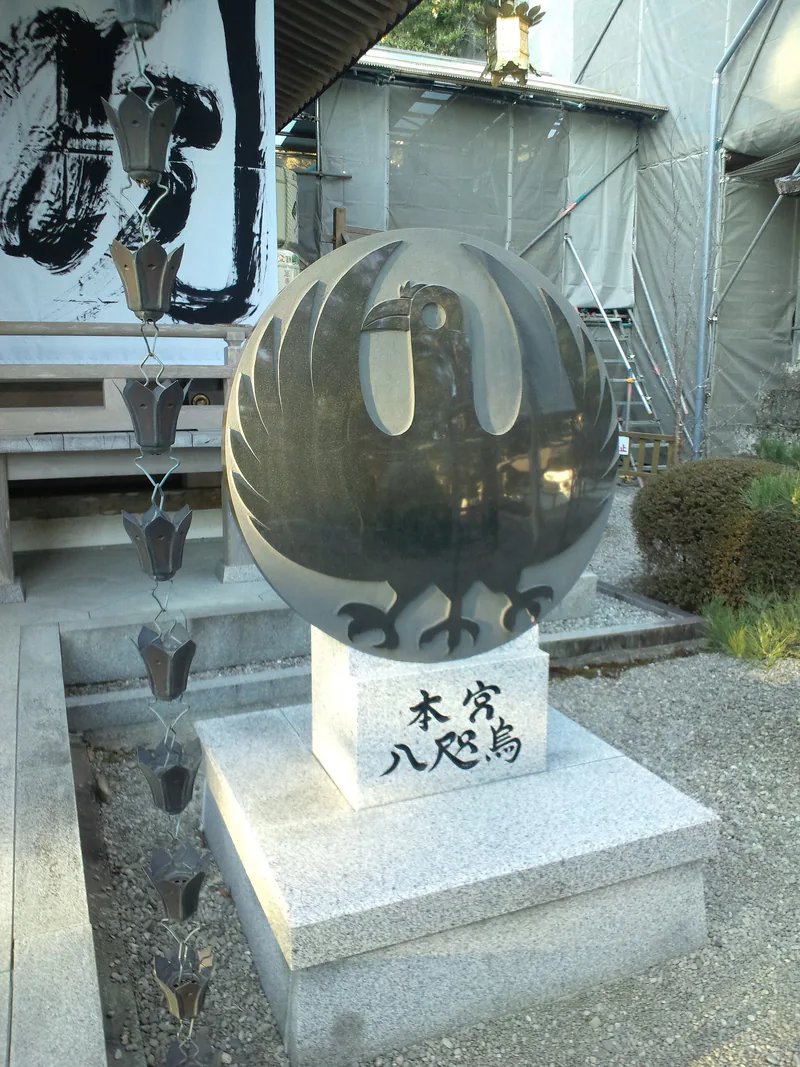
The myths also make Kumano the gateway of the imperial conquest. When the legendary first emperor, Jimmu, marched from Kyushu towards Yamato, his army was overcome by a poisonous influence in the Kumano mountains. A divine sword sent from heaven revived them, and Takamimusubi sent the great crow Yatagarasu to guide them through the mountains. Kumano tradition depicts Yatagarasu with three legs, and the crow became the messenger of the Kumano deities. It appears on the shrines' amulets and, in modern times, in the emblem of the Japan Football Association.
The Kumano Gongen: Buddhas Behind the Kami§
From the Heian period, Kumano became a centre of the combined worship of kami and buddhas explained in Shinto and Buddhism. The deities were called the Kumano Gongen, "provisional manifestations", and each was assigned an original Buddhist identity (honji): the Hongū deity was Amida, the buddha of the Western Pure Land; the Hayatama deity was Yakushi, the healing buddha; and the Nachi deity was the thousand-armed Kannon, bodhisattva of compassion.
These identifications gave the pilgrimage its meaning. To walk to Hongū was to travel to Amida's Pure Land while still alive, a powerful idea in an age when Pure Land Buddhism promised rebirth in paradise. Shugendō doctrine read the whole region as a mandala: Kumano was the Womb Realm and Yoshino to the north the Diamond Realm of esoteric Buddhism, joined by the ridge route of Ōmine along which ascetics practised. The difficult journey through mountains and forest was understood as a death and rebirth, a purification of body and mind.
Emperors on the Road: The Insei Pilgrimages§
The first recorded imperial pilgrimage was that of the retired emperor Uda in 907. Kumano's golden age came with the insei system of the late eleventh and twelfth centuries, when retired emperors held real power. Shirakawa travelled to Kumano nine times, Toba more than twenty, Go-Shirakawa thirty-four times and Go-Toba twenty-eight times. Each pilgrimage was a great procession of courtiers and attendants taking about a month for the round trip from Kyoto, and the endless lines of pilgrims became proverbial as ari no Kumano mōde, "the ants' pilgrimage to Kumano". The poet Fujiwara no Teika accompanied Go-Toba in 1201 and recorded the hardships of the journey in his diary.
Pilgrims from the capital followed the Kiiji route south along the coast and then usually turned inland on the Nakahechi through the mountains to Hongū, then travelled by boat down the river to Hayatama and along the coast to Nachi. Other routes developed: the Ōhechi along the southern coast, the Kohechi from the monastery of Kōyasan, the Iseji from Ise, and the Ōmine Okugake, the austere ridge route of the yamabushi from Yoshino. Along the main routes stood dozens of subsidiary shrines called ōji, conventionally numbered as the "ninety-nine ōji", where pilgrims rested, prayed and sometimes held poetry gatherings. In 1090 Shirakawa appointed a monk of the Onjōji as overseer of the three shrines, linking Kumano to Tendai Shugendō.
Kumano Bikuni, Mandalas and Talismans§
From the medieval period, as imperial pilgrimages declined, Kumano faith spread through the warrior class and commoners. Its agents were the sendatsu, guides, often Shugendō practitioners, who led groups of pilgrims, and the oshi, lodging masters at the shrines who offered prayers on behalf of their clients across the provinces. Kumano became known for welcoming everyone regardless of status, gender or ritual purity. A medieval legend tells that the poet Izumi Shikibu, prevented from completing her pilgrimage by menstrual impurity, was reassured in a dream that the Kumano deity did not reject her.
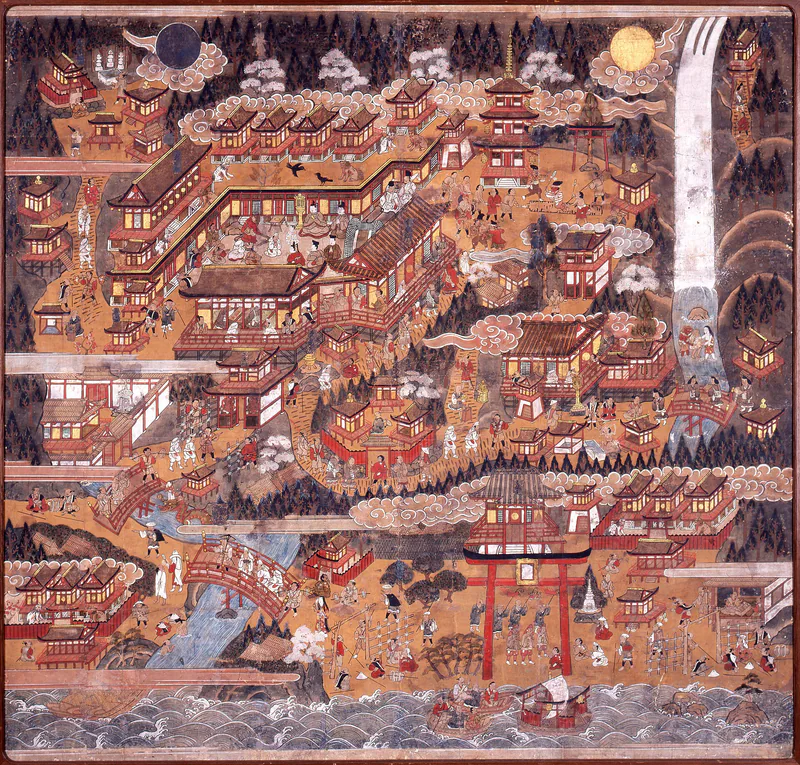
Female preachers known as Kumano bikuni travelled widely in the late medieval and early modern periods, raising funds for the shrines. They carried painted mandalas and explained them to audiences: the Kumano kanshin jikkai mandara, showing the course of human life and the ten realms from hell to buddhahood, and the Nachi sankei mandara, a panoramic picture of pilgrims at Nachi. The bikuni also sold the shrines' paper talismans, the Kumano goō hōin, printed with stylised characters formed of crows. These sheets were widely used for writing solemn oaths: breaking an oath written on one was said to cause a crow at Kumano to die and to bring punishment on the oath-breaker.
Mountain Ascetics, Ippen and the Voyages to Potalaka§
Kumano was a training ground for ascetics, and the cliffs and waterfalls of Nachi were famous places of austerity. It also shaped Japanese Buddhism. In 1274 the itinerant monk Ippen received at Hongū a revelation from the Kumano deity, as a manifestation of Amida, that rebirth in the Pure Land was already assured by Amida's vow; he went on to found the Ji school, spreading the practice of chanting the name of Amida while handing out slips of paper.
Nachi was also the starting point for one of the most extraordinary practices in Japanese religion, Fudaraku tokai, "crossing to Potalaka". Monks of the temple of Fudarakusan-ji set out to sea in small boats, sometimes sealed in, seeking the island paradise of Kannon believed to lie to the south. Temple records list voyages from the ninth to the early eighteenth century. Scholars interpret them as a form of religious suicide or self-offering, and they are remembered today as a historical phenomenon, not a living practice.
The Kumano Kodō Today§
The Meiji separation of kami and buddhas and the ban on Shugendō in 1872 broke the combined Kumano tradition. Buddhist halls were removed from the shrines, and the Kumano Gongen were redefined as kami of the classical myths; only at Nachi did the temple Seigantoji survive side by side with the shrine. The pilgrim routes fell into decline as railways and roads replaced them.
Revival came in the late twentieth century. In 2004 the "Sacred Sites and Pilgrimage Routes in the Kii Mountain Range", including the Kumano shrines, the Kumano Kodō, Kōyasan and Yoshino-Ōmine, were inscribed as a UNESCO World Heritage Site, and the Kumano Kodō has a partnership with the Camino de Santiago in Spain. Thousands of walkers now follow the Nakahechi each year, and yamabushi once again lead groups through the mountains. Several thousand Kumano shrines throughout Japan testify to the reach of the old faith, and the Nachi Fire Festival each July, with its great torches carried down the stone steps beside the waterfall, remains one of the region's most striking rites.
Frequently asked questions§
What are the Kumano Sanzan?§
The Kumano Sanzan are three grand shrines in the south of the Kii Peninsula: Kumano Hongū Taisha, Kumano Hayatama Taisha and Kumano Nachi Taisha. Together they form the centre of Kumano worship and the goal of the Kumano Kodō pilgrimage.
What is the Kumano Kodō?§
The Kumano Kodō is a network of ancient pilgrimage routes leading through the mountains of the Kii Peninsula to the Kumano shrines. Its main routes include the Nakahechi, Kohechi, Ōhechi, Iseji and the Ōmine ridge route, and it is a UNESCO World Heritage Site.
Why is the crow a symbol of Kumano?§
According to the myths, the three-legged crow Yatagarasu guided the first emperor Jimmu through the Kumano mountains. The crow became the messenger of the Kumano deities and appears on the shrines' talismans and emblems.
Sources and further reading§
- Localizing Paradise: Kumano Pilgrimage and the Religious Landscape of Premodern Japan — D. Max Moerman, 2005
- The Mandala of the Mountain: Shugendō and Folk Religion — Miyake Hitoshi, 2005
- Shugendō: Essays on the Structure of Japanese Folk Religion — Miyake Hitoshi, 2001
- Engendering Faith: Women and Buddhism in Premodern Japan — Barbara Ruch (ed.), 2002
- Buddhas and Kami in Japan: Honji Suijaku as a Combinatory Paradigm — Mark Teeuwen and Fabio Rambelli (eds.), 2003
- Nihongi: Chronicles of Japan from the Earliest Times to A.D. 697 — W. G. Aston, 1896