Liber XXVI · Shinto · Chapter IV: Myths of the Kojiki
Izanagi and Izanami: The Shinto Creation Myth of Japan
Izanagi and Izanami, the creator gods of Shinto: the birth of the Japanese islands, Izanami's death, the journey to Yomi, purification and their sacred sites.

Izanagi and Izanami, "he who invites" and "she who invites", are the divine couple who create the islands of Japan and many of its kami in the classical Shinto myths. Their story, told in the Kojiki (712) and the Nihon shoki (720), moves from the stirring of the primeval ocean and the birth of the land to Izanami's death in childbirth, Izanagi's failed journey to the underworld Yomi, and the purification from which the sun goddess Amaterasu is born.
The Creation Myth in the Kojiki and Nihon Shoki§
The two eighth-century chronicles, introduced in Myths of the Kojiki and Nihon Shoki, both begin with the origins of the world, but in different ways. The Kojiki opens in the High Plain of Heaven, where a series of deities come into being spontaneously, beginning with Ame no Minakanushi, "Lord of the Centre of Heaven", and the two creative powers Takamimusubi and Kamimusubi. The Nihon shoki, written in classical Chinese for an educated readership, begins instead with a cosmology borrowed from Chinese texts: heaven and earth are not yet separated, the light and pure rises to become heaven, and the heavy and turbid settles to become earth, a picture shaped by the theory of yin and yang.
In both accounts a sequence of "seven generations of the age of the gods" follows, ending with a brother-sister pair: Izanagi no mikoto and Izanami no mikoto. Their names share the root iza, "to invite" or "to beckon", with the suffixes -gi and -mi marking male and female. The Nihon shoki also preserves many variant versions of the myth.
Standing on the Floating Bridge of Heaven§
The heavenly deities command Izanagi and Izanami to "complete and solidify this drifting land" and give them a jewelled spear (Ame no nuboko). Standing on the Floating Bridge of Heaven (Ame no ukihashi), the pair lower the spear into the brine below and stir it until it curdles. When they lift the spear, the brine dripping from its tip piles up and forms an island, Onogoro, "self-curdling". It became a favourite subject of later painters.
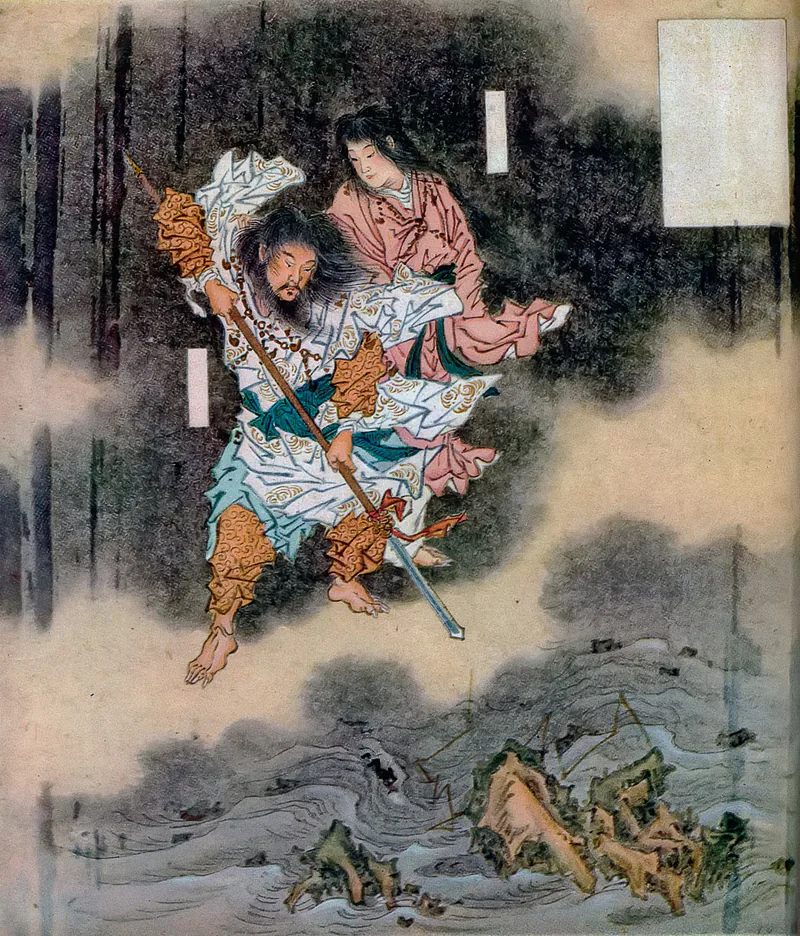
The couple descend to the island, erect a heavenly pillar and build a spacious hall. Izanagi asks Izanami how her body is formed, and they agree to unite. To marry, they walk around the pillar in opposite directions. When they meet, Izanami speaks first, praising Izanagi, and only then does he reply. Their first child is the "leech child" (Hiruko), who cannot stand; they set it adrift in a reed boat. A second offspring, the island of Awa, is also not counted among their children.
The couple return to heaven to consult the other gods, who perform a divination and declare that the failure arose because the woman spoke first. Izanagi and Izanami circle the pillar again, this time with Izanagi speaking first. Many scholars see in this episode an ancient marriage rite around a pillar and also the influence of continental ideas about the proper precedence of male over female. In later folk religion the abandoned leech child was identified with Ebisu, the popular god of fishermen and prosperity.
The Birth of the Islands and the Gods§
After the second marriage, Izanami gives birth to the "Great Land of Eight Islands" (Ōyashima). The Kojiki lists them as Awaji, Shikoku, Oki, Kyushu, Iki, Tsushima, Sado and finally Honshu, followed by a number of smaller islands.
The couple then produce a long series of kami: deities of the sea, of the river mouths, of wind, trees, mountains and moors, of houses and their parts, and of boats and food. The list expresses a basic conviction, discussed in The Kami, that the landscape and the materials of human life are themselves divine.
The last child is the fire god, Kagutsuchi. His birth burns Izanami's genitals, and she falls mortally ill. Even as she dies, deities of metal, clay, water and growth come into being from her vomit, faeces and urine. Grief-stricken, Izanagi weeps by his wife's pillow and feet. He buries Izanami, in the Kojiki's account, on Mount Hiba on the border of Izumo and Hōki. Then he draws his long sword and beheads the fire god; from the blood and body of Kagutsuchi further deities are born, among them gods of thunder, swords and mountains.
Izanami's Death and the Journey to Yomi§
Longing for his wife, Izanagi follows her to Yomi, the land of the dead. She comes to the door of the hall to meet him, but explains that she has already eaten food cooked in the hearth of Yomi, and so cannot easily return. She will ask the deities of Yomi for permission, and begs him not to look at her in the meantime.

The wait is long. Izanagi breaks off the end tooth of the comb in his hair, lights it and goes in. He finds Izanami's body swarming with maggots, with eight thunder deities seated upon it. Horrified, he flees. Shamed, Izanami sends the hags of Yomi after him, and then the thunder deities with a great army. Izanagi throws down his headdress, which turns into grapes, and his comb, which turns into bamboo shoots; the hags stop to eat them. At the slope that forms the boundary of Yomi, Yomotsu Hirasaka, he throws three peaches at his pursuers, and they turn back. Peaches had protective significance in Chinese tradition, which may be reflected here.
Finally Izanami herself comes. Izanagi blocks the slope with a boulder that would take a thousand men to move, and husband and wife speak across it, breaking their bond. She declares that she will strangle a thousand people of his land every day; he replies that he will then cause fifteen hundred to be born every day. So, the myth explains, people die and are born, and Izanami becomes the great deity of Yomi.
The episode resembles stories elsewhere: the prohibition on eating the food of the underworld recalls Persephone's pomegranate in Greek myth, and the forbidden look recalls Orpheus and Eurydice. Such parallels are discussed generally in reincarnation and the afterlife.
Purification at the River and the Birth of the Three Noble Children§
Having escaped, Izanagi declares that he has been to a hideous and polluted land and must purify himself. He goes to a river mouth at Tachibana no Odo in Himuka, in Kyushu, and performs misogi, ritual washing. As he casts off his staff, sash, clothing and ornaments, deities are born from each. Washing in the middle stream, he produces gods of misfortune born of the pollution of Yomi, and then gods who correct misfortune, as well as the deities of Sumiyoshi, later patrons of sea travel.
At the end, he washes his face. From his left eye is born Amaterasu, from his right eye the moon god Tsukuyomi, and from his nose the storm god Susanoo. Rejoicing, Izanagi entrusts heaven to Amaterasu, the realm of night to Tsukuyomi and the sea to Susanoo. Their subsequent stories are told in Amaterasu Ōmikami.
This passage is the foundation of Shinto ideas about pollution and purity. Contact with death produces kegare, a defilement that is not moral guilt but must be removed by washing and rites of harae. The short purification prayer (harae kotoba) recited at the start of shrine rites invokes Izanagi's washing at Tachibana no Odo, and the practice of standing under waterfalls or in the sea, described in Shinto shrines and purification, is understood as following his example.
Interpreting the Myth: Death, Gender and the Afterlife§
Interpreters have drawn very different meanings from the story. For the eighteenth-century scholar Motoori Norinaga, Yomi was a dark and filthy place to which all the dead must go, good and bad alike, and the proper response to death was simply grief; he rejected Buddhist and Confucian consolations as foreign. His follower Hirata Atsutane, by contrast, argued that the spirits of the dead remain in an unseen realm close to the living, an idea that shaped modern Shinto thinking about ancestors.
Modern scholars note the political dimension of the compilation, which places the couple at the head of a genealogy leading to the imperial house, and the tension in the story between Izanami's primal creative power and the reassertion of male precedence. Feminist readers have seen in Izanami a powerful mother goddess whose role was diminished by the court compilers, though there is little independent evidence for an earlier form of the myth.
Sacred Sites of Izanagi and Izanami§
Many places claim connection with the couple. Onogoro has been identified with several small islands near Awaji, and the Izanagi Shrine on Awaji (Izanagi Jingū) is traditionally said to stand where Izanagi retired after his work; the Nihon shoki places his last dwelling on Awaji, while the Kojiki names Taga in Ōmi, today the site of the Taga Taisha in Shiga Prefecture. A variant in the Nihon shoki says Izanami was buried at Arima in Kumano, where a great rock face at the shrine of Hana no Iwaya is honoured as her tomb; the wider sacred landscape of the region is described in Kumano Sanzan and the Kumano Kodō. In Shimane Prefecture, a site in the Higashi-Izumo district of Matsue is marked as the slope of Yomotsu Hirasaka.
Frequently asked questions§
Who created Japan in Shinto mythology?§
According to the Kojiki and Nihon shoki, the islands of Japan were created by the divine couple Izanagi and Izanami. They formed the first island by stirring the ocean with a jewelled spear and then gave birth to the other islands and to many kami.
What happened to Izanami?§
Izanami died after giving birth to the fire god Kagutsuchi and went to Yomi, the land of the dead. When Izanagi followed her and saw her decaying body, she pursued him in anger, and after their final separation she became the great deity of Yomi.
Why is Izanagi's purification important in Shinto?§
Izanagi's washing after his return from Yomi is the mythical origin of misogi and harae, the Shinto rites that remove pollution caused by contact with death and other sources of impurity. The sun goddess Amaterasu was born at the end of this purification.
Sources and further reading§
- Kojiki — trans. Donald L. Philippi, 1968
- The Kojiki: An Account of Ancient Matters — trans. Gustav Heldt, 2014
- The Kojiki: Records of Ancient Matters — Basil Hall Chamberlain, 1882
- Nihongi: Chronicles of Japan from the Earliest Times to A.D. 697 — W. G. Aston, 1896
- Sources of Japanese Tradition, Volume One — Wm. Theodore de Bary, Donald Keene, George Tanabe and Paul Varley (eds.), 2001
- Japanese Mythology — Juliet Piggott, 1969
- Shinto: A History — Helen Hardacre, 2017