Liber XXVI · Shinto · Chapter VII: Shrines & Purification
Shinto Shrines and Purification: Torii, Ise, Harae and Misogi
Shinto shrines and purification explained: torii and shrine halls, the Ise rebuilding, kegare and tsumi, harae, misogi, the Great Purification and priests.

A Shinto shrine (jinja) is a sacred precinct where a kami is believed to dwell, marked by a torii gateway and centred on a main hall that houses the kami's sacred object, while purification (harae) is the ritual removal of the impurity, kegare, that separates people from the kami. Washing hands and mouth at the shrine basin, the priest's waving of a purification wand, ablution under waterfalls (misogi), and the twice-yearly Great Purification all express the Shinto conviction that purity is the condition for approaching the sacred.
The Shrine as the Dwelling of the Kami§
Japanese has several words for a shrine: jinja, the general term; jingū, used for shrines with imperial connections such as Ise; taisha, "grand shrine", as at Izumo; and miya or yashiro. Early kami worship seems to have taken place at natural sites, mountains, waterfalls, great trees and rocks, where the kami was summoned temporarily into a marked object during rites. Permanent shrine buildings developed later, partly under the influence of Buddhist temple architecture.
Traces of the older pattern remain. At Ōmiwa Shrine in Nara Prefecture, worship is directed through a worship hall toward Mount Miwa itself, which serves as the kami's body, and there is no main sanctuary. The island of Okinoshima, where archaeologists have found centuries of ritual offerings, is itself treated as sacred. Many shrines are surrounded by a protected grove (chinju no mori), often among the oldest woodland in a district.
Anatomy of a Shrine: Torii, Approach and Halls§
A visitor typically passes through one or more torii, the gateways of two pillars and two crossbeams that mark the boundary of sacred space. Their origin is debated, and they vary from plain unpainted wood to the vermilion lacquer of Inari shrines. A path (sandō) leads past a pair of guardian lion-dogs (komainu), or foxes at Inari shrines, to a water basin (temizuya or chōzuya) for purification.
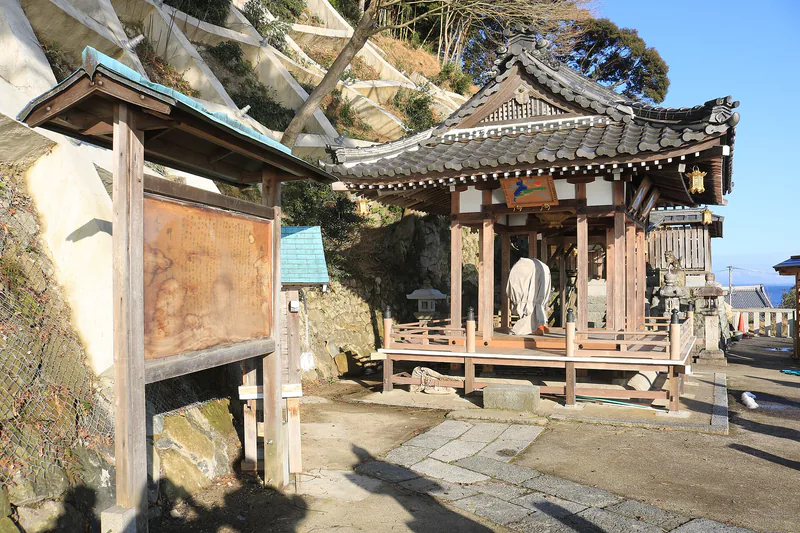
The main buildings are usually the worship hall (haiden), where people pray and rites are performed; sometimes an offering hall (heiden); and behind them the main hall (honden), which contains the shintai, the object in which the kami resides, kept from view. Sacred ropes of rice straw (shimenawa) with zigzag paper streamers (shide) mark especially holy places, trees and rocks.
Shrine architecture has several classic styles: the austere shinmei style of Ise, with thatched roofs and raised floors resembling ancient granaries; the taisha style of Izumo; the widespread nagare style with its long, flowing front roof; and the ornate gongen style of Nikkō's Tōshōgū, built for the deified Tokugawa Ieyasu. Larger shrines contain subsidiary shrines to other kami.
Ise and the Periodic Rebuilding§
The Ise Grand Shrine in Mie Prefecture is the most sacred shrine in Japan. It consists of the Inner Shrine (Naikū), dedicated to the sun goddess Amaterasu, whose sacred mirror it holds, and the Outer Shrine (Gekū), dedicated to Toyouke, goddess of food, together with more than a hundred affiliated shrines. Until the fourteenth century an unmarried imperial princess, the saiō, served Amaterasu at Ise on the emperor's behalf.
Every twenty years the main buildings and their treasures are reconstructed on an adjacent site and the kami is transferred to the new shrine in a night-time ceremony, the shikinen sengū. Tradition dates the first rebuilding to the reign of Empress Jitō in 690; the custom was interrupted for over a century during the civil wars of the fifteenth and sixteenth centuries, and the 62nd rebuilding took place in 2013. The practice preserves ancient carpentry techniques and expresses ideals of renewal and purity. In the Edo period Ise became a goal of mass pilgrimage, sometimes in waves of millions of pilgrims known as okage mairi. John Breen and Mark Teeuwen's history of Ise traces how its meaning changed across the centuries.
Pollution and Purity: Kegare and Tsumi§
Shinto distinguishes states of impurity (kegare) and offences (tsumi) rather than sin in the Christian sense. Kegare arises especially from death, but also from blood, childbirth, illness and disorder; it is contagious and can affect families and communities. Traditionally, people in mourning avoided shrines for a period, and shrines avoid funerals, which is one reason Japanese funerals are usually conducted by Buddhist priests. Historically, these ideas also led to restrictions on women in some sacred places, such as mountains closed to women, which have been widely relaxed in modern times.
The ancient ritual prayer of the Great Purification, preserved in the Engishiki of 927, lists "heavenly offences", acts like those of the storm god Susanoo in the myths, such as destroying the divisions of rice fields, and "earthly offences", including wounding, certain forbidden relations and calamities. Its theme is that these accumulated impurities can be carried away by the kami of rivers and the sea. Purity is therefore less a moral achievement than a restored condition, in which a person's original brightness of heart shines through.
Rites of Purification: Harae, Misogi and the Great Purification§
Harae (or harai) is the general term for purification. Before any rite the priest waves a wand of paper streamers (haraegushi or ōnusa) over the participants and offerings, and recites a purification prayer. Salt is used to purify spaces, which is why sumo wrestlers, whose sport has old ties to shrine ritual, throw salt into the ring.
Misogi is purification with water, modelled on Izanagi's washing in a river after his return from the land of the dead, told in the Kojiki. Some shrines and religious groups practise misogi by standing under waterfalls or entering the sea, often in winter, accompanied by chanting. Such austerities, like those of mountain ascetics in Shugendō, are undertaken under supervision by experienced practitioners.
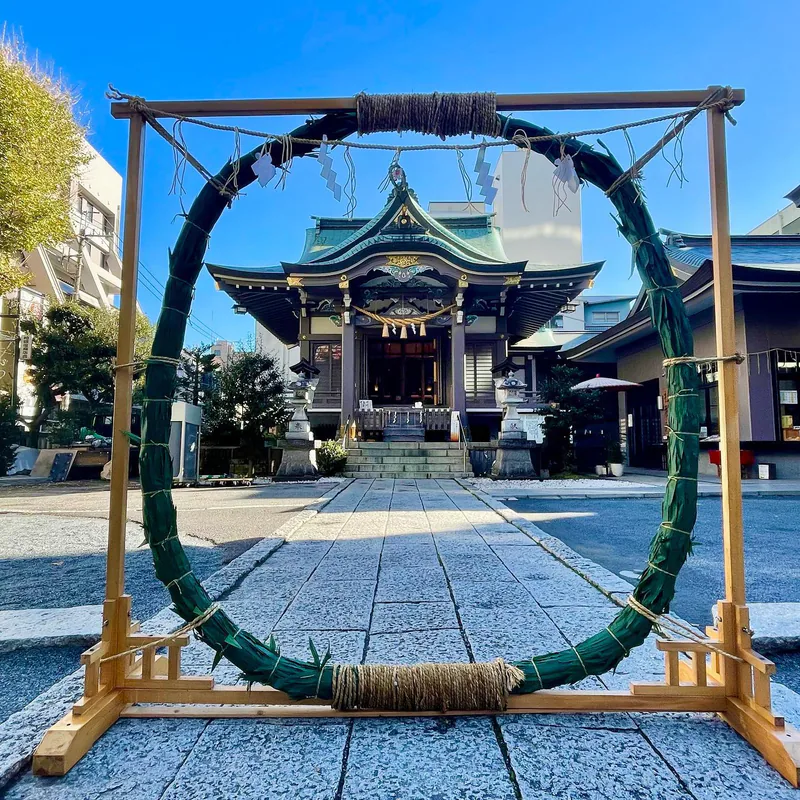
The Great Purification (Ōharae) is held at shrines throughout Japan on the last days of the sixth and twelfth months, now 30 June and 31 December. Worshippers transfer their impurities to paper figures (katashiro) that are floated away or burned, and in summer they pass through a large ring of woven grass (chinowa) to ward off misfortune for the second half of the year. Purification also features in the communal festivals that are the high points of the shrine year.
Priests, Shrine Maidens and the Running of Shrines§
Shrines are served by priests (kannushi or shinshoku), headed by a chief priest (gūji). Historically many priestly offices were hereditary, and many still pass within families, but today most priests are trained and licensed at Kokugakuin University in Tokyo or Kōgakkan University in Ise. Women have been able to serve as priests since the Second World War. Miko, usually young women, assist with rites, perform sacred dance (kagura) and sell amulets; in earlier times they also acted as spirit mediums, a role studied by Carmen Blacker. Most shrines belong to the Association of Shinto Shrines (Jinja Honchō); some major shrines, such as Fushimi Inari, are independent.
Visiting a Shrine: Customs and Etiquette§
Visitors customarily bow before passing through the torii and walk at the side of the path, the centre being reserved for the kami. At the water basin they rinse the left hand, the right hand and the mouth with a ladle. At the worship hall they offer a coin, may ring a bell, and pray with the common pattern of two bows, two claps and one bow, though some shrines, such as Izumo, use four claps. Amulets (omamori), votive plaques (ema) and written fortunes (omikuji) are obtained at the shrine office. These customs are described as practised, not prescribed: Shinto is less a matter of correct belief than of respectful conduct. See also What Is Shinto? and the comparative article on amulets and talismans.
Frequently asked questions§
What does a torii gate mean?§
A torii marks the entrance to a shrine's sacred space, the boundary between the ordinary world and the kami's precinct. Its exact origin is unknown, and theories range from bird perches to continental gateways.
What is the difference between a shrine and a temple in Japan?§
Shrines (jinja) are Shinto and dedicated to kami; temples (tera) are Buddhist and house images of buddhas. Shrines are usually marked by torii, temples by gate buildings and pagodas, though before 1868 the two were often combined.
What is misogi?§
Misogi is purification with water, such as standing under a waterfall or bathing in the sea or a river. It is modelled on the god Izanagi's purification after returning from the underworld in the Kojiki.
Sources and further reading§
- Shinto: A History — Helen Hardacre, 2017
- A New History of Shinto — John Breen and Mark Teeuwen, 2010
- A Social History of the Ise Shrines: Divine Capital — John Breen and Mark Teeuwen, 2017
- A Year in the Life of a Shinto Shrine — John K. Nelson, 1996
- Engi-shiki: Procedures of the Engi Era — trans. Felicia G. Bock, 1970
- Shinto: The Kami Way — Sokyo Ono, 1962
- The Catalpa Bow: A Study of Shamanistic Practices in Japan — Carmen Blacker, 1975