What Is Shinto? Kami, Shrines and the Way of the Gods
What is Shinto? An overview of Japan's way of the kami: origins, the Kojiki, shrines and purification, festivals, the fusion with Buddhism and State Shinto.

Shinto (神道, "the way of the kami") is the indigenous religious tradition of Japan, centred on the worship of kami, the gods, spirits and sacred powers present in nature, in ancestors and in particular places, at tens of thousands of shrines across the country. It has no single founder or creed; its practice revolves around purification, offerings, prayer and seasonal festivals, and for most of its history it was closely interwoven with Buddhism until the two were officially separated in 1868.
The Meaning of Shinto: The Way of the Kami§
The term Shintō is written with the Chinese characters for "spirit" or "god" and "way", the same characters read shendao in Chinese, and it appears in the Nihon shoki, which contrasts the "way of the kami" with the Buddhist teaching newly introduced from the continent. The native Japanese reading is kami no michi. For much of history, however, the word did not denote a separate religion; it could mean the kami themselves, their power, or the practices surrounding them.
The historian Kuroda Toshio, in an influential 1981 article, argued that Shinto as an independent religion is largely a creation of the early modern and modern periods, and that in medieval Japan kami worship was a part of a Buddhist-dominated religious system. Most scholars now accept a version of this view while recognising that shrine rites, myths and conceptions of the kami have long histories of their own. John Breen and Mark Teeuwen describe Shinto as a tradition that has been repeatedly reinvented around enduring sites and rituals.
Origins: Prehistoric Japan, the Yamato Court and the Classics§
The roots of kami worship lie in the prehistoric Jōmon and Yayoi periods, when communities venerated mountains, rocks, trees and springs and conducted rites for rice agriculture. The Chinese Records of Wei describe a third-century Japanese queen, Himiko, who ruled through shamanic powers. Excavations at sites such as Okinoshima, an island in the strait between Japan and Korea, reveal ritual offerings from the fourth to the ninth centuries.
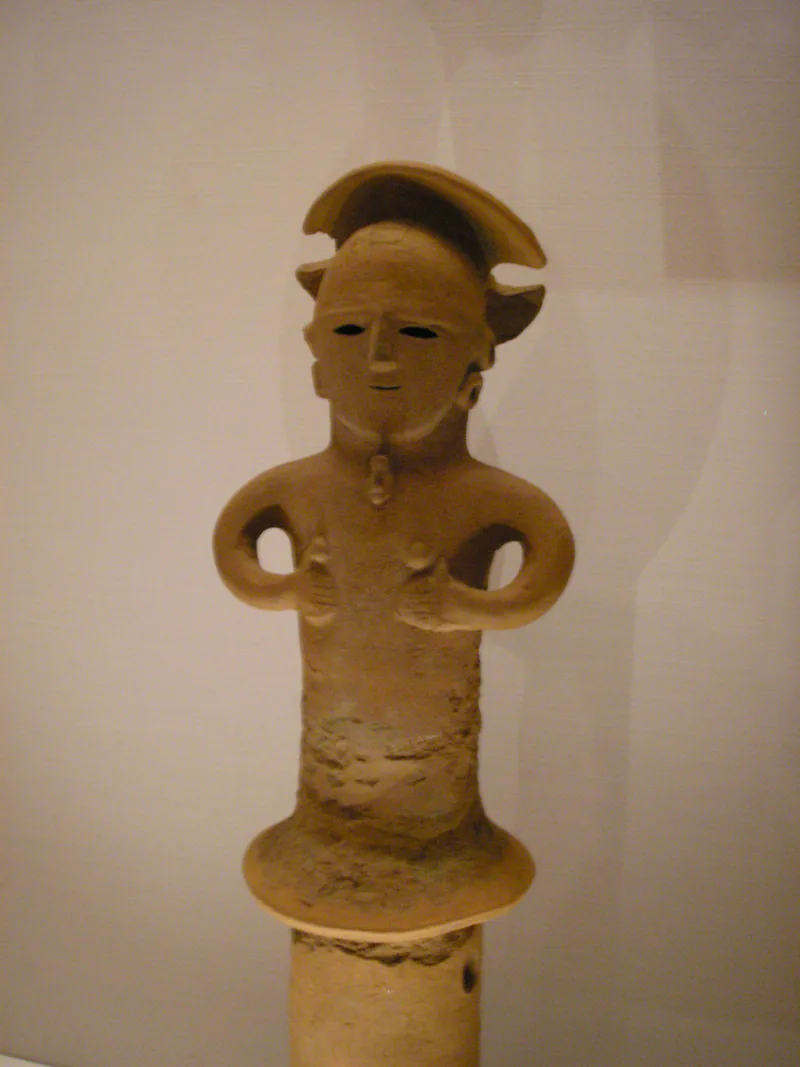
From the late seventh century the Yamato court, modelling its state on Tang China, organised kami worship into an official system. A Department of Divinities (Jingikan) supervised offerings to designated shrines, the emperor performed key rites such as the harvest festival, and the court compiled the mythological histories, the Kojiki and Nihon shoki, which present the imperial family as descendants of the sun goddess Amaterasu. The Engishiki, completed in 927, lists 2,861 shrines receiving state offerings and preserves ritual prayers (norito) still recited today.
Kami, Purity and Sincerity: Core Ideas of Shinto§
Kami are countless: the "eight hundred myriad kami" of the myths include celestial deities, gods of mountains, rivers, wind and fire, clan ancestors, deified emperors and heroes, and spirits of particular trees or rocks. The scholar Motoori Norinaga (1730–1801) famously defined kami as anything extraordinary that inspires awe, whether good or bad.
Shinto has no fixed theology of creation, sin or salvation. Its central ethical and ritual concerns are purity and pollution. Kegare, impurity, arises from contact with death, blood, disease and certain transgressions, and it is removed through harae (purification) and misogi (ablution with water). The ideal disposition is makoto or magokoro, a sincere and bright heart. The myths describe the creator god Izanagi purifying himself in a river after visiting the land of the dead, a model for later rites; see shrines and purification.
Shrines, Priests and Everyday Practice§
A Shinto shrine (jinja) is the dwelling of a kami. It is marked by a torii gateway, and its main hall (honden) houses a sacred object (shintai), such as a mirror, sword or stone, in which the kami resides; at some shrines the kami's body is a mountain itself. Worshippers purify their hands and mouth at a water basin, make a small offering, bow, clap and pray at the worship hall. Priests (kannushi), assisted by shrine maidens (miko), conduct daily offerings and seasonal festivals.

The most sacred shrine is the Ise Grand Shrine, dedicated to Amaterasu, whose main buildings are rebuilt every twenty years; the 62nd rebuilding took place in 2013. Other major shrines include Izumo, Kasuga, Fushimi Inari, Hachiman shrines such as Iwashimizu, and the Meiji Shrine in Tokyo. Many Japanese visit a shrine at New Year (hatsumōde), bring infants for blessing, celebrate the shichi-go-san festival for children, buy amulets (omamori), write wishes on wooden plaques (ema) and draw paper fortunes (omikuji). Funerals, by contrast, are usually Buddhist, reflecting an old division of labour.
Shinto and Buddhism: A Thousand Years of Combination§
Buddhism reached Japan in the sixth century, traditionally in 538 or 552, and soon became the religion of the court. Rather than replacing kami worship, it absorbed it. Kami were understood first as beings in need of Buddhist salvation, then as protectors of the Dharma, and from the Heian period as local "traces" of buddhas and bodhisattvas, an idea known as honji suijaku. Temples and shrines shared precincts, and Buddhist monks managed many shrines. This long fusion, called shinbutsu shūgō, is described in Shinto and Buddhism, and its esoteric dimension in esoteric Buddhism in Japan and Shugendō.
In the medieval period, priests at Ise and later the Yoshida family of Kyoto developed theologies that placed the kami first. Yoshida Kanetomo (1435–1511) proclaimed a "Unique" (Yuiitsu) Shinto and claimed authority to license shrine priests throughout Japan.
From National Learning to State Shinto§
In the Edo period (1603–1868) the scholars of National Learning (kokugaku), above all Motoori Norinaga, whose commentary on the Kojiki took more than thirty years, sought an authentic Japanese spirit beneath Chinese and Buddhist influences. Hirata Atsutane (1776–1843) developed their ideas into a theology of the afterlife and of Japan's divine destiny that inspired the movement to restore imperial rule.
After the Meiji Restoration of 1868 the new government ordered the separation of kami and buddhas (shinbutsu bunri), removing Buddhist images and clergy from shrines; in places this provoked violent destruction of Buddhist property. Over the following decades the state organised shrines into a national hierarchy, defined shrine rites as patriotic duties rather than religion, and taught reverence for the emperor in schools. Historians call this system State Shinto. Meanwhile, popular religious groups were classified separately as "Sect Shinto"; some, like Tenrikyō, later became independent new religions.
Shinto Since 1945§
After Japan's defeat, the Allied Occupation's "Shinto Directive" of December 1945 abolished state support for shrines, and on 1 January 1946 the emperor issued a rescript widely interpreted as renouncing his divinity. The 1947 constitution separated religion and state. Most shrines then joined the newly founded Association of Shinto Shrines (Jinja Honchō), with Ise at its symbolic centre. Controversy continues over official visits to the Yasukuni Shrine, which enshrines Japan's war dead including convicted war criminals, and over the place of imperial rites in public life.
Many Japanese say they are not religious, yet participate in shrine visits and festivals as part of family and community life. Shinto ideas of sacred nature have also attracted international interest, while scholars caution against presenting Shinto as a timeless nature religion separate from its complex history.
Frequently asked questions§
What do Shinto followers believe?§
Shinto centres on reverence for the kami, the sacred powers present in nature, places, ancestors and the imperial line, and on maintaining purity and harmony with them through rituals, offerings and festivals. It has no single creed or sacred book comparable to the Bible.
Does Shinto have a founder or holy book?§
No. Shinto has no founder. The Kojiki and Nihon shoki contain its classical myths and the Engishiki preserves ancient prayers, but none of these functions as a scripture in the way the Bible or Qur'an does.
Can you be Shinto and Buddhist at the same time?§
Yes. Most Japanese participate in both: shrine visits for New Year, births and festivals, and Buddhist rites for funerals and ancestors. For more than a thousand years the two were integrated, and many people see no contradiction in practising both.
What is State Shinto?§
State Shinto is the term historians use for the system between 1868 and 1945 in which the Japanese government organised shrines, defined their rites as civic duties, and used them to promote reverence for the emperor. It was dismantled by the Occupation's Shinto Directive in 1945.
Sources and further reading§
- Shinto: A History — Helen Hardacre, 2017
- A New History of Shinto — John Breen and Mark Teeuwen, 2010
- Shinto and the State, 1868–1988 — Helen Hardacre, 1989
- Shinto: The Kami Way — Sokyo Ono, 1962
- Religion in Japanese History — Joseph M. Kitagawa, 1966
- Shinto: The Way Home — Thomas P. Kasulis, 2004
- Religion in Contemporary Japan — Ian Reader, 1991
- Kojiki — trans. Donald L. Philippi, 1968