Liber XXVI · Shinto · Chapter IV: Myths of the Kojiki
Susanoo: The Storm God of Shinto and the Serpent Yamata no Orochi
Susanoo, the unruly storm god of Japanese myth: his quarrel with Amaterasu, the slaying of the serpent Yamata no Orochi and his cult at Izumo and Gion.

Susanoo (須佐之男, also Susanoo no Mikoto or Takehaya Susanoo) is the turbulent younger brother of the sun goddess Amaterasu in the Japanese myths of the Kojiki (712) and Nihon shoki (720). Expelled from heaven for his violent deeds, he descends to Izumo, slays the eight-headed serpent Yamata no Orochi, finds the sword later known as Kusanagi and becomes the ancestor of the gods of Izumo; he was also worshipped for centuries as a deity of plague and its prevention.
Birth of Susanoo and the Three Noble Children§
In the creation myth (see Izanagi and Izanami), the god Izanagi returns from Yomi, the land of the dead, and purifies himself in a river. From his left eye is born Amaterasu, the sun goddess; from his right eye Tsukuyomi, the moon god; and from his nose Susanoo. Izanagi rejoices at these "three noble children" and assigns them their realms: to Amaterasu the High Plain of Heaven, to Tsukuyomi the realm of night, and, in the Kojiki, to Susanoo the sea.
Susanoo refuses his task. He weeps and howls until his beard reaches down to his chest, and his crying withers the green mountains and dries up rivers and seas, while evil spirits swarm like summer flies. Asked why, he says he longs to go to the land of his dead mother Izanami. Izanagi, enraged, expels him. The name Susanoo is often explained as "the impetuous male" from susabu, "to rage", though some scholars connect it with Susa, a place in Izumo; both readings are debated.
The Contest with Amaterasu and the Offences in Heaven§
Before departing Susanoo climbs to heaven to take leave of his sister. The mountains and rivers shake at his approach, and Amaterasu, fearing invasion, arms herself as a warrior. To prove his good intentions Susanoo proposes a ritual contest, an ukei, in which each will produce children. Amaterasu breaks his sword in three, chews the pieces and blows out three goddesses, the deities later worshipped at Munakata; Susanoo chews her jewels and produces five male gods, including the ancestor of the imperial line. Each claims the children born from his or her own possession, and Susanoo declares himself the winner.
Victory makes him wild. He breaks down the ridges between Amaterasu's rice fields, fills in the irrigation ditches, and defiles the hall where the first fruits are offered. Finally he flays a piebald colt "backwards" and hurls it through a hole in the roof of the sacred weaving hall, causing the death of a weaving maiden. Amaterasu withdraws into the Rock Cave of Heaven, plunging the world into darkness until the gods lure her out (see Amaterasu). The gods then fine Susanoo a thousand tables of offerings, cut off his beard and his finger- and toenails, and drive him out of heaven.
Scholars have long noticed that these offences correspond closely to the "heavenly sins" (amatsu tsumi) listed in the Great Purification prayer (Ōharae no kotoba) preserved in the Engishiki: breaking field ridges, filling ditches, flaying alive and flaying backwards, and defiling with excrement. The myth thus serves as a charter for the purification rites that remove pollution from the community, with Susanoo bearing away the community's offences.
The Food Goddess and the Origin of Crops§
A short episode in the Kojiki explains the origin of agriculture. On his way down from heaven Susanoo asks the food goddess Ōgetsuhime for something to eat. She produces delicacies from her nose, mouth and rear, and Susanoo, thinking she is offering him filth, kills her. From her body grow silkworms, rice, millet, red beans, barley and soybeans. The Nihon shoki tells a parallel story about the moon god Tsukuyomi and the food goddess Ukemochi. Comparative mythologists have related such tales to a widespread Southeast Asian and Pacific motif in which useful plants grow from a slain deity's body.
Yamata no Orochi: The Slaying of the Eight-Headed Serpent§
Susanoo descends to Izumo, at the upper reaches of the Hi River, where he sees chopsticks floating downstream and follows the river to find an old couple, Ashinazuchi and Tenazuchi, weeping beside their daughter, Kushinadahime. Seven of their eight daughters have already been devoured by the Yamata no Orochi, a monstrous serpent with eight heads and eight tails, eyes red as winter cherries, and a body covered with moss, cypress and cedar, long enough to stretch across eight valleys and eight hills; its belly is always bloody and inflamed. Now it is the last daughter's turn.
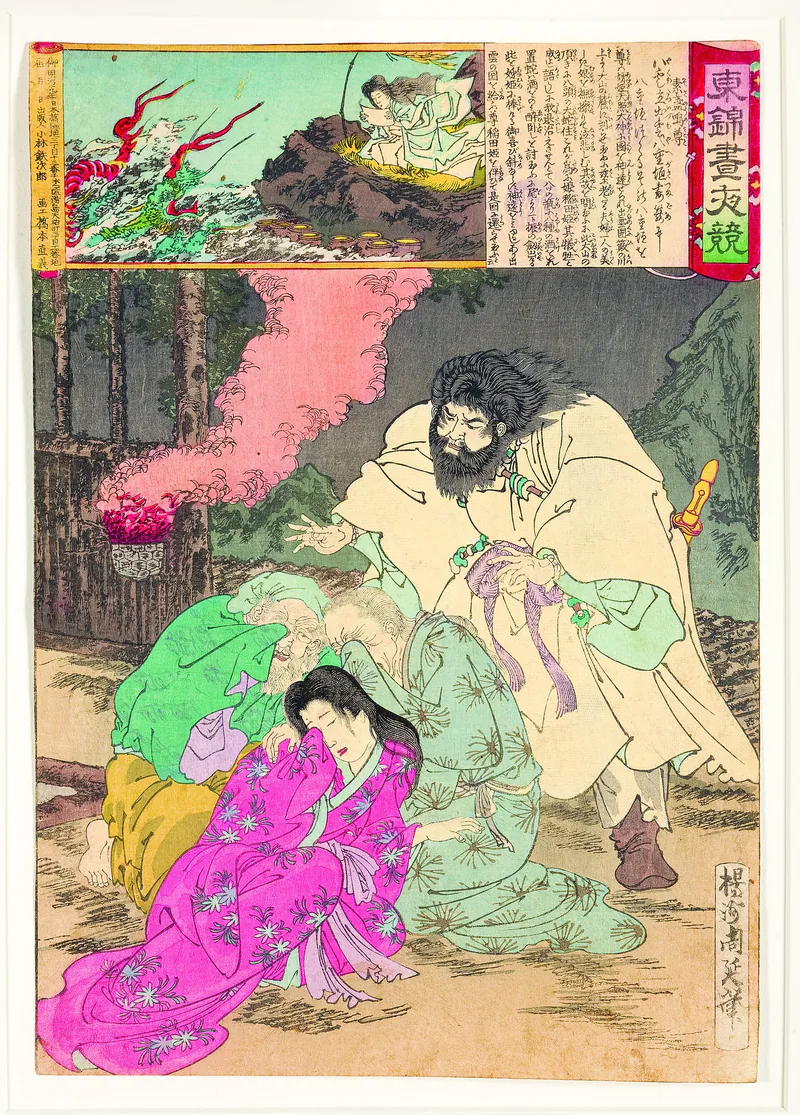
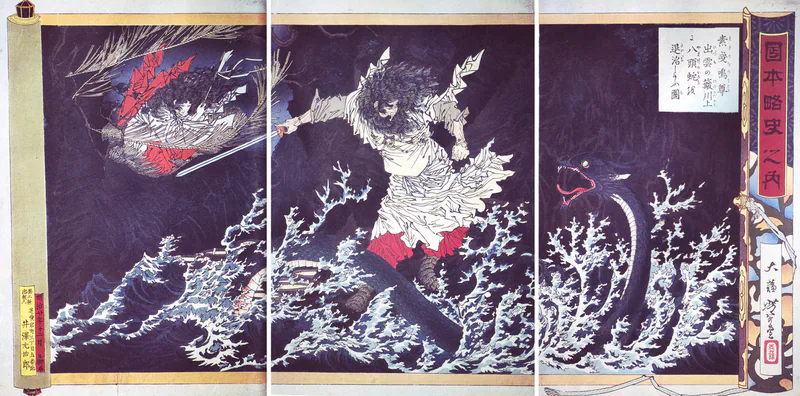
Susanoo reveals that he is Amaterasu's brother and asks for the girl's hand. He transforms her into a comb, which he places in his hair, and orders the parents to brew a strong rice wine refined eight times, to build a fence with eight gates and to place a vat of the wine at each gate. The serpent arrives, plunges each head into a vat, drinks and falls asleep. Susanoo draws his long sword and hacks the monster to pieces, until the Hi River runs with blood. When his blade strikes something hard in the middle tail, he cuts it open and finds a great sword, the Ame no Murakumo no Tsurugi, "Sword of the Gathering Clouds of Heaven". Recognising it as extraordinary, he presents it to Amaterasu. Later the hero Yamato Takeru is said to have used it to mow down burning grass, earning it the name Kusanagi, "Grass-Cutter"; it became one of the three imperial regalia and is said to be enshrined at Atsuta Shrine in Nagoya.
Susanoo then builds a palace at Suga, declaring that his heart feels refreshed (sugasugashi), and as clouds rise he sings a poem about the "eightfold fence" of Izumo that he builds to shelter his bride. Tradition counts it as the first waka poem in Japanese.
Interpretations of the Orochi story are many. Some scholars read the serpent as the flooding Hi River, whose many tributaries resemble its heads; others connect its bloody belly and the sword in its tail with the iron sand and smelting of the Izumo region; others see a political myth of Yamato's subjugation of Izumo. Comparativists have compared the story with Greek and Indo-European dragon-slaying myths such as that of Perseus and Andromeda. None of these readings is conclusive, and they may complement one another.
Lord of the Root Land: Susanoo and Ōkuninushi§
After his victory Susanoo eventually goes to the Ne no Kuni, the "Root Land", a netherworld associated with his mother. There he appears in a different role, as a stern father-in-law. His descendant Ōnamuchi, fleeing his murderous brothers, comes to Susanoo's palace and falls in love with Susanoo's daughter Suseribime. Susanoo tests him by making him sleep in a room of snakes and another of centipedes and wasps and by setting fire to a field around him, but with Suseribime's help the young god survives. Finally Ōnamuchi ties Susanoo's hair to the rafters while he sleeps and escapes with his daughter, his sword, bow and lute. Susanoo shouts after them, telling him to subdue his brothers and become Ōkuninushi, "Great Master of the Land", the god later enshrined at Izumo Taisha.
The Nihon shoki records variant versions, in one of which Susanoo first descends to the Korean kingdom of Silla before crossing to Izumo, and in another plants forests from the hairs of his body. The Izumo fudoki (733), a provincial gazetteer, presents him more as a benign local deity associated with place names, and does not mention the serpent at all.
Susanoo, Gozu Tennō and the Gion Cult§
From the Heian period Susanoo was identified with Gozu Tennō, the "Ox-Head Heavenly King", a deity of epidemics of continental origin worshipped at the Gion shrine-temple in Kyoto. A tale preserved in a fragment of the Bingo fudoki tells how a wandering god was refused lodging by a rich man but welcomed by his poor brother, Somin Shōrai, whose descendants he promised to spare from plague if they wore a ring of reeds. The god identifies himself in the fragment as Susanoo. Talismans inscribed "descendants of Somin Shōrai" and the great reed rings (chi no wa) through which worshippers pass at summer purification rites preserve this story.
The Gion festival, one of Japan's great matsuri, developed from rites to placate such plague deities. After the Meiji separation of kami and buddhas the Gion shrine was renamed Yasaka Shrine in 1868, and Gozu Tennō was officially replaced by Susanoo. Today Susanoo is worshipped at Yasaka, at the many Hikawa shrines of the Kantō region, at Susa Shrine and Suga Shrine in Shimane, and at Yaegaki Shrine, where Kushinadahime is honoured as a goddess of marriage.
Frequently asked questions§
Who is Susanoo in Japanese mythology?§
Susanoo is the storm god and younger brother of the sun goddess Amaterasu, born from the nose of the creator god Izanagi. He is expelled from heaven for his violence, slays the eight-headed serpent Yamata no Orochi in Izumo and becomes the ancestor of the Izumo gods.
What is the Kusanagi sword?§
Kusanagi no Tsurugi, originally called Ame no Murakumo no Tsurugi, is the sword Susanoo found inside the tail of Yamata no Orochi. It is one of the three imperial regalia of Japan, together with a mirror and a jewel, and is said to be kept at Atsuta Shrine.
Is Susanoo good or evil?§
Neither label fits well. In heaven he is destructive and polluting, but in Izumo he is a heroic serpent-slayer, a husband and a cultural founder, and as a plague deity he both causes and averts disease. This ambivalence is typical of kami, who may show both rough and gentle aspects.
Sources and further reading§
- Nihongi: Chronicles of Japan from the Earliest Times to A.D. 697 — W. G. Aston, 1896
- Kojiki — Donald L. Philippi (trans.), 1968
- Records of Wind and Earth: A Translation of Fudoki with Introduction and Commentaries — Michiko Y. Aoki, 1997
- The Kojiki: An Account of Ancient Matters — Gustav Heldt (trans.), 2014
- The Fluid Pantheon: Gods of Medieval Japan — Bernard Faure, 2016
- Shinto: A History — Helen Hardacre, 2017