Liber XXVI · Shinto · Chapter V: Onmyodo
Abe no Seimei: The Legendary Onmyōji of Heian Japan
Abe no Seimei (921–1005), Japan's most famous onmyōji: his Heian court career, legends of shikigami and his fox mother, the Seimei star and shrine.

Abe no Seimei (921–1005) was a yin-yang master (onmyōji) of the Heian court and is the most celebrated figure in the history of Onmyōdō, Japan's tradition of divination, calendrical science and protective ritual. Historical records show him as a respected astronomer and ritualist serving emperors and the regent Fujiwara no Michinaga; legend made him a sorcerer who commanded spirit servants, was born of a fox, and defeated rival magicians.
Abe no Seimei in the Historical Record§
The historical Seimei is known chiefly from the diaries of Heian aristocrats, above all the Shōyūki of Fujiwara no Sanesuke and the Midō kanpakuki of Fujiwara no Michinaga, and from official records. His birth year of 921 is calculated from his reported age at death in 1005, and nothing reliable is known of his childhood. He belonged to the Abe, a family of no great rank, and trained in the Bureau of Yin and Yang (Onmyōryō), where later tradition says he studied under the masters Kamo no Tadayuki and Kamo no Yasunori.
Seimei appears in the records only in middle age. By the 970s he held the post of Doctor of Astronomy (tenmon hakase), responsible for observing the heavens and reporting unusual phenomena to the throne in sealed memorials. He later held a series of offices and rose to the junior fourth rank, an unusually high rank for a member of the technical bureaux. He served emperors from Murakami to Ichijō and became a trusted adviser to Michinaga, the most powerful man of the age.
A divination manual, the Senji ryakketsu ("Summary of Divination Judgements"), dealing with the Chinese method of the "six ren" (rikujin) performed with a divination board, is generally accepted as his work. Another text, the Hoki naiden, a compendium of calendrical lore and directional taboos, circulated under his name from the medieval period, but scholars regard the attribution as legendary.
Onmyōji at the Heian Court: Seimei's Work§
The court diaries show what an onmyōji actually did. Seimei divined the causes of illnesses and omens, selected auspicious days for journeys, building work and ceremonies, and advised on the directional taboos that governed movement around the capital. He performed rites of protection and purification on behalf of the emperor and nobles: rites to the Lord of Mount Tai, the Chinese ruler of life spans, for long life; purifications at rivers in which pollution was transferred to paper figures; and rites to quell earth spirits before construction. Diaries record a rain-bringing rite he performed in 1004 during a drought, which was credited with success and rewarded.

This was learned, prestigious work, rooted in Chinese texts on yin and yang and the five phases, astronomy and calendrics. Seimei's descendants inherited his position: together with the Kamo family, the Abe monopolised the Bureau of Yin and Yang from the late tenth century, and in the medieval period the senior Abe line took the name Tsuchimikado. In 1683 the Tokugawa shogunate confirmed the Tsuchimikado as licensers of onmyōji throughout Japan, a role they kept until Onmyōdō was abolished in 1870.
Seimei in Tales: Shikigami, Frogs and the Abdication of Kazan§
Within a century of his death, Seimei had become a figure of story. The historical tale Ōkagami ("The Great Mirror"), probably written in the late eleventh or early twelfth century, tells that on the night in 986 when Emperor Kazan secretly left the palace to take Buddhist vows, his carriage passed Seimei's house. Seimei was heard clapping his hands and exclaiming that the heavens showed signs of the emperor's abdication, and he ordered an unseen servant to go to the palace; the servant replied that the emperor was at that moment passing the gate.
The Konjaku monogatari shū, a large collection of tales compiled around the 1120s, adds more. As a boy accompanying his teacher Kamo no Tadayuki at night, Seimei alone saw a band of demons approaching the carriage and woke his master, who concealed them by magic and thereafter taught Seimei everything. In another tale, monks at the Hirosawa temple ask him whether he can kill a man with his arts. He says he could, but it would be a waste of effort; instead he plucks a leaf of grass, recites a spell and throws it on a frog, which is crushed. People said that his house opened and closed its shutters with no one present, because he was served by shikigami, invisible spirits under his command. Later lore held that he kept them under the Ichijō Modori Bridge in Kyoto because his wife feared them.
The term shikigami is obscure in origin; it may refer to spirits associated with the divination board (shiki) used by onmyōji. In the tales they function as messengers and agents, and in later centuries they were imagined in a variety of forms, sometimes as paper figures brought to life. The famous fourteenth-century picture scroll Fudō riyaku engi shows Seimei performing a rite with two small demon-like figures crouching beside him, among the earliest images of shikigami.
Kuzunoha: The Fox Mother of Seimei§
The most famous legend about Seimei concerns his birth. According to the tale, his father, Abe no Yasuna, saved a white fox from hunters in the forest of Shinoda in Izumi Province (in present-day Osaka Prefecture). Soon afterwards a beautiful woman named Kuzunoha came to him; they married and had a son. When the boy was a few years old, he glimpsed his mother's fox nature, and she was forced to leave, writing a farewell poem inviting her husband and son to seek her in the forest of Shinoda. The child inherited from her his extraordinary powers of insight.
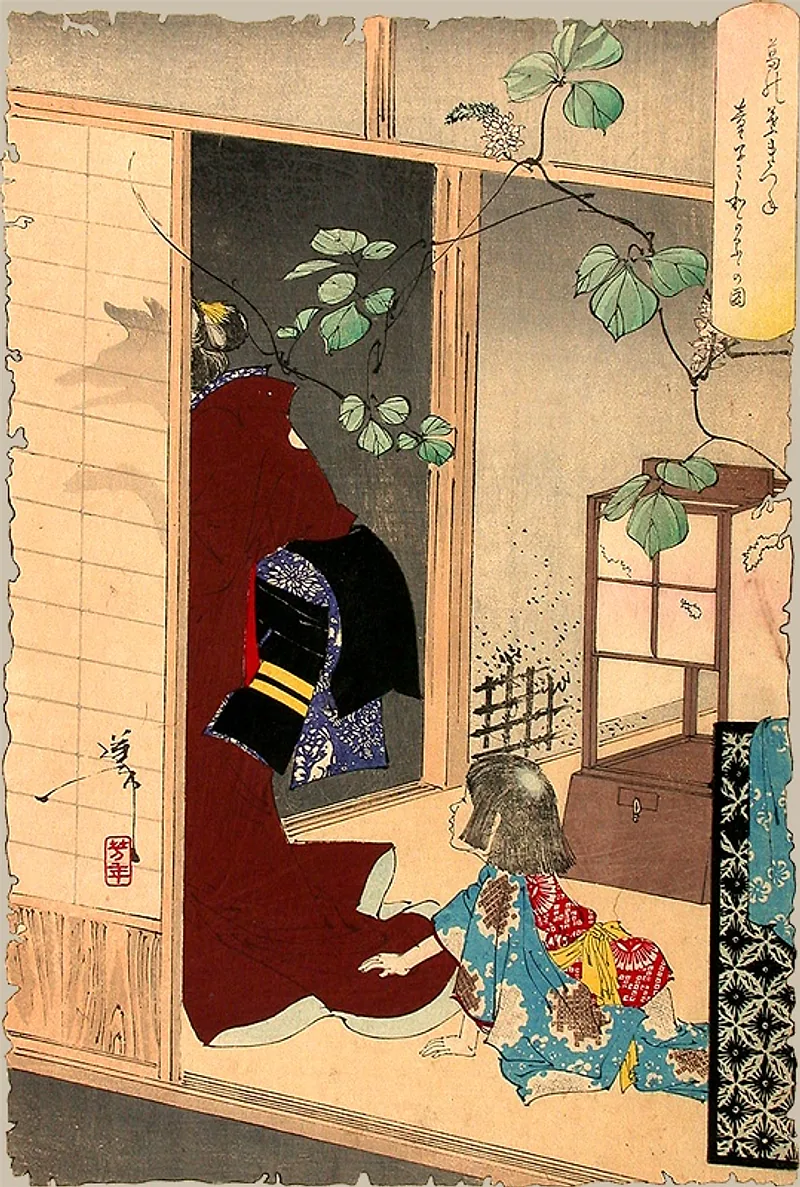
The story is not found in the early sources. It first appears in late medieval commentaries on the Hoki naiden and was developed in seventeenth-century storytelling, reaching its classic form in the puppet play Ashiya Dōman ōuchi kagami (1734) by Takeda Izumo I, later adapted for kabuki. The scene of Kuzunoha's farewell, in which the actor writes the poem on a paper screen, sometimes with the brush held in the mouth, became one of the best-loved moments of the theatre. A shrine dedicated to Kuzunoha stands in the Shinoda forest, and the Abeno district of Osaka also claims Seimei's birthplace. The fox-mother theme reflects a long tradition of fox wives described in Kitsune: fox spirits in Japanese folklore.
Ashiya Dōman and the Rival Sorcerer§
Legend gave Seimei a rival: Ashiya Dōman, an independent sorcerer from Harima Province. In a story in the Uji shūi monogatari (early thirteenth century), Michinaga's white dog refuses to let him enter the gate of his temple, the Hōjōji. Seimei is summoned and discovers a curse buried in the ground: two earthenware vessels bound together with a yellow paper cord and marked with a single character in vermilion. He folds a piece of paper into the shape of a bird and casts a spell; it flies off to the house of the man responsible, who confesses that he made the curse at the request of a rival noble and is banished to Harima. Historians note that the Hōjōji was built after Seimei's death, a sign of the tale's legendary character.
In later works, including the 1734 play, Dōman becomes Seimei's arch-enemy, contesting his inheritance of secret texts. The rivalry may echo real tensions between licensed court onmyōji and the many unofficial practitioners, often itinerant and sometimes ordained Buddhist monks, who offered similar services in the provinces. Seimei also appears in the Noh play Kanawa, in which he performs a rite to protect a man from the curse of a jealous former wife who has become a demon; the wider world of such beings is described in yōkai and Japanese folklore.
The Seimei Pentagram and the Seimei Shrine§
The five-pointed star known as the Seimei kikyō ("Seimei bellflower") or Seimei-in ("Seimei seal") is associated with Seimei and with Onmyōdō generally, where it is linked to the five phases. A grid of four horizontal and five vertical lines, called Dōman after his rival, is also used as a protective sign. Women divers (ama) of the Shima peninsula near Ise traditionally marked their tools and headcloths with both the seiman star and the dōman grid as charms against danger at sea. The use of the pentagram as a protective sign has parallels elsewhere, discussed in the pentagram.
The Seimei Shrine (Seimei Jinja) in Kyoto, on the traditional site of his residence, was according to its own tradition founded in 1007 by Emperor Ichijō, two years after Seimei's death, to honour him as a kami. It displays the star on its torii, lanterns and amulets. Seimei's reputed grave lies in the Saga district of Kyoto.
Seimei in Modern Japan§
After the abolition of Onmyōdō in 1870, Seimei survived as a figure of legend. From the late 1980s Yumemakura Baku's series of novels Onmyōji, followed by manga and a successful film of 2001, created a "Seimei boom" that recast him as an elegant, enigmatic hero. Pilgrims and fans have since visited the Seimei Shrine in large numbers, and he features widely in anime and games. Historians such as Shigeta Shin'ichi have meanwhile reconstructed the much more prosaic career of the real court official behind the legend.
Frequently asked questions§
Was Abe no Seimei a real person?§
Yes. Abe no Seimei was a historical onmyōji who lived from 921 to 1005 and served the Heian court as an astronomer, diviner and ritualist; his activities are recorded in contemporary diaries. The magical feats associated with him come from later tales and plays.
What are shikigami?§
Shikigami are spirits that an onmyōji was believed to command as servants and messengers. In the tales about Seimei they open his shutters, carry messages and act on his behalf; their exact nature is uncertain, and later lore imagined them in many forms.
Why is Abe no Seimei associated with a fox?§
A legend first recorded in the late medieval period says that his mother was a white fox, Kuzunoha, who took human form and married his father. The story, made famous by the puppet theatre in 1734, explained his supernatural abilities.
Sources and further reading§
- Japanese Tales — Royall Tyler, 1987
- Ōkagami, The Great Mirror: Fujiwara Michinaga (966–1027) and His Times — Helen Craig McCullough, 1980
- A Collection of Tales from Uji: A Study and Translation of Uji Shūi Monogatari — D. E. Mills, 1970
- The Fluid Pantheon: Gods of Medieval Japan — Bernard Faure, 2016
- The World of the Shining Prince: Court Life in Ancient Japan — Ivan Morris, 1964
- Kitsune: Japan's Fox of Mystery, Romance, and Humor — Kiyoshi Nozaki, 1961