Liber XXX · Symbols · Chapter III: Occult Symbols
The Pentagram: Meaning and History of the Five-Pointed Star
The pentagram's history and meaning: Mesopotamian signs, the Pythagorean 'health' star, Gawain's pentangle, Agrippa, Lévi's inverted star and Wicca.

The pentagram is a five-pointed star drawn with five straight lines in a single unbroken stroke. It is one of the oldest geometric signs in human use: it appears in Mesopotamia around 3000 BCE, was a Pythagorean badge of "health", stood for the five wounds of Christ in medieval England, protected doorways against nightmare spirits in German folklore and became, from the Renaissance onward, the chief emblem of the human microcosm in Western magic. Since the nineteenth century the upright pentagram has been associated with spirit ruling the elements and the inverted one with Satanism, and today the encircled pentagram is the main religious symbol of Wicca.
What Is a Pentagram? Geometry and Names§
A regular pentagram is formed by extending the sides of a regular pentagon, or by joining every second corner of one. The figure is unicursal, drawable without lifting the pen, and its five lines enclose a smaller pentagon at the centre, inside which another pentagram can be drawn, and so on without end. Each line is cut by the others in the golden ratio (about 1.618), so the figure was studied by mathematicians long before it became a magical emblem (see the golden ratio).
The name comes from Greek pente, "five", and gramma, "line" or "letter". It has had many others: pentalpha (because it can be seen as five interlaced letters A), pentangle in medieval English, Drudenfuss ("nightmare-spirit's foot") in German, and in medieval Jewish and Islamic lore it was sometimes one form of the Seal of Solomon, which could also be drawn as a hexagram.
Its five points invited many correspondences: the five senses, the five fingers, the five wounds of Christ, the five elements of later occultism (earth, water, air, fire and spirit) and the head and four limbs of the human body. Five-pointed stars on national flags and military insignia are usually solid stars without inner lines and belong to a different heraldic history.
The Pentagram in the Ancient World§
Pentagram signs appear on pottery and seals in Mesopotamia from the late fourth millennium BCE, and the figure occurs in early cuneiform, where scholars have connected it with a sign meaning "corner" or "region", possibly the quarters of the world. Its precise meaning at that date is uncertain, and modern claims that it was a symbol of a particular goddess should be treated with caution.
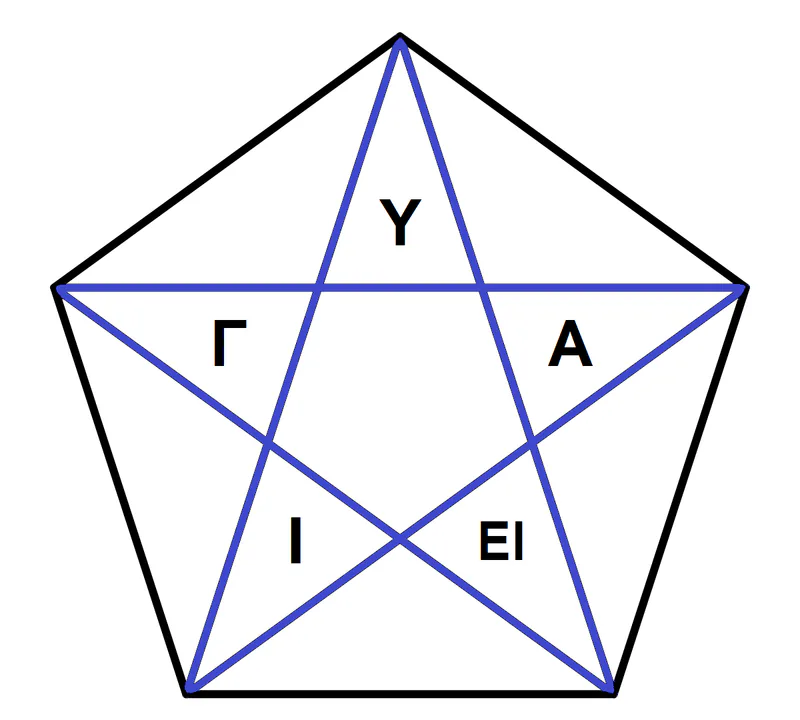
In the Greek world the pentagram is linked above all with the Pythagoreans. The satirist Lucian, writing in the second century CE, reports that they used the "triple interwoven triangle", the pentagram, as a sign of recognition among themselves and called it hygieia, "health". Later illustrations place the letters of that word at its points. Since early Pythagorean sources are fragmentary, scholars such as Walter Burkert caution against attributing late reports to Pythagoras himself; but the association between the pentagram, wholeness and well-being was firmly established in antiquity. The figure also appears on Greek coins and pottery, and some historians connect its prominence with the planet Venus, whose successive conjunctions with the sun over about eight years trace out an approximate pentagram on the zodiac, though there is no clear ancient text making that link.
The Christian Pentangle and the Seal of Solomon§
Medieval Christians gave the five points new meanings. The clearest example is the fourteenth-century English poem Sir Gawain and the Green Knight (c. 1390), whose hero bears a gold pentangle on a red shield. The poet calls it an "endless knot" and explains its five fives: Gawain's five senses, his five fingers, his faith in the five wounds of Christ, the five joys of Mary and five knightly virtues, among them generosity, fellowship, chastity, courtesy and piety. The poem also notes that the sign was "set by Solomon" as a token of truth, showing that the link with Solomon's ring was familiar to its audience.
In the medieval Islamic and Jewish world the seal of Solomon, with which the king was said to command the jinn and demons, was drawn sometimes as a pentagram and sometimes as a hexagram, and both forms appear on amulets, bowls and coins. In German-speaking lands the pentagram, called Drudenfuss, was carved or chalked on doors, cradles and stable thresholds to keep away the Drude, a spirit believed to cause nightmares by sitting on sleepers. Goethe used this folk belief in Faust Part One (1808): Mephistopheles cannot leave Faust's study because a pentagram is drawn on the threshold, until he notices that one of its angles has been left open. Such uses belong to the wider world of protective magic.
Agrippa and the Pentagram as the Human Microcosm§
In Renaissance occult philosophy the pentagram became a diagram of humanity's place in the cosmos. In Book II of his Three Books of Occult Philosophy (1533), Heinrich Cornelius Agrippa discusses geometrical figures and their virtues and states that the pentagram, by the power of the number five, has great authority over evil spirits. A few chapters later, in his treatment of the proportions of the human body, he prints a figure of a man with arms and legs outstretched inside a pentagram, with the signs of the planets placed around him. The body is the microcosm, the small world that mirrors the great world, and the five-pointed star maps the limbs and head onto the heavens. Agrippa's chapters can be read in the 1651 English translation in the reading room.

Pentagrams also appear in the grimoire tradition, especially on the protective seals and "pentacles" of the Key of Solomon. There the word pentacle (from Old French, related to a word for a hanging ornament, and later linked with penta-) refers to any consecrated disc or sheet bearing sacred names and figures, whether or not it contains a five-pointed star. The modern habit of using "pentacle" for an encircled pentagram is a later narrowing of meaning.
Éliphas Lévi and the Inverted Pentagram§
The meaning of the pentagram's orientation is largely an invention of the nineteenth century. The French occultist Éliphas Lévi, in Dogme et rituel de la haute magie (1854–56), called the pentagram the sign of the microcosm and of the intellect's mastery over the elements. Upright, with one point above, it signified the spirit ruling the four elements; reversed, with two points above, it represented the goat of the witches' sabbath attacking heaven with its horns. Lévi wrote that the inverted figure was a sign of evil, while the upright one put demons to flight.
Lévi's followers made the image concrete. Stanislas de Guaita's La Clef de la magie noire (1897) printed a goat's head drawn within an inverted pentagram, labelled with the Hebrew letters of Samael and Lilith. The Church of Satan, founded by Anton LaVey in 1966, adopted a modified version, now called the Sigil of Baphomet, with the Hebrew letters of "Leviathan" around the rim, and it became the best-known emblem of modern Satanism. Because of this history, during the Satanic Panic of the 1980s any pentagram was often taken as evidence of devil worship.
The convention is not universal. The Order of the Eastern Star, a Masonic-related organisation founded in the nineteenth century, uses a point-down star whose five points honour biblical heroines, and some modern pagans use the inverted pentagram to mark a second degree of initiation in certain Wiccan lineages.
The Golden Dawn, Wicca and the Modern Pentacle§
The Hermetic Order of the Golden Dawn, founded in 1888, built the pentagram into ritual. It assigned spirit to the top point and the four elements to the others, and taught that tracing the figure in the air in different directions invoked or banished the elemental forces. Its best-known exercise, the Lesser Banishing Ritual of the Pentagram, is still widely practised by ceremonial magicians.
In Wicca, as developed by Gerald Gardner from the 1940s, the pentacle, a disc engraved with a pentagram and other symbols, is one of the working tools on the altar and represents the element of earth. The encircled pentagram, worn as jewellery, became the principal emblem of Wicca and of much wider modern paganism, read as the elements united by spirit within the circle of the whole. In 2007, after legal action by Wiccan families, the United States Department of Veterans Affairs added the pentacle to the emblems of belief that may be engraved on government-issued headstones of service members.
The pentagram also passed into tarot. Lévi and later the Golden Dawn linked the suit of coins with the pentacle, and the Rider–Waite–Smith deck of 1909 made "Pentacles" its standard name (see the Minor Arcana). The wider family of esoteric emblems is surveyed in Occult Symbols.
Frequently asked questions§
Is the pentagram a satanic symbol?§
Not in itself. For most of its history the pentagram was a symbol of health, protection, Christ's wounds or the human microcosm. Its association with Satanism comes mainly from Éliphas Lévi's nineteenth-century reading of the inverted star and from the emblem adopted by the Church of Satan in the late 1960s.
What is the difference between a pentagram and a pentacle?§
A pentagram is the five-pointed star itself. A pentacle, in the grimoires, is any consecrated talismanic disc with sacred names or figures; in modern Wicca it usually means a disc or emblem bearing an encircled pentagram.
What do the five points of the pentagram represent?§
The answer depends on the tradition: the five wounds of Christ, the five senses, the head and limbs of the human body, or, in modern occultism and Wicca, the four elements crowned by spirit.
Sources and further reading§
- Three Books of Occult Philosophy — Henry Cornelius Agrippa, 1533
- Transcendental Magic: Its Doctrine and Ritual — Eliphas Lévi, 1856
- Sir Gawain and the Green Knight — Anonymous, c. 1390
- Lore and Science in Ancient Pythagoreanism — Walter Burkert, 1972
- The Golden Dawn — Israel Regardie, 1937
- The Triumph of the Moon: A History of Modern Pagan Witchcraft — Ronald Hutton, 1999
- The Key of Solomon the King — S. L. MacGregor Mathers, 1889