Liber XXX · Symbols · Chapter III: Occult Symbols
Eye of Providence: History of the All-Seeing Eye Symbol
The Eye of Providence explained: the all-seeing eye of God in Christian art, the eye in the triangle, Freemasonry, the Great Seal and the dollar bill.

The Eye of Providence, or all-seeing eye, is a symbol of God's watchful care: a single human eye, usually set within a triangle and surrounded by rays of light. It developed in Christian art of the late Middle Ages and Renaissance, where the triangle stood for the Trinity, and from there passed into Freemasonry, the art of the French Revolution and the Great Seal of the United States, whose reverse has been printed on the American one-dollar bill since 1935. Its modern reputation as an "Illuminati" sign is a twentieth-century conspiracy reading with no basis in the symbol's history.
What the Eye of Providence Shows§
The classic form has three elements. The eye is a single open human eye, looking straight at the viewer. The triangle, usually equilateral and pointing upwards, encloses the eye. A glory of rays, sometimes with clouds, radiates from the triangle in all directions. Together they say that God sees everything, that the God who sees is the triune Father, Son and Holy Spirit, and that his gaze is a source of light rather than menace.
"Providence" (Latin providentia, "foresight") is the theological term for God's continuing governance of creation: knowing in advance, caring for and guiding all things toward their end. The symbol is therefore not primarily about surveillance but about protection and order, though it could also warn the sinner that nothing is hidden. Variants omit the triangle, place the eye in a cloud or sun, or combine it with the Hebrew letters of the divine name. It should not be confused with the Egyptian Eye of Horus (wedjat), a protective amulet of a different form and meaning described in ancient Egyptian amulets, or with the third eye of Indian and modern esoteric thought, although popular books often link all three.
The Eye of God in the Bible and Medieval Art§
The image rests on a biblical metaphor. "The eyes of the LORD are in every place, beholding the evil and the good," says Proverbs 15, and the Psalms speak of the eye of the Lord upon those who fear him (Psalm 33). In the book of Zechariah, seven eyes "run to and fro through the whole earth". Medieval theologians developed the idea of God's knowledge in philosophical terms, and preachers used it to remind listeners that every act and thought lay open before God.
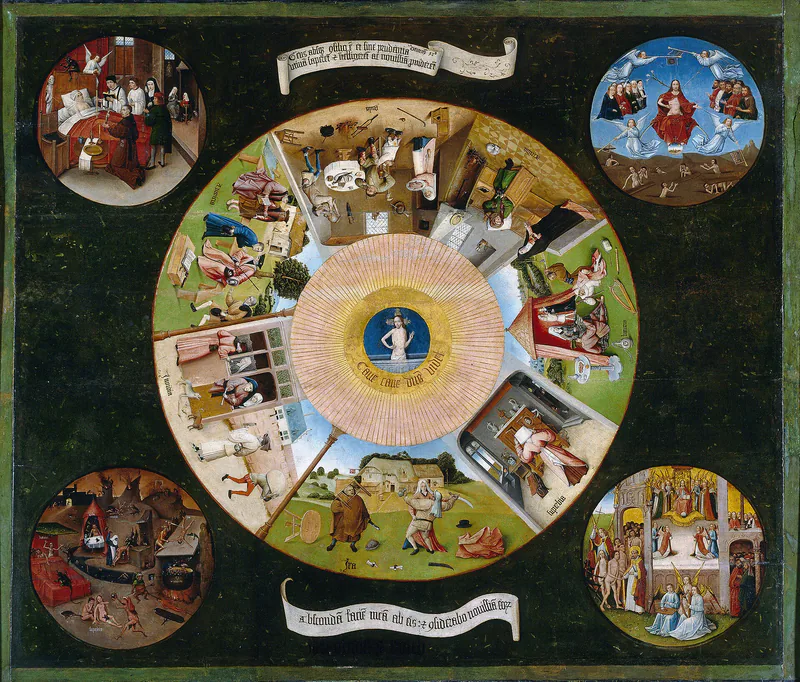
Medieval art usually showed God's presence through a hand emerging from a cloud or through a full figure of Christ or the Father, not through a disembodied eye. One of the most striking early uses of the eye as a visual programme is the painted tabletop of the Seven Deadly Sins and the Four Last Things attributed to Hieronymus Bosch (around 1500, now in the Prado). Its centre is a great circular eye whose pupil shows the risen Christ, surrounded by scenes of the seven sins and the inscription Cave cave deus videt, "Beware, beware, God sees." The work turns the viewer's own gaze into a confrontation with the divine gaze, a moral use of the image that later emblem books would continue.
The Eye in the Triangle: Renaissance and Baroque Christianity§
The combination of eye and triangle appears in the sixteenth century. A frequently cited early example is Jacopo Pontormo's Supper at Emmaus (1525), painted for the Carthusian monastery near Florence, in which an eye within a triangle hovers above the head of Christ as he blesses the bread. The triangle had long served as an emblem of the Trinity, one figure with three equal sides, and joining it to the eye produced a compact image of the triune God who sees all. The doctrine behind it is outlined in the Trinity: history of the doctrine.
In the seventeenth and eighteenth centuries the symbol became widespread. Emblem books, which paired images with mottos and verses, used the eye in clouds or a triangle to illustrate divine providence, vigilance and conscience. In Baroque churches across Catholic Europe, and in Orthodox and Lutheran churches in central and eastern Europe, a gilded triangle with an eye in a burst of rays was placed above altars, on pulpits and on ceilings. It also appeared on title pages, tombstones and printers' devices. By 1750 it was simply one of the standard ways of picturing God, uncontroversial and widely understood.
The All-Seeing Eye in Freemasonry§
Freemasonry, which took its developed form in Britain in the early eighteenth century, adopted many emblems from the Christian and emblematic culture around it. The all-seeing eye appears among Masonic symbols in the later eighteenth century, on aprons, certificates, jewels and the painted boards (tracing boards) used to teach the degrees. In Masonic usage the eye normally stands alone, often in a sunburst or cloud, rather than within a triangle.
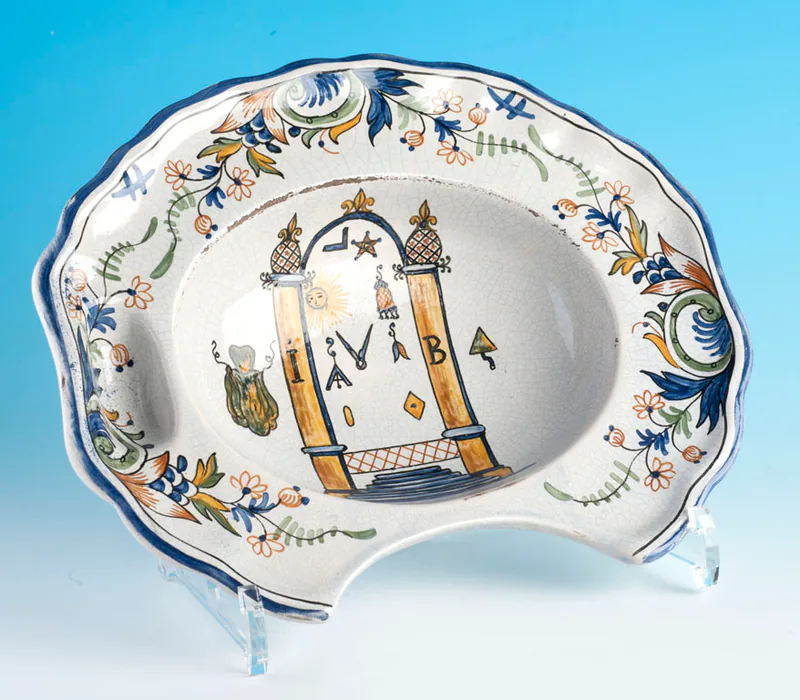
Masonic handbooks explained it in moral terms. The American lecturer Thomas Smith Webb, in his Freemason's Monitor (1797), describes it as an emblem of the Supreme Being, whom the sun, moon and stars obey and who sees into the human heart and will reward its works. This is a non-denominational version of the Christian meaning, suited to a fraternity that admitted men of different churches and required only belief in a Supreme Being. The fraternity's history and symbols are covered in Freemasonry. The pyramid, by contrast, is not a traditional Masonic emblem, a fact that matters for the next part of the story.
The Great Seal of the United States and the Dollar Bill§
On 4 July 1776 the Continental Congress appointed Benjamin Franklin, Thomas Jefferson and John Adams to design a seal for the new nation. Their consultant, the Swiss-born artist Pierre Eugène du Simitière, proposed among other things an Eye of Providence in a radiant triangle. Congress did not adopt the committee's design, but the eye survived through later committees. In 1782 the lawyer William Barton and the secretary of Congress Charles Thomson produced the final design. Its obverse shows the bald eagle; its reverse shows an unfinished pyramid of thirteen courses, dated MDCCLXXVI (1776) at the base, beneath an eye in a triangle of glory.
Thomson explained the meaning in his report: the pyramid signified strength and duration, and the eye and the motto Annuit coeptis ("He has favoured our undertakings") alluded to the many interventions of Providence in favour of the American cause. The second motto, Novus ordo seclorum, "a new order of the ages", adapts a line of Virgil's fourth Eclogue and refers to the new American era beginning in 1776. Of the men who shaped the reverse, Franklin was a Freemason, but his committee's design was not adopted, and neither Barton nor Thomson is known to have been one.
The reverse was rarely used until 1935, when, at the suggestion of Secretary of Agriculture Henry A. Wallace and with the approval of President Franklin D. Roosevelt, both sides of the seal were printed on the one-dollar bill. Wallace, who had interests in esoteric spirituality, later recalled being struck by the motto, which he read as a "New Deal of the ages". Richard Patterson and Richardson Dougall's official history, The Eagle and the Shield, documents the seal's development in detail.
Revolution, Cao Đài and Modern Conspiracy Theories§
The eye travelled with the political symbolism of the Enlightenment. Jean-Jacques-François Le Barbier's well-known painting of the Declaration of the Rights of Man and of the Citizen (1789) places an eye in a triangle of rays above the text, presiding over the new constitutional order as the "Supreme Being" of the revolutionary era. In the twentieth century the Vietnamese religion Cao Đài, founded in 1926, made a left eye within a triangle or globe its central emblem of God, as described in syncretic new religions.
The modern conspiracy reading of the symbol grew in the later twentieth century. Writers combined the eye and pyramid on the dollar with the eighteenth-century Bavarian Illuminati, founded on 1 May 1776, and with fears of a "New World Order", a mistranslation of novus ordo seclorum. The Illuminati, a short-lived Enlightenment society suppressed in the 1780s, did not use the eye as its emblem, and the seal's designers had no known connection with it. The eye-in-pyramid nevertheless became a stock image of secret power in popular fiction, music videos and the internet, a process traced in Michael Barkun's A Culture of Conspiracy and in conspiracy myths. The broader fate of esoteric signs in popular culture is surveyed in occult symbols.
Frequently asked questions§
What does the Eye of Providence mean?§
It represents the eye of God watching over creation with care and knowledge. In Christian art the triangle around it stands for the Trinity and the rays for divine glory.
Is the eye on the dollar bill a Masonic symbol?§
Not in origin. The eye in a triangle was a common Christian emblem when the Great Seal was designed in 1782, the pyramid is not a traditional Masonic symbol, and the designers of the seal's reverse are not known to have been Freemasons. Freemasons did use an all-seeing eye, which explains the frequent confusion.
Is the all-seeing eye connected with the Illuminati?§
There is no historical evidence for it. The Bavarian Illuminati did not use the eye as an emblem, and the link was popularised by twentieth-century conspiracy literature that connected the dollar bill with the order because both date from 1776.
Sources and further reading§
- The Eagle and the Shield: A History of the Great Seal of the United States — Richard S. Patterson and Richardson Dougall, 1976
- The Freemason's Monitor; or, Illustrations of Masonry — Thomas Smith Webb, 1797
- Revolutionary Brotherhood: Freemasonry and the Transformation of the American Social Order, 1730–1840 — Steven C. Bullock, 1996
- A Culture of Conspiracy: Apocalyptic Visions in Contemporary America — Michael Barkun, 2003
- The Divine Eye and the Diaspora: Vietnamese Syncretism Becomes Transpacific Caodaism — Janet Alison Hoskins, 2015
- Signs and Symbols in Christian Art — George Ferguson, 1954