Liber XXX · Symbols · Chapter II: Number Symbolism
The Number Twelve: Its Sacred Meaning in Religion and Myth
Why twelve is sacred: months and zodiac, the Twelve Olympians, twelve tribes and apostles, the New Jerusalem, Twelver Shi'ism, and twelve in esoteric lore.

Twelve is the sacred number of cosmic and social order. It comes from the year, which contains about twelve lunar months, and from the division of the sky into twelve zodiac signs; from there it became the number of the Olympian gods, the tribes of Israel, the apostles of Jesus, the gates of the heavenly Jerusalem, the Imams of Twelver Shi'ism and the animals of the Chinese calendar. Where seven often signifies holiness and completion in time, twelve usually signifies a complete and ordered whole: a full year, a full people, a full assembly of gods or judges.
Twelve and the Heavens: Months, Zodiac and Hours§
A solar year lasts about 365¼ days, and a lunar month about 29½. Twelve lunar months therefore fall about eleven days short of a year, and thirteen overshoot it. Nearly every ancient calendar that counted months settled on twelve, adding an extra "leap" month when needed, as the Babylonian and Hebrew calendars did, or abandoning the true lunar month, as the Egyptian and later Roman calendars did. Twelve became the natural number of the year's parts.
The zodiac followed. Babylonian astronomers traced the path of the Sun, Moon and planets through a band of constellations, and by about the fifth century BCE they had standardised it as twelve equal signs of thirty degrees each, a scheme the Greeks adopted and passed on to Western and Indian astrology. Each sign corresponds roughly to a month of the Sun's journey (see the zodiac and the planets and the Western horoscope).
The day itself was divided by twelves. Egyptians divided the night into twelve hours, a scheme dramatised in the New Kingdom Books of the Netherworld, in which the sun god travels through twelve regions of the underworld each night; the daylight was likewise given twelve hours. The Babylonians divided the full day into twelve double-hours. Our twenty-four-hour day and the twelve-numbered clock face descend from these systems. Twelve's practical advantages, being divisible by two, three, four and six, also made it a favourite base for counting: dozens and grosses, twelve pence to the shilling and twelve inches to the foot.
The Twelve Gods of Greece and Rome§
The Greeks spoke of "the Twelve Gods" (dōdeka theoi) as the principal assembly of Olympus. The membership varied: Zeus, Hera, Poseidon, Demeter, Athena, Apollo, Artemis, Ares, Aphrodite, Hermes and Hephaestus were almost always included, while the twelfth place went to Hestia or Dionysus, and other lists differ more widely. The number mattered more than the names. In Athens an Altar of the Twelve Gods was set up in the agora in 522/521 BCE and served as the city's central milestone, and Rome adopted a parallel group of twelve Di Consentes, whose gilded statues stood in the Forum.
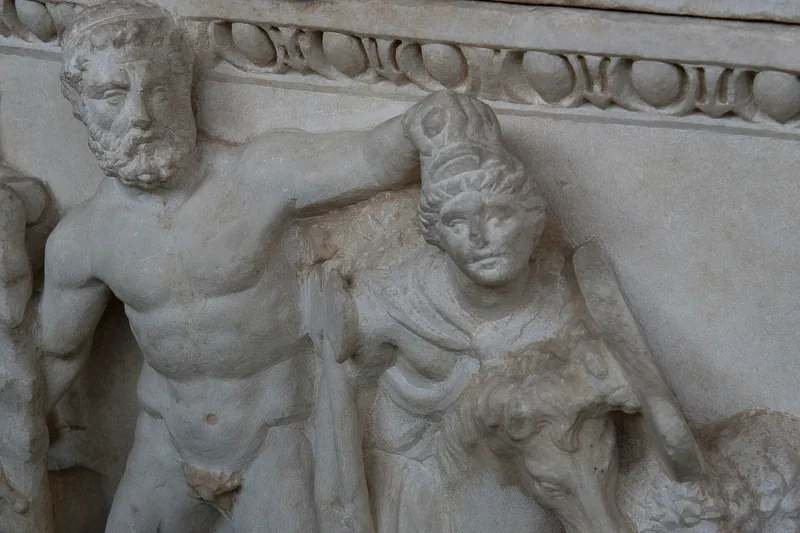
Twelve also structured Greek myth. Hesiod's Theogony lists twelve Titans, six sons and six daughters of Earth and Sky, and the labours of Heracles came to be fixed at twelve. The twelve metopes of the Temple of Zeus at Olympia (c. 460 BCE) are among the earliest groupings of the labours as a set of twelve, though the canonical list varied for some time, and later writers linked them with the Sun's passage through the twelve signs. For the wider religious background see Greek religion and the mysteries.
Twelve Tribes and the High Priest's Breastplate§
In the Hebrew Bible twelve is the number of the people of Israel. Jacob has twelve sons, ancestors of the twelve tribes, and the tradition kept the number at twelve even when the tribal lists changed: when Levi became a priestly tribe without territory, Joseph's two sons Ephraim and Manasseh were counted separately to keep the total. The high priest's breastplate held twelve precious stones, each engraved with the name of a tribe (Exodus 28), stones that later inspired traditions of birthstones and gem symbolism. Twelve loaves of showbread were set out before God each Sabbath, Moses sent twelve spies into Canaan, Joshua set up twelve stones from the Jordan, and Elijah built his altar on Mount Carmel from twelve stones "according to the number of the tribes".
Twelve thus represented Israel as a complete and ordered whole under God. Even after the northern tribes were lost following the Assyrian conquest of 722 BCE, prophets looked forward to the restoration of all twelve. The collection of twelve shorter prophetic books, the "Book of the Twelve", reflects the same habit of thinking in twelves.
Twelve Apostles and the New Jerusalem§
Jesus' choice of twelve apostles was understood as a deliberate sign. In the Gospels he promises that the twelve will sit on twelve thrones "judging the twelve tribes of Israel" (Matthew 19), presenting his movement as the renewal of the whole people. After the death of Judas, the remaining eleven chose Matthias to make up the number again (Acts 1). The feeding of the five thousand ends with twelve baskets of leftovers, and the daughter of Jairus, healed by Jesus, is twelve years old.
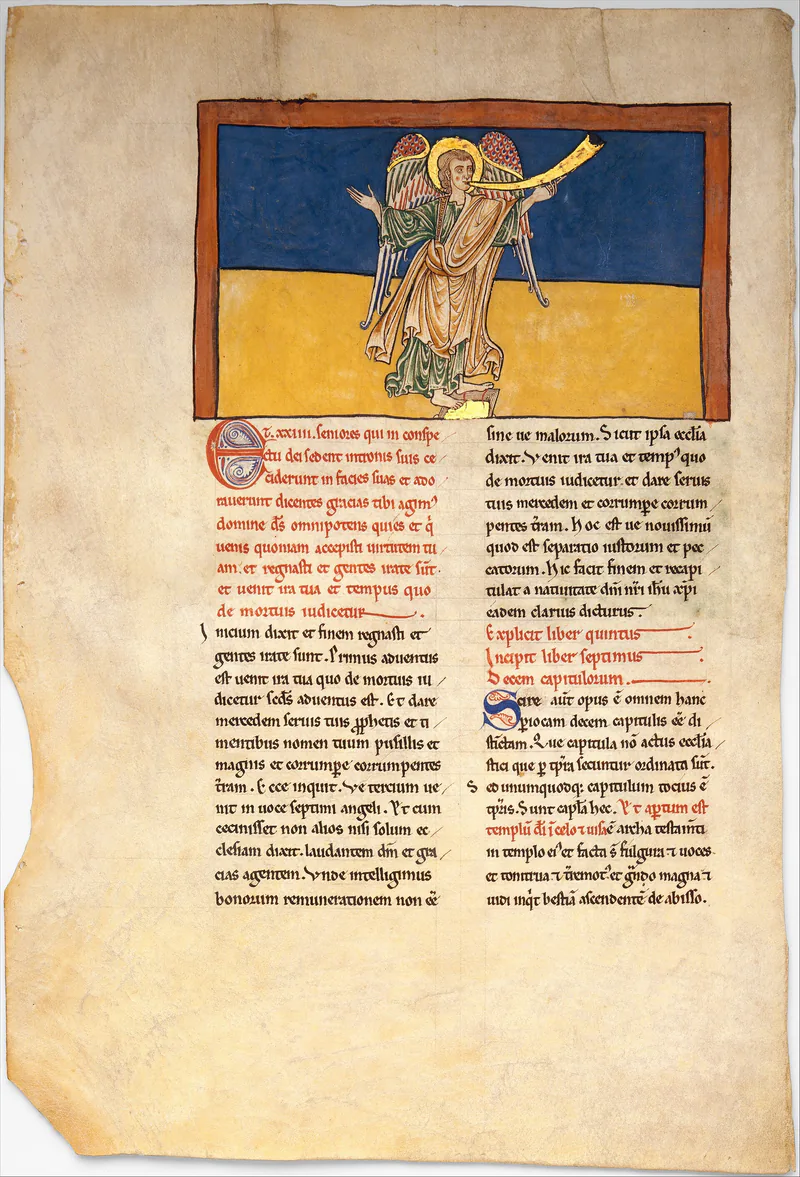
The Book of Revelation builds its final vision on twelve. A woman appears in heaven crowned with twelve stars, and 144,000 servants of God are sealed, twelve thousand from each tribe. The New Jerusalem that descends from heaven is a perfect cube of twelve thousand furlongs, with twelve gates bearing the names of the tribes, guarded by twelve angels, and twelve foundations bearing the names of the twelve apostles, each adorned with a precious stone; the tree of life bears twelve kinds of fruit, one for each month (Revelation 21 and 22). Medieval commentators read twelve as three times four, the Trinity multiplied through the four corners of the world, so that the apostles carried the faith to the whole earth. Medieval artists, especially in the illuminated Beatus manuscripts of Spain, drew the heavenly city as a square with three gates on each side. Christian custom later added the twelve days of Christmas and twelve major feasts in the Orthodox year. See Biblical numerology.
Twelve in Islam, Buddhism and East Asia§
The Qur'an states that the number of months with God is twelve (Surat at-Tawba) and recounts how Moses struck a rock from which twelve springs gushed, one for each tribe (Surat al-Baqara). The largest branch of Shi'a Islam is called Twelver (Ithna 'Ashari) because it recognises twelve Imams descended from the Prophet through Ali and Fatima, the last of whom, Muhammad al-Mahdi, is believed to have gone into occultation in the ninth century and to be destined to return (see Sunni and Shia Islam).
In Buddhism, the chain of dependent origination (pratītyasamutpāda) has twelve links, from ignorance through birth to ageing and death, explaining how suffering arises and how it may cease (see core teachings of Buddhism). In China, the twelve Earthly Branches count years, months and double-hours, and since at least the Han dynasty they have been matched with twelve animals, the rat, ox, tiger, rabbit, dragon, snake, horse, goat, monkey, rooster, dog and pig. The planet Jupiter's orbit of roughly twelve years may lie behind the twelve-year cycle. See Chinese astrology and the Chinese horoscope.
In northern Europe, Snorri Sturluson's Prose Edda (c. 1220) speaks of twelve divine Æsir, and medieval romance gave Charlemagne twelve peers. Juries of twelve in English common law, a custom established by the later Middle Ages, have often been explained by analogy with the apostles, though their real origins are more practical.
Twelve in Western Esotericism and Folk Custom§
The Sefer Yetzirah, an early Jewish cosmological text, divides the twenty-two letters of the Hebrew alphabet into three "mothers", seven "doubles" and twelve "simple" letters. The twelve simple letters are linked with the twelve signs of the zodiac, the twelve months and twelve parts of the body. Renaissance Christian kabbalists and, later, the Hermetic Order of the Golden Dawn built on this scheme, assigning the twelve simple letters to the zodiacal paths of the Tree of Life and to the corresponding tarot trumps. Heinrich Cornelius Agrippa's Three Books of Occult Philosophy (1533) gives a "scale of the number twelve" listing the twelve signs alongside angels, tribes, apostles, months, plants, stones and animals (read it here).
Twelve also structures larger magical numbers. The seventy-two names of God and the seventy-two angels of the Shem ha-Mephorash are six times twelve, and astrologers divide each sign into "decans" to obtain thirty-six faces. In tarot, the twelfth trump is The Hanged Man. Folk belief sometimes treated thirteen as unlucky precisely because it broke the completeness of twelve, a theme discussed in lucky and unlucky numbers and days. Seen together with seven, twelve completes the two great sacred numbers of the ancient calendar: seven of the planets and the week, twelve of the zodiac and the year. For the wider picture see Number Symbolism.
Frequently asked questions§
Why is twelve considered a perfect number?§
It is not "perfect" in the mathematical sense, but it was seen as complete because the year has about twelve lunar months and the zodiac twelve signs. Its divisibility by two, three, four and six also made it convenient for counting and measurement.
What does twelve mean in the Bible?§
It signifies the whole people of God: the twelve tribes of Israel in the Old Testament and the twelve apostles in the New. Revelation's New Jerusalem, with its twelve gates and foundations, unites both.
Why are there twelve signs of the zodiac?§
Because the Sun completes its yearly circuit in roughly twelve lunar months. Babylonian astronomers standardised twelve equal signs of thirty degrees by about the fifth century BCE.
Sources and further reading§
- Medieval Number Symbolism: Its Sources, Meaning, and Influence on Thought and Expression — Vincent Foster Hopper, 1938
- The Mystery of Numbers — Annemarie Schimmel, 1993
- Mapping Time: The Calendar and Its History — E. G. Richards, 1998
- The Heavenly Writing: Divination, Horoscopy, and Astronomy in Mesopotamian Culture — Francesca Rochberg, 2004
- Sefer Yetzirah: The Book of Creation — Aryeh Kaplan, 1990
- Three Books of Occult Philosophy — Henry Cornelius Agrippa, 1533
- The Prose Edda — Snorri Sturluson, c. 1220