Liber XXX · Symbols · Chapter II: Number Symbolism
The Number Three: Its Sacred Meaning in Religion and Myth
Why three is sacred: Pythagorean beginning, middle and end, divine triads, the Trinity, the Trimurti, the Three Jewels, alchemy's tria prima and folklore.

Three is the number of completeness in a great many religious and mythological traditions: the first number with a beginning, a middle and an end, the number of the triangle, and the number of divine triads from Mesopotamia and Rome to the Christian Trinity and the Hindu Trimurti. Greek philosophers called it the number of "the all", folk tales arrange heroes, trials and wishes in threes, and esoteric systems from Kabbalah to alchemy built their cosmologies on threefold principles. Its prestige rests less on the sky, as with seven and twelve, than on the structure of thought and language itself.
Why Three? Beginning, Middle and End§
Ancient Greek thinkers often did not treat one and two as numbers in the full sense: one was the source of number, two the principle of division. Three was therefore the first true number, and the first that has a beginning, a middle and an end. Aristotle, opening his treatise On the Heavens, reports the Pythagorean view that the universe and everything in it is determined by the number three, and adds that Greeks use the number three in the worship of the gods because they have learned it from nature. Three points define the first plane figure, the triangle, and three dimensions define a body.
Language reinforces the pattern. Many languages distinguish three grammatical persons (I, you, he or she), three tenses of time (past, present, future), and three degrees of comparison (good, better, best). Ritual formulas are repeated three times, and lists of three feel complete in a way that lists of two do not, a fact still exploited in rhetoric. The French scholar Georges Dumézil argued that early Indo-European societies organised their gods and social order according to three functions, sovereignty and the sacred, war, and fertility and production; his theory remains influential though much debated. For the general background see number symbolism and Pythagoras and Pythagorean number mysticism.
Divine Triads of the Ancient World§
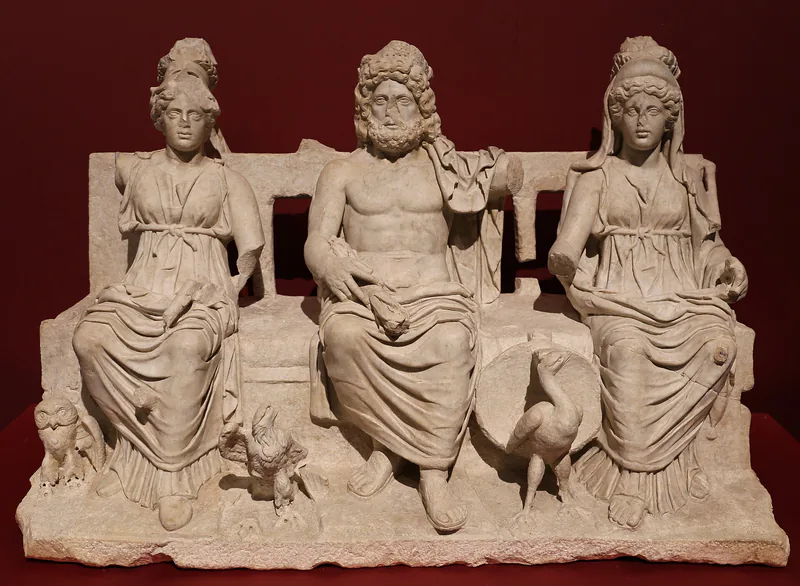
Groups of three gods appear across the ancient Near East and Mediterranean. In Mesopotamia, the great gods Anu, Enlil and Ea ruled sky, earth and the waters, and a second, astral triad of Sin (Moon), Shamash (Sun) and Ishtar (Venus) appears on boundary stones and seals. Egyptian temple theology often grouped deities into families of father, mother and child, such as Amun, Mut and Khonsu at Thebes, or the mythic family of Osiris, Isis and Horus. The Capitoline Triad of Jupiter, Juno and Minerva was worshipped in the chief temple of Rome on the Capitoline Hill, and Roman colonies built capitolia to the same three gods.
Female triads are especially common. The Greek Moirai or Fates spun, measured and cut the thread of life; the Norse Norns, named Urðr, Verðandi and Skuld, sat by the well at the root of the world tree; the Graces, the Furies and the Gorgons were also three. The goddess Hecate was shown in triple form at crossroads. In Roman Gaul and the Rhineland, hundreds of inscriptions and reliefs honour the Matres or Matronae, mother goddesses usually depicted as three seated women, and Irish tradition knew triple figures such as the war goddesses called the Morrígna and the three Brigids. Modern pagan ideas of a Maiden, Mother and Crone, examined in the triple goddess, draw on these sources but are largely a twentieth-century synthesis.
Three in the Bible and the Christian Trinity§
Three recurs throughout the Bible as a number of completion and of decisive time. Abraham receives three visitors at Mamre (Genesis 18), whom Christian interpreters later read as a foreshadowing of the Trinity; Jonah spends three days and three nights in the fish (Jonah 1), a sign that Jesus applies to his own death (Matthew 12); Jesus rises on the third day, Peter denies him three times and is three times asked "Lovest thou me?". Paul names three abiding virtues, "faith, hope, charity, these three" (1 Corinthians 13), which became the three theological virtues of Christian teaching. The Magi bring three gifts, which is why tradition, though not the Gospel, counts three kings.
The decisive development was the doctrine of the Trinity: one God in three persons, Father, Son and Holy Spirit, formulated at the councils of Nicaea (325) and Constantinople (381). From then on, three was the number of God himself. Augustine, in On the Trinity, searched for "images" of the triune God in the human mind (memory, understanding and will), and medieval writers found threes everywhere in creation as traces of their maker. Andrei Rublev's icon of the Hospitality of Abraham, painted in the early fifteenth century, became the classic Orthodox image of the Trinity. The history of the doctrine is set out in the Trinity: history of the doctrine.
Other religions of the region also used three as a structure of faith. Zoroastrian ethics are summed up in the triad of good thoughts, good words and good deeds (humata, hukhta, hvarshta), described in Ahura Mazda and Zoroastrian dualism. In Islamic practice, many acts of the Prophet's custom are performed three times, including the washing of each limb in ritual ablution.
Three in Hinduism, Buddhism and Daoism§
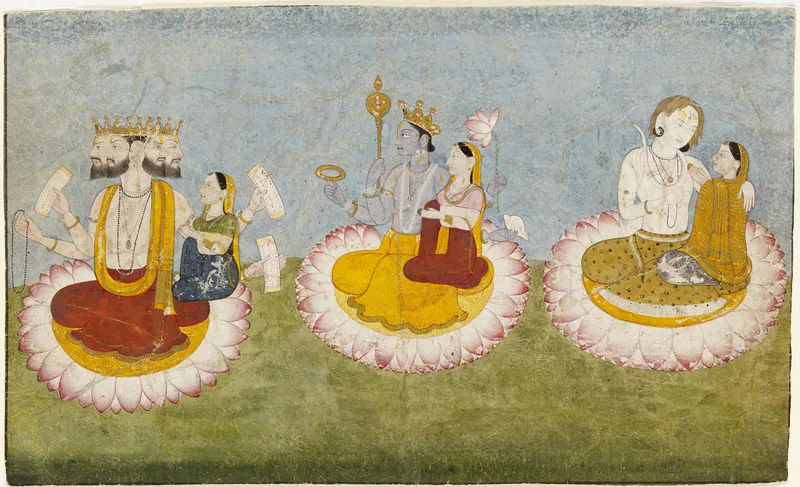
In India the three Vedas (Rig, Sama and Yajur) were long called the trayī vidyā, the "threefold knowledge", before the Atharvaveda was counted as a fourth. The sacred syllable Om was analysed into three sounds, A, U and M, related in the Mandukya Upanishad to waking, dreaming and dreamless sleep, with the silence after them as a fourth. The Samkhya philosophy describes all matter as composed of three gunas, qualities of clarity (sattva), activity (rajas) and inertia (tamas). The Trimurti, which presents Brahma, Vishnu and Shiva as creator, preserver and destroyer, appears in Puranic literature and art, though in actual worship most Hindus are devoted chiefly to Vishnu, Shiva or the Goddess rather than to the triad as such; see Hindu gods and goddesses.
Buddhists take refuge in the Three Jewels: the Buddha, the Dharma (his teaching) and the Sangha (the community). Buddhist teaching describes three marks of existence (impermanence, suffering and non-self), three poisons (greed, hatred and delusion) and, in Mahayana thought, the three bodies (trikaya) of a Buddha; see core teachings of Buddhism. In China the Daodejing gives a famous cosmogony in which the Dao produces one, one produces two, two produce three, and three produce the ten thousand things (chapter 42). Daoist religion honours the Three Pure Ones as its highest deities, and Chinese thought often speaks of the triad of Heaven, Earth and Humanity.
Three in Esotericism: Hermes, Kabbalah and Alchemy§
Western esoteric traditions inherited and multiplied these triads. The legendary sage Hermes Trismegistus was "thrice-greatest", a title that Renaissance writers explained as greatest philosopher, priest and king, or as knower of the three parts of the wisdom of the universe. In the Jewish Sefer Yetzirah, the twenty-two Hebrew letters are divided into three "mothers" (aleph, mem and shin), seven "doubles" and twelve "simples"; the three mother letters correspond to air, water and fire and to the head, belly and chest. Later Kabbalah arranged the ten sefirot of the Tree of Life in three pillars, with a supernal triad of Keter, Chokhmah and Binah at the summit. See Sefer Yetzirah and the Tree of Life.
In alchemy, the medieval theory that metals are compounded of sulphur and mercury was expanded by Paracelsus in the sixteenth century into the tria prima, the three principles of salt, sulphur and mercury, corresponding to body, soul and spirit; the signs used for them are listed in alchemical symbols. Christian theosophers such as Jacob Boehme read the Trinity into the processes of nature, and nineteenth-century occultists such as Eliphas Lévi made the ternary, the reconciliation of two opposites by a third, a law of magic. In tarot, the card numbered three in the Major Arcana is The Empress, and modern numerology associates three with expression and creativity.
The Rule of Three in Folklore and Modern Magic§
Folk narrative is full of threes: three brothers or sisters of whom the youngest succeeds, three tasks, three wishes, three visits from a supernatural helper, three attempts of which the third is decisive. The Danish folklorist Axel Olrik described this as one of the "epic laws" of folk narrative in 1909, calling it the law of three. Proverbs such as "third time lucky" and "all good things come in threes" express the same expectation.
Charms and spells repeated words or actions three times to make them effective, often invoking the Trinity, and many superstitions involve three, from knocking three times to the belief, popularised during the First World War, that it was unlucky to light three cigarettes from one match; see lucky and unlucky numbers. In modern Wicca a principle of threefold return, found in Gerald Gardner's writings, was later popularised as the "Rule of Three": whatever a practitioner sends out returns to them threefold. It is an ethical teaching of the modern craft rather than an ancient rule; see Wicca and Gerald Gardner. Three's partners in sacred arithmetic, seven and twelve, are treated separately; both were often explained as products or sums of three and four.
Frequently asked questions§
Why is three considered a sacred number?§
Because it was seen as the first complete number, with beginning, middle and end, and the number of the triangle. Many religions group their gods or principles in threes, and Christianity made three the number of God through the doctrine of the Trinity.
What does the number three mean in the Bible?§
It often marks completion and decisive moments, such as the resurrection on the third day, Jonah's three days in the fish and Peter's three denials. Christian theology later read the threes of scripture in the light of the Trinity.
Is the Hindu Trimurti the same as the Christian Trinity?§
No. The Trimurti presents three distinct gods, Brahma, Vishnu and Shiva, as aspects of cosmic creation, preservation and destruction, and it is not the focus of most Hindu worship. The Christian Trinity is a doctrine of one God in three co-equal persons.
Sources and further reading§
- On the Heavens — Aristotle, c. 350 BCE
- The Trinity — Augustine of Hippo, c. 420
- Medieval Number Symbolism: Its Sources, Meaning, and Influence on Thought and Expression — Vincent Foster Hopper, 1938
- The Mystery of Numbers — Annemarie Schimmel, 1993
- The Destiny of the Warrior — Georges Dumézil, 1970
- Celtic Heritage: Ancient Tradition in Ireland and Wales — Alwyn Rees and Brinley Rees, 1961
- Trioedd Ynys Prydein: The Triads of the Island of Britain — Rachel Bromwich, 1961