Liber XXX · Symbols · Chapter II: Number Symbolism
The Number Forty: Meaning in the Bible, Islam and Tradition
Why forty matters in religion: the Flood, Sinai and the wilderness, Christ's fast and Lent, Muhammad's call, Sufi retreats, mourning customs and quarantine.

Forty is the number of trial, preparation and transition in the religions of the Near East. The rain of Noah's flood lasts forty days and nights, Moses spends forty days on Sinai, Israel wanders forty years in the wilderness, Jesus fasts forty days before his ministry, and the Prophet Muhammad is traditionally said to have received his first revelation at the age of forty. From these models came the forty days of Lent, Sufi forty-day retreats, forty-day periods of mourning and childbirth, and even the word "quarantine". Unlike seven or twelve, forty has no obvious astronomical basis; it seems to have begun as a round number for "a long time" or "a generation" that acquired sacred weight through scripture.
Forty as "a Long Time": Origins of a Sacred Number§
In many Near Eastern languages forty functioned as a large round number, much as "dozens" or "scores" do in English. A Turkish or Persian expression for "many times" literally says "forty times", and the tale of Ali Baba and the Forty Thieves, added to the Arabian Nights by its French translator Antoine Galland in the early eighteenth century, uses forty in the same way. In biblical idiom forty years is roughly a generation, the span in which one group of adults is replaced by the next, and Greek chronographers placed the akmē, the prime of a person's life, at about forty.
Some ancient associations may have reinforced the number. In Mesopotamian scholarship each great god had a number, and that of Ea (Enki), god of fresh water, wisdom and magic, was forty. The Greek poet Hesiod, in Works and Days, notes that the Pleiades are hidden for forty days and nights each year before reappearing to mark the season of the harvest, an interval that may have given forty a calendrical meaning in agricultural societies. These parallels are suggestive rather than proven, and the biblical uses of forty need no single origin. For Mesopotamian religion more broadly see Mesopotamian religion, and for the general theory of sacred numbers see number symbolism.
Forty in the Hebrew Bible: Flood, Sinai and Wilderness§
The Hebrew Bible uses forty more consistently than any other source. In the Flood story it rains for forty days and forty nights (Genesis 7), and Noah waits another forty days before opening the window of the ark. Moses remains on Mount Sinai "forty days and forty nights" when he receives the law (Exodus 24), and again when the tablets are renewed, fasting from bread and water. The twelve spies explore Canaan for forty days, and because of the people's lack of faith Israel is condemned to wander in the wilderness forty years, a year for each day, until the generation that left Egypt has died (Numbers 14).
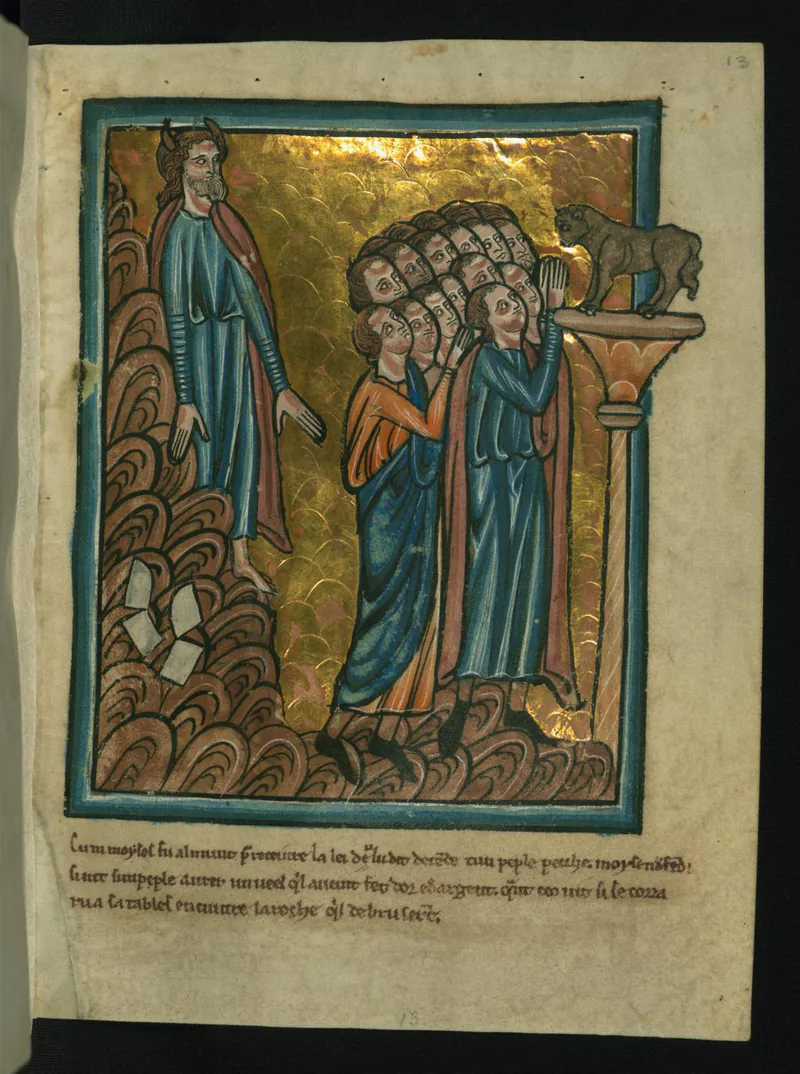
The pattern continues through Israel's history. Under the judges the land has rest for forty years at a time; Goliath taunts Israel for forty days; David and Solomon each reign forty years, and later tradition gave Saul the same. Elijah, fleeing Jezebel, travels forty days and forty nights on the strength of one meal to Horeb, the mountain of God (1 Kings 19). Jonah warns Nineveh that it will be overthrown in forty days (Jonah 3), and Ezekiel lies on his side forty days to bear the iniquity of Judah. The law limits a beating to forty strokes, which later practice reduced to thirty-nine to avoid exceeding the limit by mistake, the "forty stripes save one" that Paul says he received five times (2 Corinthians 11).
In almost every case forty marks an in-between time of testing, purification or waiting that ends in a new beginning: a cleansed world, a covenant, a new generation, a renewed prophet. Even the life of Moses was divided by later interpreters into three periods of forty years, in Egypt, in Midian and in the wilderness, reaching the 120 years of Deuteronomy.
Forty in Rabbinic Judaism and Kabbalah§
Rabbinic literature extended the biblical pattern. A ritual bath (mikveh) must contain at least forty se'ah of water, a measure that commentators connected with the forty days of the Flood, the great purification of the world. The Talmud regards an embryo in its first forty days as not yet fully formed, a view that has played a part in later Jewish legal discussion. The Mishnah tractate Avot lists the stages of life and says that at forty a person attains understanding (binah).
The Hebrew letter mem, which has the numerical value forty in gematria, is also the initial of mayim, "water", and kabbalistic writers drew on this coincidence in reflections on the Flood, the mikveh and the womb; the letters' symbolism is discussed in Hebrew letters in Kabbalah. An often-repeated rule that one should not study Kabbalah before the age of forty developed in early modern times as a caution about esoteric study; it is not a Talmudic law, and many famous kabbalists, including Isaac Luria, were younger when they taught.
Forty in the New Testament and the Christian Year§
The Gospels of Matthew, Mark and Luke relate that after his baptism Jesus was led into the wilderness and fasted forty days and forty nights, where he was tempted by the devil (Matthew 4). The parallel with Moses and Elijah, both of whom fasted forty days at the mountain of God, was obvious to early readers. The Acts of the Apostles says that the risen Christ appeared to his disciples over forty days before his ascension (Acts 1), so Ascension Day falls on the fortieth day after Easter.
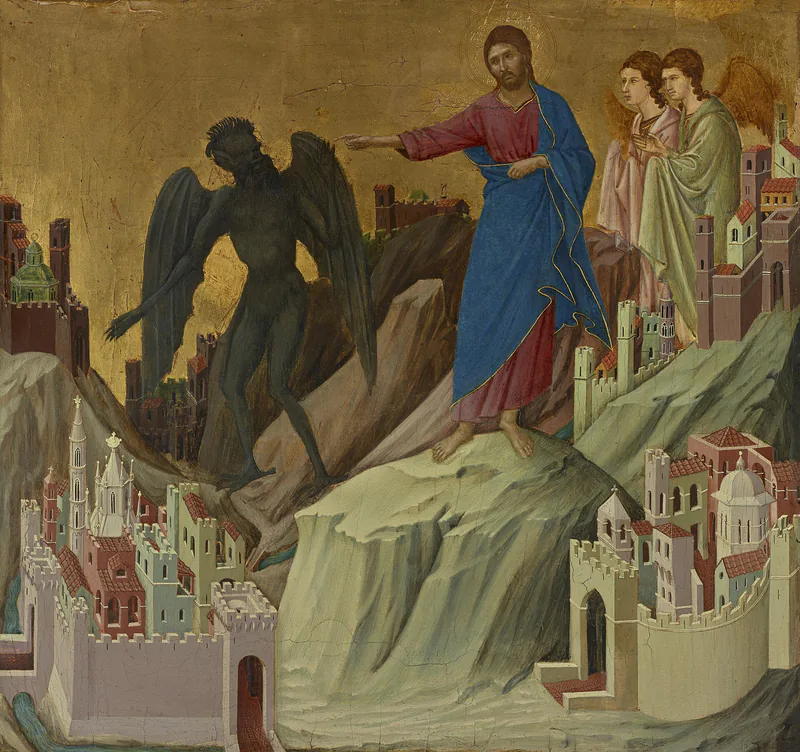
From these texts came the Christian season of Lent, called Quadragesima ("the fortieth") in Latin and Tessarakostē in Greek. A forty-day fast before Easter is attested by the fourth century, when the Council of Nicaea (325) refers to it in passing, though its exact origins and early length varied by region; the history is traced by Paul Bradshaw and Maxwell Johnson. In the Western reckoning the six Sundays are not counted, so Lent runs from Ash Wednesday to Holy Saturday; see Easter and Holy Week. The feast of the Presentation of Christ in the Temple, or Candlemas, on 2 February, falls forty days after Christmas, following the purification period after the birth of a son in Leviticus. Augustine, followed by many medieval writers, explained forty as four times ten, the law (ten commandments) fulfilled throughout the four quarters of the world, and therefore as the number of this present life of discipline; see biblical numerology. The Forty Martyrs of Sebaste, Roman soldiers said to have frozen to death in a lake around 320, remain popular saints in Eastern Christianity.
Forty in Islam and Sufism§
Islamic tradition gives forty a similar meaning of maturity and preparation. According to the standard biographies, the Prophet Muhammad was about forty years old when the first revelation came to him in the cave of Hira. The Qur'an speaks of a person reaching full strength and "forty years" as the age of gratitude and maturity (Surat al-Ahqaf), and it recounts that God appointed for Moses forty nights (Surat al-A'raf; compare Surat al-Baqara). The Israelites' wandering is also given as forty years (Surat al-Ma'ida).
A hadith promising reward to anyone who preserves forty traditions for the community inspired a whole literary genre of "forty hadith" collections (arba'in), of which the most famous is that of the thirteenth-century Syrian scholar al-Nawawi; see the Qur'an and hadith. In Sufism, the forty-day spiritual retreat, called arba'in in Arabic and chilla in Persian and South Asian usage, became a central discipline: the disciple withdraws into seclusion, fasts and practises remembrance of God under a master's guidance, imitating Moses' forty nights. Popular piety also speaks of forty hidden saints who sustain the world. For the Sufi path see Sufism in Islam.
Mourning, Childbirth and Quarantine: Forty in Custom§
Forty-day periods also structure the rites of passage of everyday life. In Eastern Orthodox Christianity, memorial services are held on the fortieth day after death, when, according to popular belief, the soul's earthly wanderings end and it faces its particular judgement. Many Muslim communities likewise mark the fortieth day after a death, and among Shi'a Muslims the Arba'een, forty days after the anniversary of the martyrdom of Husayn at Karbala in 680, has become one of the largest pilgrimages in the world; see the twelve imams. A forty-day period of rest and seclusion after childbirth, often ending with a churching or blessing, is observed in Greek, Middle Eastern, South Asian and Latin American traditions, with roots in the purification laws of Leviticus; folk beliefs about it are surveyed in superstitions of birth, marriage and death.
The most secular legacy of the number is the word quarantine. During the plague epidemics of the fourteenth century, the city of Ragusa (Dubrovnik) required arrivals from infected areas to wait thirty days in isolation in 1377; Venice and other ports later extended the period to forty days, quaranta giorni, from which "quarantine" derives. Historians have suggested that the choice of forty reflected its biblical associations with purification as much as any medical observation. In this form a sacred number of the wilderness entered the vocabulary of public health. Its companions in sacred arithmetic, seven and three, are treated separately.
Frequently asked questions§
What does the number forty mean in the Bible?§
It usually marks a period of testing, trial or preparation that leads to a new stage, such as the Flood, Moses' forty days on Sinai, Israel's forty years in the wilderness and Jesus' forty-day fast. It can also simply mean a generation or a long time.
Why does Lent last forty days?§
Lent imitates the forty-day fast of Jesus in the wilderness, which itself echoes the fasts of Moses and Elijah. A forty-day season before Easter is attested by the fourth century, though practices varied before it was standardised.
Why do some traditions mark forty days after a death?§
In Eastern Christian and many Muslim cultures the fortieth day is believed to mark the end of a transitional period for the soul and for the mourners. The custom reflects the wider association of forty with completed periods of trial and transformation.
Sources and further reading§
- Medieval Number Symbolism: Its Sources, Meaning, and Influence on Thought and Expression — Vincent Foster Hopper, 1938
- The Mystery of Numbers — Annemarie Schimmel, 1993
- Biblical Numerology — John J. Davis, 1968
- The Origins of Feasts, Fasts and Seasons in Early Christianity — Paul F. Bradshaw and Maxwell E. Johnson, 2011
- Mystical Dimensions of Islam — Annemarie Schimmel, 1975
- Works and Days — Hesiod, c. 700 BCE
- Quarantine: Local and Global Histories — Alison Bashford, 2016