Liber XVII · Islam · Chapter VII: The Qur'an & Hadith
The Qur'an and Hadith: Revelation, Compilation and Authority
The Qur'an and hadith explained: how Muslims understand revelation, how the Qur'an was compiled, its structure and exegesis, and the great hadith collections.

The Qur'an is the sacred scripture of Islam, which Muslims believe to be the literal word of God revealed in Arabic to the Prophet Muhammad between about 610 and 632. The hadith are the reports of what the Prophet said, did and approved, collected and critically sifted by Muslim scholars in the first three centuries of Islam. Together they are the two textual foundations of Islamic belief, worship and law.
The Qur'an as Recitation and Revelation§
The word qurʾān comes from the Arabic verb "to read aloud" or "to recite", and the scripture was first of all something heard. According to tradition the first revelation came to Muhammad on Mount Hira with the command "Read: In the name of thy Lord Who createth" (al-Alaq 96:1), and revelation continued in passages of varying length for the rest of his life. Muslims associate its beginning with the "Night of Power" in the month of Ramadan, celebrated in the short sura al-Qadr.
In Islamic belief the Qur'an is not Muhammad's composition but God's speech, transmitted through the angel Gabriel; Muhammad is its recipient and first reciter. Its Arabic is regarded as inimitable (iʿjāz), and the Qur'an itself challenges doubters to produce a chapter like it. For this reason Muslims recite the text in Arabic in prayer, and many memorise it entirely; a person who has done so is honoured as a ḥāfiẓ, "guardian". The art of correct recitation, tajwīd, governs pronunciation, pauses and melody, and great reciters are admired across the Muslim world.
Medieval theologians debated whether the Qur'an, as God's speech, was created or eternal. The Abbasid caliph al-Ma'mun imposed the doctrine of its createdness in an inquisition (miḥna) begun in 833, but the policy was abandoned within about fifteen years, and Sunni orthodoxy came to hold that the Qur'an is the uncreated speech of God.
Structure of the Qur'an: Suras, Verses and Themes§
The Qur'an contains 114 suras, divided into verses (āyāt, "signs"); the most widely used count gives 6,236 verses. After the brief opening prayer, al-Fatiha, the suras are arranged roughly in order of decreasing length, so that the long Medinan chapters such as al-Baqara come first and the short, intense early chapters come at the end. Each sura except the ninth begins with the formula "In the name of God, the Merciful, the Compassionate".
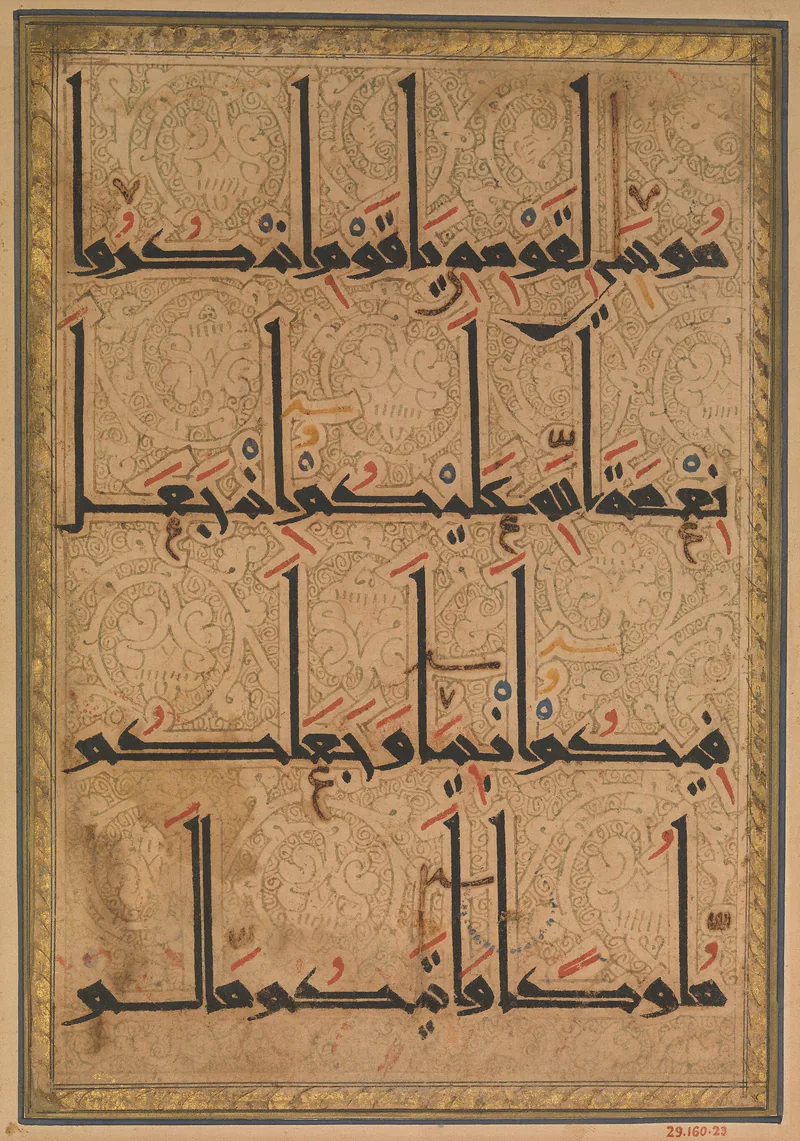
Muslim scholars classify suras as Meccan or Medinan according to whether they were revealed before or after the emigration of 622. The Meccan suras, short and rhythmic, proclaim God's oneness, the signs of creation, the resurrection and the judgement, and the stories of earlier prophets. The Medinan suras are longer and address the life of a community: worship, family law, inheritance, warfare and relations with Jews and Christians. The Qur'an does not tell a continuous story; it moves between exhortation, narrative, law, prayer and argument, and it assumes that its hearers already know many of the figures it mentions, from Adam and Noah to Moses, Mary and Jesus, and Solomon, whose command over the jinn is discussed in Sulayman in Islamic tradition.
How the Qur'an Was Compiled§
According to the Sunni historical tradition, the revelations were memorised by the Prophet's companions and written on materials such as palm stalks, bone and parchment. After many reciters were killed in battle in 632–633, the first caliph Abu Bakr asked Zayd ibn Thabit, who had served as the Prophet's scribe, to gather the text into a single collection. Under the third caliph, 'Uthman (r. 644–656), concern over differences in recitation led to the preparation of a standard codex, copies of which were sent to the main cities while other personal codices were ordered destroyed.
Early Arabic script did not distinguish many consonants and lacked vowel signs, so a single written outline could be read in more than one way. Over the following centuries dots and vowel marks were added, and the scholar Ibn Mujahid (d. 936) recognised seven accepted "readings" (qirāʾāt); later authorities added three more. Today the reading of Hafs from 'Asim is used in most of the Muslim world, and that of Warsh from Nafi' in much of North and West Africa. The differences mostly concern vowels and small grammatical forms.
Modern critical scholarship has debated the tradition's account. In the 1970s some scholars, notably John Wansbrough, argued that the text took its final form much later. Manuscript discoveries have weighed against very late dating: radiocarbon tests on early parchment leaves, including the Birmingham folios published in 2015, gave date ranges in the seventh century, and the palimpsest found at Sana'a in Yemen preserves an early text with variants in its lower layer. Most historians now accept that the consonantal text was substantially fixed within a few decades of the Prophet's death, while continuing to study its earlier history.
Interpreting the Qur'an: Tafsir and Esoteric Exegesis§
Commentary on the Qur'an is called tafsīr. The great early commentary of al-Tabari (d. 923) gathers reports from the Prophet, his companions and their successors verse by verse. Later classics include the rationalist commentary of al-Zamakhshari (d. 1144), the philosophical-theological work of Fakhr al-Din al-Razi (d. 1210), the hadith-based commentary of Ibn Kathir (d. 1373) and the concise Tafsīr al-Jalālayn of the fifteenth century. The Qur'an itself distinguishes between "clear" verses and "ambiguous" ones whose interpretation is reserved (Al Imran 3:7), a passage that later debates about allegory turned on.
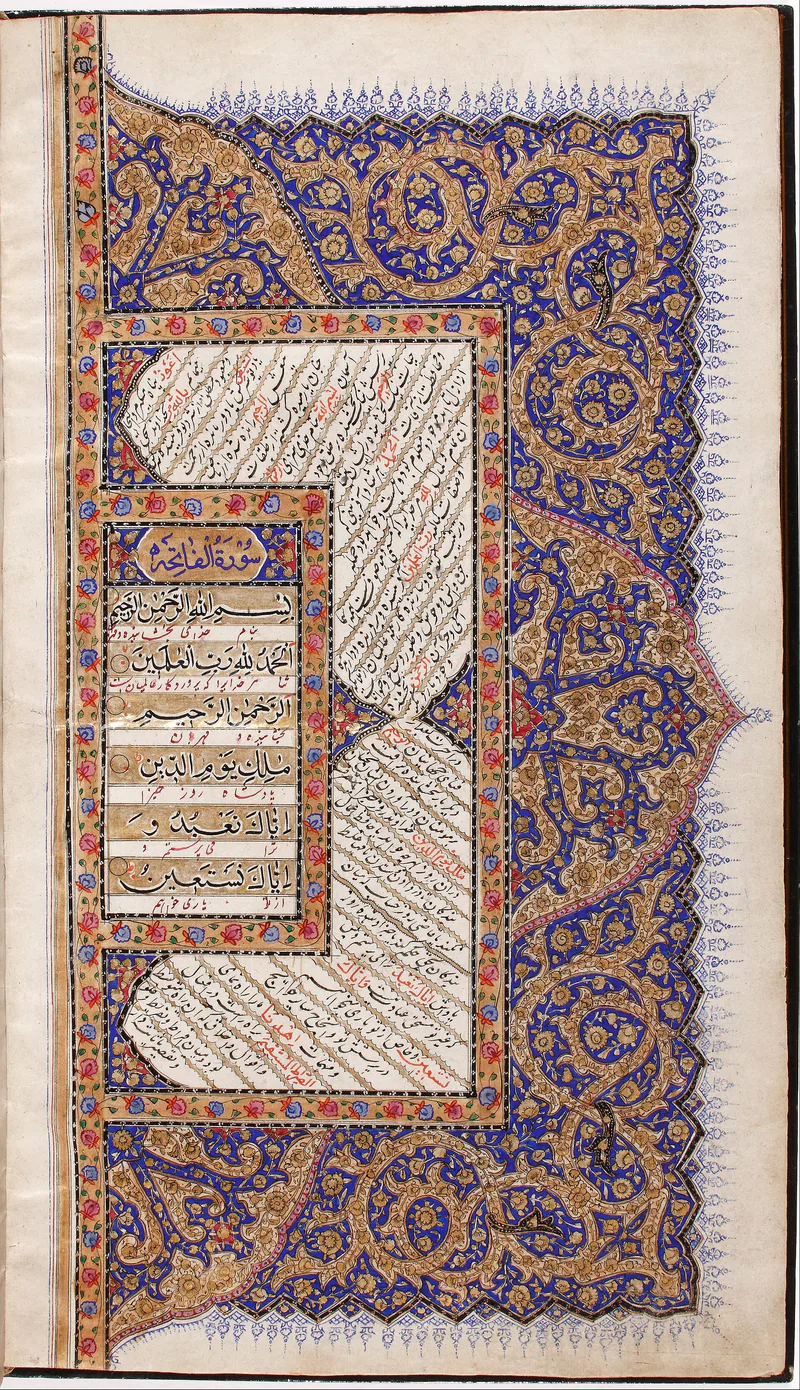
Sufis and Shi'i thinkers developed taʾwīl, interpretation that seeks the inner (bāṭin) meaning beneath the outer (ẓāhir) sense. Sufi commentators read the Qur'an's light, journeys and prophets as figures of the soul's ascent; the Light Verse (an-Nur 24:35), with its lamp, glass and olive tree "neither of the East nor of the West", inspired a famous treatise by al-Ghazali, The Niche of Lights. Shi'i exegesis often reads verses in relation to the Imams. Mainstream scholars accepted inner readings as long as they did not cancel the plain meaning and the law. The occult use of Qur'anic verses and letters in amulets is discussed in Islamic Occult Sciences.
Hadith: Reports of the Prophet's Words and Deeds§
The sunna, the exemplary way of the Prophet, is known through hadith ("report", "narrative"). Each hadith has two parts: the isnād, the chain of people who passed it on ("A told me that B told him that he heard the Prophet say…"), and the matn, the content. A special category, ḥadīth qudsī, contains words attributed to God but outside the Qur'an.
Because many reports were in circulation, some of them fabricated for political, sectarian or pious motives, Muslim scholars developed a science of hadith criticism (ʿulūm al-ḥadīth). They compiled biographical dictionaries of transmitters, judged their memory and integrity, checked whether they could have met, and graded reports as ṣaḥīḥ (sound), ḥasan (good), ḍaʿīf (weak) or mawḍūʿ (forged). Hadith are central to law and ritual, since the Qur'an commands prayer but does not describe its movements in detail.
Western scholars such as Ignaz Goldziher in the 1890s and Joseph Schacht in 1950 argued that many legal hadith were projected back onto the Prophet in the eighth and ninth centuries. Later researchers, including Harald Motzki, used close analysis of chains to argue that some material can be traced to the late seventh century. The question remains debated, and Muslim scholars generally regard the classical critical method as reliable.
The Great Hadith Collections, Sunni and Shi'i§
Sunni Islam recognises six canonical collections, the Kutub al-Sitta. The most respected are the Ṣaḥīḥ of al-Bukhari (d. 870) and the Ṣaḥīḥ of Muslim ibn al-Hajjaj (d. 875), often described as the most authoritative books after the Qur'an. The other four are the Sunan of Abu Dawud, al-Tirmidhi, al-Nasa'i and Ibn Majah, compiled in the later ninth and early tenth centuries. Earlier works such as the Muwaṭṭaʾ of Malik ibn Anas (d. 795) and the Musnad of Ahmad ibn Hanbal (d. 855) are also highly valued.
Twelver Shi'is accept reports transmitted through the family of the Prophet and the Imams, and their "Four Books" are al-Kāfī of al-Kulayni (d. 941), Man lā yaḥḍuruhu al-faqīh of Ibn Babawayh (d. 991), and two collections by Shaykh al-Tusi (d. 1067). The differing hadith canons are one of the deepest roots of the distinctions between Sunni and Shi'a Islam, and both canons feed the systems of Islamic law.
Frequently asked questions§
Is the Qur'an the same as the hadith?§
No. Muslims regard the Qur'an as the direct word of God and the hadith as human reports about the Prophet's words and actions. The Qur'an is recited in prayer; hadith are not, and they carry different degrees of authority according to their reliability.
Can the Qur'an be translated?§
Muslims hold that only the Arabic text is the Qur'an itself, so translations are regarded as interpretations of its meaning. The first Latin version was made in 1143 for Peter the Venerable, and widely used English versions include those of Marmaduke Pickthall (1930) and M. A. S. Abdel Haleem (2004).
What does "sahih" mean?§
Ṣaḥīḥ means "sound" or "authentic". It is the highest grade given to a hadith whose chain of reliable transmitters is unbroken and whose content has no hidden defect, and it is also the title of the collections of al-Bukhari and Muslim.
How long is the Qur'an?§
It has 114 suras and, in the most common count, 6,236 verses, roughly the length of the New Testament. For recitation it is divided into thirty equal parts (juzʾ), so that it can be read through in a month.
Sources and further reading§
- The Meaning of the Glorious Koran — Marmaduke Pickthall, 1930
- The Qur'an: A New Translation — M. A. S. Abdel Haleem, 2004
- Major Themes of the Qur'an — Fazlur Rahman, 1980
- Approaching the Qur'an: The Early Revelations — Michael Sells, 1999
- The Cambridge Companion to the Qur'an — Jane Dammen McAuliffe (ed.), 2006
- Hadith: Muhammad's Legacy in the Medieval and Modern World — Jonathan A. C. Brown, 2009