Liber XVII · Islam · Chapter VIII: Sufi Orders & Saints
Rumi and the Mevlevi Order: The Masnavi and Whirling Dervishes
Rumi and the Mevlevi order explained: the poet's life in Konya, Shams of Tabriz, the Masnavi and Divan, and the sema ceremony of the whirling dervishes.

Jalal al-Din Rumi (1207–1273), called Mawlānā ("our master", Turkish Mevlânâ), was a Persian-speaking Muslim scholar and Sufi of Konya whose poetry is among the most celebrated in world literature. His Masnavi and the lyric Divan of Shams of Tabriz express the soul's love for God in images drawn from everyday life. After his death his son and disciples organised the Mevlevi order, whose ceremony of turning, the semā, made its members famous in the West as the "whirling dervishes".
Rumi's Early Life: From Khorasan to Konya§
Rumi was born on or about 30 September 1207 in the eastern Persian world, either in Balkh (in present-day Afghanistan) or, as his biographer Franklin Lewis argues, in the small town of Vakhsh in what is now Tajikistan; hence he is also known as Balkhi. His father, Bahā' al-Dīn Walad, was a preacher and jurist with mystical leanings, whose notebooks, the Maʿārif, Rumi later treasured. Around 1216–20, shortly before the Mongol invasions, the family left Khorasan. Later legend has them meet the poet 'Attar in Nishapur, who is said to have foreseen the boy's greatness; the story is famous but unverifiable.
After pilgrimage to Mecca and years in Syria and eastern Anatolia, the family settled around 1229 in Konya, capital of the Seljuk sultanate of Rum, which gave Rumi his best-known name ("the man from Rum", that is, Anatolia). When his father died in 1231 Rumi succeeded him as a teacher. A former disciple of his father, Burhān al-Dīn Muḥaqqiq of Tirmidh, trained him in the Sufi path, and he studied further in Aleppo and Damascus, where he may have encountered the circle of Ibn 'Arabi. By his mid-thirties he was a respected jurist of the Hanafi school, a preacher and a teacher of religious law.
Shams of Tabriz and the Birth of a Poet§
In late 1244 a wandering dervish, Shams al-Dīn of Tabriz, arrived in Konya. The two men became inseparable, and Rumi withdrew from his students to spend months in conversation with him. The jealousy of disciples drove Shams away; Rumi sent his son Sultan Walad to bring him back from Damascus, but around 1247 Shams vanished for good. Hagiographers later suggested he was murdered, while some modern scholars think he simply left. Whatever happened, Rumi's grief and longing turned him into a poet.

The ghazals and quatrains of the Dīvān-e Shams-e Tabrīzī, numbering in the thousands, often carry the name of Shams in place of Rumi's own, as though the beloved were the true author. In them human love, music and intoxication become figures for union with God, the "Beloved" whose presence the poet glimpses in the friend. Rumi later found similar companionship with the goldsmith Ṣalāḥ al-Dīn Zarkūb and then with his disciple Ḥusām al-Dīn Chalabī, who encouraged him to compose the Masnavi. Rumi died in Konya on 17 December 1273, a night still commemorated by the Mevlevis as his Şeb-i Arûs, his "wedding night" with God.
The Masnavi and Rumi's Other Works§
The Masnavi-ye Ma'navi§
The Masnavī-ye maʿnavī ("Rhyming couplets of inner meaning") runs to about 25,000 couplets in six books, dictated to Ḥusām al-Dīn over the last fifteen or so years of Rumi's life. It opens with the lament of a reed flute torn from its reed bed, an image of the soul separated from its origin. What follows is a sprawling web of stories, fables, Qur'anic commentary and teaching, in which one tale opens into another. Persian speakers have long called it "the Qur'an in the Persian language", a phrase of praise rather than a theological claim.
Fihi ma fihi and the Letters§
Rumi's prose works include Fīhi mā fīhi ("In it is what is in it"), a collection of talks recorded by his disciples, seven sermons (Majālis-e sabʿa) and some 150 letters, many of them requests on behalf of friends and disciples to Seljuk officials. They show a teacher deeply rooted in the Qur'an, the hadith and Islamic law, and they give a more practical picture than the poetry alone. Comparable earlier teaching on the inner life can be found in al-Ghazali, whose works were widely read in the learned circles of Rumi's day.
The Mevlevi Order and Its Discipline§
Rumi did not found an order in the formal sense. That was the work of his son Sultan Walad (d. 1312), who gave the community at Konya a structure, wrote verse accounts of his father's life and established lodges in other Anatolian towns, and of his grandson Ulu 'Arif Chalabi. Hagiographies such as Aflākī's Manāqib al-ʿārifīn, completed in the fourteenth century, fixed the image of Rumi as saint. The heads of the order, the Çelebi, were his descendants, and Konya remained its centre.
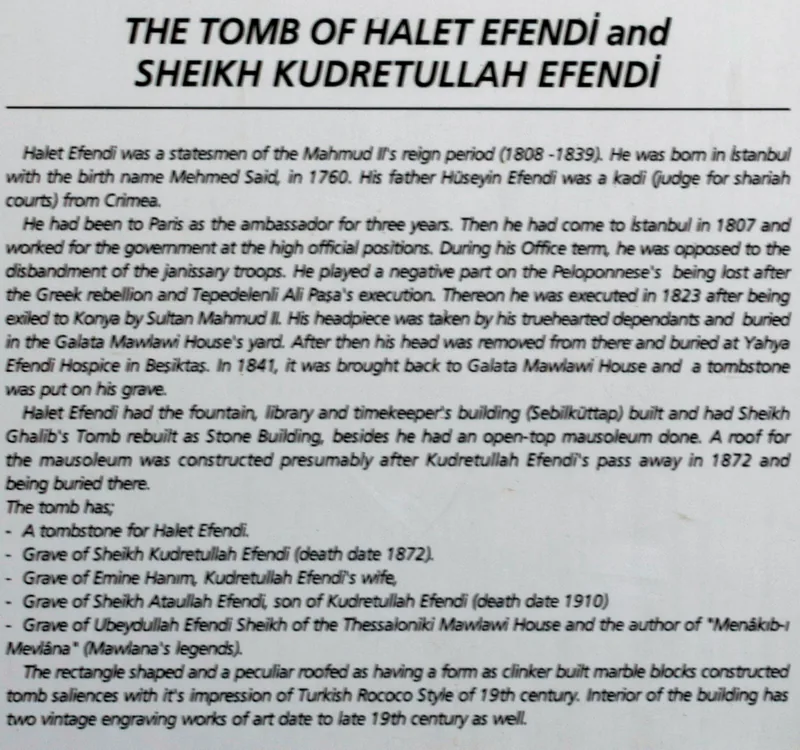
Under the Ottomans the Mevlevis became the most refined of the Sufi orders, closely tied to the court and to Ottoman music, calligraphy and poetry. Mevlevi lodges (mevlevihane) were founded in Istanbul, notably at Galata in 1491, and as far afield as Cairo, Damascus and the Balkans. Sultan Selim III (r. 1789–1807), a composer, was among their patrons. A novice traditionally served a retreat of 1,001 days, beginning in the kitchen, before being accepted as a dervish. The general pattern of initiation and lodge life is described in Sufi Orders and Saints.
The Sema: Ceremony of the Whirling Dervishes§
The Mevlevi semā ("listening") is a ritual of remembrance (dhikr) set to music. It took its classical form over several centuries after Rumi, who is said to have turned spontaneously in the streets of Konya. Its symbolism, as explained in Mevlevi tradition, is precise. The dervish's tall felt hat (sikke) represents the tombstone of the ego; the black cloak (hırka), set aside at the start, the grave; and the white robe (tennure), the shroud. Turning counter-clockwise around the heart, with the right palm open to the sky and the left turned to the earth, the dervish is understood to receive grace from above and pass it on to the world.
The ceremony opens with a hymn in praise of the Prophet, the Naʿt-i Şerif set by the seventeenth-century composer Itri, followed by an improvisation on the reed flute (ney) and the beat of the kettledrums (kudüm). The dervishes greet one another, then turn in four sections called selam, under the direction of the semazenbaşı, while the shaykh stands at his red sheepskin seat, which marks the place of Rumi. The ritual closes with recitation from the Qur'an and prayers for the souls of the masters.
In 1925 the Turkish Republic closed all Sufi lodges, and Rumi's tomb at Konya, beneath its green-tiled dome, became the Mevlana Museum in 1927. Public performances resumed as a cultural event in Konya in the 1950s, and every December the anniversary of his death draws large crowds. UNESCO proclaimed the Mevlevi sema ceremony a Masterpiece of the Oral and Intangible Heritage of Humanity in 2005.
Rumi in the Modern World§
Rumi has long been read across the Persian, Turkish and South Asian worlds; the Masnavi was commented on in Persian, Ottoman Turkish and Urdu for centuries, and the Indo-Muslim poet Muhammad Iqbal called him his spiritual guide. In English, Reynold Nicholson's scholarly edition and translation of the Masnavi (1925–40) and A. J. Arberry's versions made him available to specialists. Since the 1990s free poetic renderings, especially those of Coleman Barks, have made Rumi a best-selling poet in the United States.
Scholars such as Franklin Lewis have noted that these popular versions often remove the Qur'anic references, Islamic practice and Persian literary context that pervade the originals. Rumi was a Muslim jurist and Sufi master whose love mysticism grew out of prayer, fasting and the remembrance of God, and readers who want the full picture increasingly turn to annotated translations of the Masnavi alongside the overview in Sufism: History, Masters and Practices.
Frequently asked questions§
Was Rumi Persian, Turkish or Afghan?§
Rumi was born in the eastern Persian cultural world, in present-day Afghanistan or Tajikistan, wrote almost entirely in Persian and lived most of his life in Anatolia, today's Turkey. All three countries honour him, and the question reflects modern borders more than his own world.
Why do the whirling dervishes turn?§
In Mevlevi teaching the turning is a form of remembrance of God. It is understood as a symbolic journey in which the dervish abandons the ego, turns towards truth and returns to serve creation, echoing the circling of the heavens and of all created things.
Is Rumi's poetry religious?§
Yes. Its central subject is love for God, expressed through Qur'anic allusion, Sufi doctrine and the imagery of Persian poetry. Many popular modern versions downplay this religious context.
Where is Rumi buried?§
Rumi is buried in Konya, Turkey, beneath the green dome of the former Mevlevi lodge, now the Mevlana Museum, beside his father and many of his descendants.
Sources and further reading§
- Rumi: Past and Present, East and West — Franklin D. Lewis, 2000
- The Triumphal Sun: A Study of the Works of Jalaloddin Rumi — Annemarie Schimmel, 1978
- The Sufi Path of Love: The Spiritual Teachings of Rumi — William C. Chittick, 1983
- The Mathnawi of Jalalu'ddin Rumi — Reynold A. Nicholson (ed. and trans.), 1925
- The Masnavi, Book One — Jalal al-Din Rumi, trans. Jawid Mojaddedi, 2004
- The Feats of the Knowers of God — Shams al-Din Aflaki, trans. John O'Kane, 2002