Liber XVII · Islam · Chapter X: Sunni & Shi'a
Sunni and Shi'a Islam: Origins, Beliefs and Key Differences
Sunni and Shi'a Islam explained: the succession to the Prophet, Karbala, caliphs and Imams, Twelvers, Ismailis and Zaydis, and what the branches share.

Sunni and Shi'a Islam are the two main branches of the Islamic faith. They separated over the question of who should lead the Muslim community after the death of the Prophet Muhammad in 632: Sunnis accepted the caliphs chosen by the community, while Shi'is held that leadership belonged to the Prophet's cousin and son-in-law 'Ali and to Imams descended from him. Both share the Qur'an, the Prophet and the Five Pillars; Sunnis are roughly 85 to 90 per cent of Muslims and Shi'is most of the remainder.
The Question of Succession after the Prophet§
When the Prophet Muhammad died in June 632, he left no son and, in the view of the majority, no explicit instruction about a successor. Leaders of the community met at a hall in Medina, the saqīfa of the Banu Sa'ida, and chose his close companion and father-in-law Abu Bakr as khalīfa, "successor" or "deputy". He was followed by 'Umar (r. 634–644), 'Uthman (r. 644–656) and 'Ali (r. 656–661). Sunnis later called these four the "rightly guided caliphs" (al-khulafāʾ al-rāshidūn).
A minority believed that 'Ali ibn Abi Talib, the Prophet's cousin, husband of his daughter Fatima and father of his only surviving grandsons, Hasan and Husayn, had been designated by the Prophet himself. They point especially to an event at a pool called Ghadir Khumm, on the return from the Farewell Pilgrimage, where the Prophet is reported to have said that whoever held him as mawlā (master or friend) should hold 'Ali as mawlā. Sunnis accept the report but read mawlā as an expression of love and support rather than appointment. Those who supported 'Ali were called shīʿat ʿAlī, "the party of 'Ali", from which comes the name Shi'a.
'Ali's caliphate was consumed by the first civil war (fitna): the Battle of the Camel (656) against a coalition that included the Prophet's widow 'A'isha, and the indecisive Battle of Siffin (657) against Mu'awiya, governor of Syria. After 'Ali agreed to arbitration, a group of his own followers rejected it and broke away as the Kharijites; one of them assassinated him in Kufa in 661. Mu'awiya founded the Umayyad dynasty, and 'Ali's elder son Hasan renounced his claim.
Karbala and the Making of Shi'a Identity§
In 680, after Mu'awiya's son Yazid succeeded him, Husayn ibn 'Ali set out for Kufa, whose people had invited him to lead them. At Karbala in Iraq, on the tenth day of the month of Muharram, his small party of family and companions was surrounded and killed by an Umayyad army; the women and children were taken captive to Damascus. For Shi'is Husayn's death became the supreme example of sacrifice for justice against tyranny, and his shrine at Karbala one of the holiest sites in Islam.
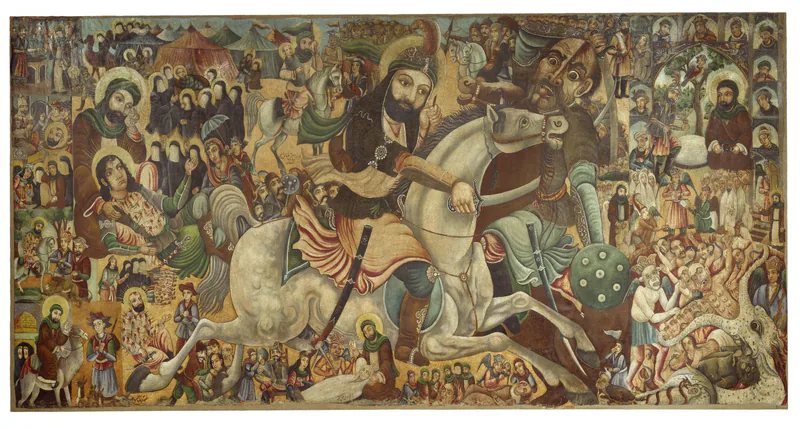
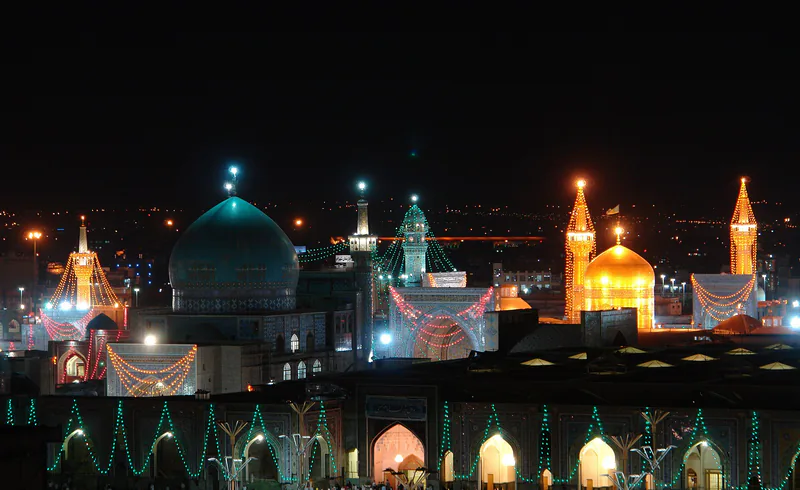
The day of his death, ʿĀshūrāʾ, is commemorated with mourning gatherings (majlis) at which the story is recited, processions, poetry of lamentation and, in Iran, the passion plays called taʿziya. Pilgrimage to the shrines of the Imams, at Najaf, Karbala, Kadhimiya, Samarra and Mashhad, and to that of Fatima Ma'suma at Qom, is a central part of Shi'i piety. Sunnis too honour Husayn and the Prophet's family (ahl al-bayt) and observe Ashura, mostly as a day of voluntary fasting.
Sunni Islam: The People of the Sunna and the Community§
The term Sunni comes from ahl al-sunna wa'l-jamāʿa, "the people of the Prophet's practice and of the community". The name, which became current from about the ninth century, expresses two convictions: that authority lies in the sunna as transmitted by the Prophet's companions as a whole, and that the unity of the community is a value in itself. Sunnis hold all the companions in respect and regard the order of the first four caliphs as legitimate.
Sunni Islam has no clergy with authority comparable to that of the senior Shi'i jurists. Religious authority is spread among scholars (ʿulamāʾ) trained in the four schools of law and the theological traditions described in Islamic Law and Theology. The caliphate continued, in name at least, under the Umayyads, the Abbasids and later the Ottoman sultans, until it was abolished by the Turkish Republic in 1924. Sufi orders flourished widely within Sunni Islam, as described in Sufi Orders and Saints.
Twelver Shi'ism and the Hidden Imam§
For Shi'is the leader of the community is the Imam, a descendant of 'Ali and Fatima designated by his predecessor, who is believed to be protected by God from sin and error (ʿiṣma) and to possess authoritative knowledge of the inner meaning of the Qur'an. The largest branch, the Twelvers (Ithnā ʿAshariyya), recognise twelve Imams, from 'Ali to Muhammad ibn al-Hasan, who they believe went into concealment (ghayba) as a child in 874. During the "lesser occultation" he communicated through four successive deputies; since 941 the "greater occultation" has continued. He will return at the end of time as the Mahdi, the rightly guided one, to fill the earth with justice.
In the Imam's absence, Twelver jurists gradually took on his functions. The Safavid dynasty made Twelver Shi'ism the state religion of Iran from 1501, inviting scholars from Lebanon and Bahrain, and the country became largely Shi'i over the next two centuries. Senior jurists acquired the title āyatollāh, and believers follow the rulings of a living marjaʿ. In 1979 the Iranian Revolution put into practice Ayatollah Khomeini's doctrine of the "guardianship of the jurist" (wilāyat al-faqīh), a doctrine that not all Shi'i jurists accept. Twelver law, the Ja'fari school, differs from the Sunni schools on some points, such as the permissibility of temporary marriage (mutʿa) and the combining of daily prayers.
Ismailis, Zaydis and Other Shi'i Communities§
The Ismailis separated from the line that became the Twelvers after the death of the sixth Imam, Ja'far al-Sadiq, in 765, following his son Isma'il and Isma'il's descendants. They developed a highly esoteric theology: the Qur'an and the law have an outer form (ẓāhir) and an inner truth (bāṭin) explained by the Imam, and history unfolds in cycles of prophets. An Ismaili dynasty, the Fatimids, ruled North Africa and Egypt from 909 to 1171 and founded Cairo and the mosque-university of al-Azhar. A dispute in 1094 divided the Nizaris, whose Persian fortress of Alamut became the subject of the Crusaders' "Assassins" legends, from the Musta'lis, whose descendants include the Bohras of South Asia. The Aga Khan is the Imam of the Nizari Ismailis today. The encyclopaedic Epistles of the Brethren of Purity, which mixes philosophy, number symbolism and astrology, is often linked with Ismaili circles, though its authorship is debated (see Islamic Philosophy).
The Zaydis, named after Zayd ibn 'Ali (d. 740), recognise any learned descendant of 'Ali and Fatima who rises to claim leadership as Imam. Closer to Sunnis in law and theology, they ruled parts of Yemen for about a thousand years until 1962. Other communities with roots in Shi'ism, such as the Alawites of Syria and the Alevis of Turkey, developed distinctive teachings and practices of their own.
Shared Faith, Differences and Modern Politics§
Sunnis and Shi'is recite the same Qur'an, pray toward the same Ka'ba, fast the same month and perform the same pilgrimage. Their principal differences concern the doctrine of the imamate, the authority of certain companions of the Prophet, the hadith collections each accepts, and details of law and ritual. For much of history they lived side by side, intermarried and studied with one another, though periods of persecution and polemic also occurred; Shi'i scholars permitted the concealment of one's faith (taqiyya) under threat. In modern times sectarian identity has often been sharpened by political rivalry, notably between Iran and Saudi Arabia and in the wars in Iraq, Syria and Yemen, while many religious leaders on both sides have promoted mutual recognition, as in the Amman Message of 2004–2005.
Frequently asked questions§
What is the main difference between Sunni and Shia Muslims?§
The original difference was over leadership after the Prophet: Sunnis accept the historical caliphs, while Shi'is believe authority passed to 'Ali and the Imams descended from him. That disagreement led over time to differences in theology, hadith, law and religious practice.
What percentage of Muslims are Shia?§
Estimates usually place Shi'is at about 10 to 15 per cent of the world's Muslims. They form majorities in Iran, Iraq, Bahrain and Azerbaijan and large communities in Lebanon, Pakistan, India, Afghanistan, the Gulf states and elsewhere.
What is Ashura?§
Ashura is the tenth day of Muharram, the first month of the Islamic year. For Shi'is it is the anniversary of Husayn's death at Karbala in 680 and a day of mourning; Sunnis often observe it with a voluntary fast associated with the Prophet's practice.
Sources and further reading§
- An Introduction to Shi'i Islam: The History and Doctrines of Twelver Shi'ism — Moojan Momen, 1985
- The Succession to Muhammad: A Study of the Early Caliphate — Wilferd Madelung, 1997
- Shi'ism — Heinz Halm, 1991
- The Isma'ilis: Their History and Doctrines — Farhad Daftary, 1990
- The Formation of Islam: Religion and Society in the Near East, 600–1800 — Jonathan P. Berkey, 2003
- After the Prophet: The Epic Story of the Shia-Sunni Split in Islam — Lesley Hazleton, 2009