Liber XVI · Indigenous & Ancient Religions · Chapter VI: Mesopotamian Religion
Mesopotamian Religion: Gods, Temples and Myths of Sumer
Mesopotamian religion explained: gods of Sumer, Babylon and Assyria, temples and ziggurats, the Enuma Elish and Gilgamesh, divination and the afterlife.

Mesopotamian religion was the religion of the peoples of ancient Iraq and its neighbours, the Sumerians, Akkadians, Babylonians and Assyrians, from the rise of the first cities before 3000 BCE until the end of cuneiform culture around the first century CE. Its many gods, among them An, Enlil, Enki, Inanna (Ishtar), Shamash and Marduk, lived in temples as the masters of each city, and humans were created to serve them. Mesopotamian scribes produced some of the world's oldest religious literature, including the Enuma Elish and the Epic of Gilgamesh, and developed divination and astrology into learned sciences.
Gods of Sumer, Babylon and Assyria§
The Mesopotamian pantheon was large and changed over three millennia, but a core group remained. An (Akkadian Anu) was the sky god, senior but remote. Enlil, lord of the wind, was the executive king of the gods, with his temple, the Ekur, at Nippur. Enki (Ea), god of the fresh waters beneath the earth, of wisdom and of crafts, was humanity's clever friend and the patron of exorcists. Nanna (Sin) was the moon god of Ur, and Utu (Shamash) the sun god of justice. Inanna (Ishtar), goddess of sexual love and war and of the planet Venus, was the most prominent goddess. Ereshkigal ruled the underworld with her consort Nergal.
Political change reshaped the divine order. When Babylon rose under Hammurabi (eighteenth century BCE) and again in later centuries, its city god Marduk became king of the gods; in Assyria the national god Ashur held that role. Gods were also identified with each other across languages, so that Sumerian Inanna and Akkadian Ishtar merged into one figure. Divine symbols were carved on boundary stones (kudurrus): the star of Ishtar, the sun disc of Shamash, the crescent of Sin.
Temples, Ziggurats and the Care of the Gods§
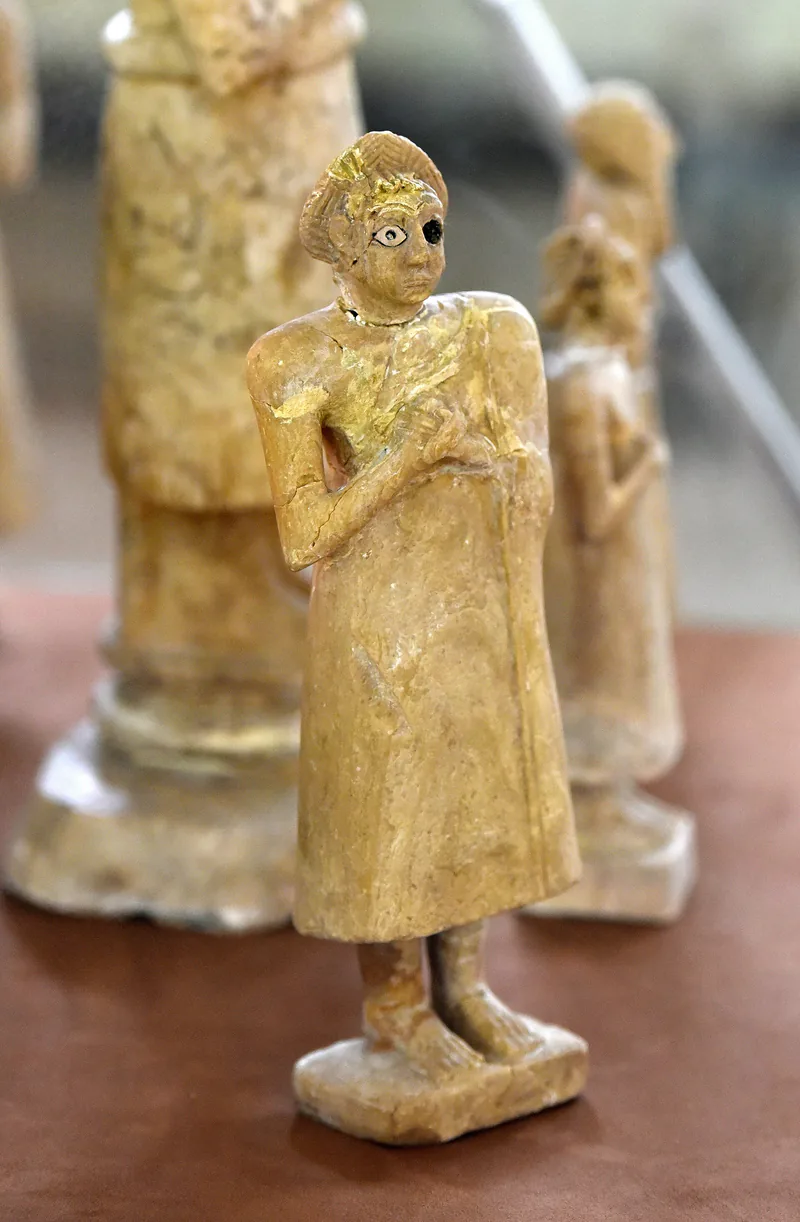
In Mesopotamian belief the cult statue, made of precious wood overlaid with gold, was the god's living presence after it had undergone the "washing of the mouth" ritual (mīs pî), which transformed a craftsman's work into a divine being. Priests woke, washed, clothed and fed the god twice a day with lavish meals; the leftovers went to the king and temple personnel. Temples were also great economic institutions, owning land, herds and workshops and employing thousands.
Beside the main temple of major cities rose the ziggurat, a stepped tower of mud brick crowned by a shrine. The best preserved is the ziggurat of Ur, begun by King Ur-Nammu around 2100 BCE. The great ziggurat of Babylon, Etemenanki ("house of the foundation of heaven and earth"), is often connected with the biblical Tower of Babel in Genesis 11. Ziggurats were probably understood as links between heaven and earth rather than places of public worship.
Priests and priestesses were numerous and specialised. The high priestess of the moon god at Ur held one of the most prestigious offices; the first known holder, Enheduanna, daughter of Sargon of Akkad (c. twenty-third century BCE), is credited with temple hymns and poems to Inanna and is often called the earliest named author in history. Exorcists, lamentation priests, singers and diviners all had defined roles; the ritual experts who fought demons and witchcraft are treated in Mesopotamian Magic.
Myths of Creation, Flood and Kingship§
Mesopotamian myths survive on clay tablets in Sumerian and Akkadian. The Atrahasis epic, known from copies of about 1700 BCE, tells how the junior gods rebelled against digging canals, so that Enki and the mother goddess created humans from clay mixed with the flesh and blood of a slain god. When human noise disturbed Enlil, he sent plague, famine and finally a flood, from which the wise Atrahasis escaped in a boat on Enki's advice. The parallels with the flood story in Genesis 6 to 9 have been discussed since George Smith announced a Babylonian flood tablet in 1872.
The Enuma Elish, the Babylonian epic of creation, is usually dated to the late second millennium BCE, though some scholars place it earlier. It tells how Marduk defeated the sea goddess Tiamat and her monstrous host, split her body to form heaven and earth, set the stars in their courses, created humans from the blood of the rebel god Kingu, and was acclaimed king of the gods with fifty names. It was recited during the New Year festival at Babylon.
The Epic of Gilgamesh, whose Standard Babylonian version is traditionally attributed to the scholar Sîn-lēqi-unninni, follows the king of Uruk in his friendship with Enkidu and his search for immortality after his friend's death, including the flood story told by the survivor Utnapishtim. Its theme, the acceptance of mortality, sums up Mesopotamian religious realism. Other myths include Inanna's Descent to the Netherworld, in which the goddess dies in her sister's realm and is revived.
Festivals, Divination and the Heavens§
The best-known festival was the spring Akitu, the New Year at Babylon, held over twelve days in the month Nisannu. Marduk's statue was honoured, gods from other cities visited, and the king was ritually struck by the high priest and reinvested with his kingship before the gods processed to the Akitu house outside the city. Other cities had their own festival calendars.

Mesopotamians believed the gods wrote messages into the world. Specialist diviners (bārû) inspected the liver and entrails of sacrificial sheep, a practice called extispicy, and consulted vast omen series. The heavens were read in the same way: the series Enūma Anu Enlil, compiled by the late second millennium BCE, gathered some seven thousand celestial omens concerning king and country. By the fifth century BCE Babylonian scholars had developed the zodiac of twelve equal signs, and the first personal horoscopes date from around 410 BCE. Their legacy is traced in Astrology and What Is Divination?.
Death and the Underworld§
Mesopotamians imagined the dead descending to the "land of no return", a dusty, dark realm where they ate clay and drank muddy water unless their families provided for them. The regular kispu offering of food, drink and the invocation of names kept the ancestors content; neglected or improperly buried dead could become restless ghosts (eṭemmu) who troubled the living. Unlike the Egyptians, Mesopotamians did not expect a judgment leading to bliss; their religion focused on a good life now, under the protection of personal gods who interceded for an individual before the great gods.
The End and Legacy of Mesopotamian Religion§
After the fall of Assyria (612 BCE) and Babylon's conquest by Persia (539 BCE), the temples continued under Persian, Greek and Parthian rule. Uruk and Babylon kept cuneiform scholarship alive until the first century CE, when the last datable astronomical tablet was written. Mesopotamian ideas lived on in the Hebrew Bible, in Greek astrology, in the demonology of later magic and in the reputation of the "Chaldeans" as masters of the stars. Rediscovered by archaeologists in the nineteenth century, the religion is now one of the best documented of the ancient world. Compare its outlook with that of its neighbour in Ancient Egyptian Religion.
Frequently asked questions§
Who was the chief god of Mesopotamia?§
It changed over time. Anu was the senior sky god and Enlil the active king of the gods for much of history; later Marduk became supreme in Babylon and Ashur in Assyria.
What was a ziggurat used for?§
A ziggurat was a stepped tower beside a major temple, topped by a shrine. Its exact rituals are poorly known, but it seems to have symbolised a link between heaven and earth and the god's exalted dwelling, rather than serving as a place of public worship.
Did Mesopotamians believe in heaven?§
Not for humans. Heaven belonged to the gods; the human dead went to a gloomy underworld whatever their deeds in life, though proper burial and family offerings made their condition more bearable.
Sources and further reading§
- The Treasures of Darkness: A History of Mesopotamian Religion — Thorkild Jacobsen, 1976
- Religion in Ancient Mesopotamia — Jean Bottéro, 2001
- Myths from Mesopotamia — Stephanie Dalley (trans.), 1989
- The Epic of Gilgamesh — Andrew George (trans.), 1999
- Gods, Demons and Symbols of Ancient Mesopotamia — Jeremy Black and Anthony Green, 1992
- Ancient Mesopotamia: Portrait of a Dead Civilization — A. Leo Oppenheim, 1964
- The Harps That Once: Sumerian Poetry in Translation — Thorkild Jacobsen, 1987