Liber II · Ancient Magic · Chapter VI: Mesopotamian Magic
Mesopotamian Magic: Exorcists, Incantations and Maqlû
Mesopotamian magic explained: the āšipu exorcist, Maqlû and Šurpu incantations, demons such as Lamaštu and Pazuzu, witchcraft beliefs and Babylonian medicine.

Mesopotamian magic was the system of incantations, rituals and protective objects used in ancient Sumer, Babylonia and Assyria, from the third millennium BCE to the end of cuneiform culture around the first century CE, to protect people from demons, witchcraft, divine anger and the evils announced by omens. It was the work of trained temple scholars, above all the āšipu or exorcist, who drew on long standardised series of incantations such as Maqlû and Šurpu.
The Āšipu and Other Ritual Experts§
Mesopotamian society had several kinds of ritual specialists. The bārû was a diviner, reading the future in the livers of sacrificed sheep, the flight of birds and other signs. The kalû was a lamentation priest who soothed angry gods with song. The asû was a healer known for his knowledge of plants and medical preparations. The āšipu, the central figure of what we call magic, was a scholar-priest who diagnosed the supernatural causes of illness and misfortune and performed rituals to remove them.
The āšipu's training was long and textual. A Neo-Assyrian list known as the "Exorcist's Manual", attributed to the eleventh-century BCE scholar Esagil-kīn-apli, enumerates the series an exorcist had to master: incantations against demons, rituals for the king, medical diagnostics and more. The same scholar is credited with editing Sakikkû, the great Diagnostic Handbook, which interprets symptoms as signs of the "hand" of a particular god, ghost or demon. There was no sharp line between medicine and magic; āšipu and asû often treated the same patients.
Gods, Demons and the Causes of Misfortune§
Mesopotamians understood illness and disaster as having many possible causes: offended gods who withdrew their protection, angry ghosts of the improperly buried dead, demons who attacked at random, oaths and curses that had been broken, and witches who worked evil in secret. Diagnosis was therefore essential, and the āšipu combined observation of symptoms with omens to identify the agent responsible.
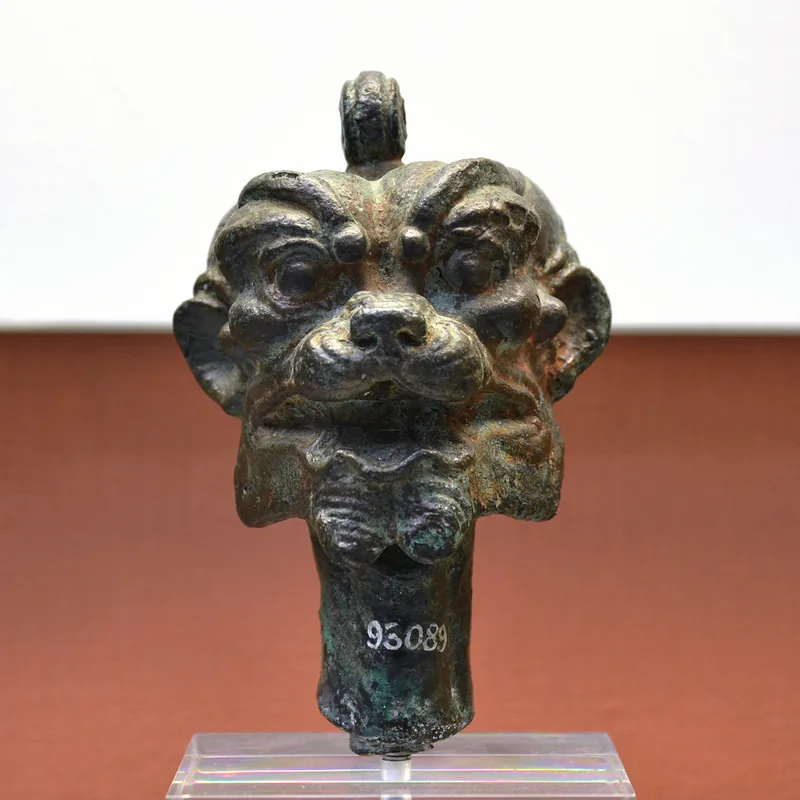
The demonic world was densely populated. The utukkū lemnūtu, "evil spirits", were the subject of a major bilingual Sumerian-Akkadian series. The Sebettu, a group of seven demons, could be harmful or protective. Lamaštu, a monstrous female demon with a lion's head and donkey's teeth, was believed to attack pregnant women and newborns. Pazuzu, a demon of the winds with a canine face, wings and talons, was paradoxically used against her: bronze and stone Pazuzu heads were worn or hung as amulets, and Lamaštu plaques show the demoness being driven away. Wind demons called lilû and ardat-lilî are sometimes cited as distant background to the later Jewish figure of Lilith, though the connection is debated. These objects are discussed further in Amulets and Talismans.
Incantations and the Marduk-Ea Formula§
Mesopotamian incantations, in Sumerian, Akkadian or both, followed recognisable patterns. Many begin with a description of the demon or affliction, then shift to a mythological scene: Asalluhi (identified in Babylon with Marduk) sees the suffering man and goes to his father Ea, asking what to do. Ea replies, "My son, what do you not know?" and gives the ritual instructions, which the āšipu then performs. This "Marduk-Ea formula" placed every human ritual within a divine precedent, so that the exorcist acted as the agent of the gods.
The incantations were accompanied by acts: tying and untying knots, wiping the patient with dough or flour, pouring water, burning or dissolving figurines, setting up reed huts and censers, and drawing protective figures around the bed or doorway. Sacred water from the Apsû, the cosmic freshwater realm of Ea, was central to purification.
Maqlû and Šurpu: Burning Away Evil§
Two great series give a sense of the scale of Mesopotamian ritual. Maqlû ("Burning"), best known from first-millennium copies, consists of eight tablets of incantations and a ritual tablet. It was performed at night, probably at the end of the month Abu (July–August), when ghosts were thought to move between worlds. Figurines representing the unknown witch were burned, dissolved or otherwise destroyed while the incantations accused the witch of her crimes and turned her own spells back upon her. Tzvi Abusch, who has devoted decades to the text, argues that it was compiled from earlier, shorter anti-witchcraft rites into a single all-night ceremony.

Šurpu, which also means "burning", addressed a different danger: the māmītu, a curse incurred by breaking oaths or committing offences, often unknowingly. The patient listed possible sins, and objects such as an onion peeled layer by layer, a date cluster or a tuft of wool were thrown into fire, so that the guilt would vanish like them. Erica Reiner's edition of 1958 made the series accessible to modern scholars.
Witchcraft in Mesopotamia§
Witchcraft (kišpū) was a real fear. Witches, imagined usually though not exclusively as women, were thought to make figurines of their victims, bury them or feed them to animals, steal personal items, and cause impotence, illness, slander or ruin. Daniel Schwemer's comprehensive study (2007) shows that anti-witchcraft rites formed one of the largest groups of magical texts. Legal codes also addressed the issue: the Laws of Hammurabi (eighteenth century BCE) prescribed a river ordeal for anyone accused of sorcery.
Mesopotamian witchcraft beliefs differ from the later European idea of the satanic witch, but they share a pattern: misfortune is explained by hidden human malice, and a ritual specialist identifies and neutralises it. Comparisons with later periods are developed in Maleficium, Curses and Protective Magic and in Ronald Hutton's comparative history of witch beliefs.
Namburbi Rituals and Royal Protection§
Mesopotamian divination produced vast omen collections, such as Šumma ālu for everyday events and Enūma Anu Enlil for celestial phenomena. An omen was not unavoidable fate but a warning, and namburbi ("its loosening") rituals were designed to cancel the evil it announced. A person who saw a snake in the house or a strange birth among the flocks could have the portent ritually dispelled.
Kings were especially well protected. When eclipses threatened the Assyrian king in the seventh century BCE, scholars sometimes installed a substitute king who bore the danger in his place while the real king lived in seclusion; letters to Esarhaddon describe this practice. Royal libraries, above all the collection assembled for Ashurbanipal at Nineveh in the seventh century BCE, preserved many of the texts we now read.
Legacy of Mesopotamian Magic§
Mesopotamian magic shaped neighbouring traditions. Aramaic incantation bowls from Sasanian Mesopotamia continued techniques of binding demons, and Jewish and later Mandaean magic owe something to Babylonian precedent. Greek and Roman writers used "Chaldean" as a byword for astrologers and wise magicians, and the traditions of demon-binding behind the Testament of Solomon have deep Near Eastern roots. Modern scholarship, from the decipherment of cuneiform in the nineteenth century to current editions, has transformed our picture of this ritual world from a caricature of "Chaldean sorcery" into one of the best-documented magical systems of antiquity. For the wider context, see What Is Ancient Magic? and Protective Magic.
Frequently asked questions§
What was an āšipu?§
An āšipu was a Mesopotamian exorcist or incantation priest, trained in cuneiform texts, who diagnosed the supernatural causes of illness and misfortune and performed rituals to remove them. He worked for temples, the palace and private clients.
Who was Pazuzu?§
Pazuzu was a Mesopotamian wind demon, shown with a dog-like face, wings and talons. Although fearsome, he was used as a protective figure against the demoness Lamaštu, and his image appears on many first-millennium BCE amulets.
What does Maqlû mean?§
Maqlû means "Burning". It is the name of a long Akkadian anti-witchcraft ceremony in which figurines of the witch were burned while incantations turned her spells back on her.
Did Mesopotamians separate magic from medicine?§
Not strictly. The āšipu and the asû both treated illness, often together, and medical texts combine plant remedies with incantations. Illness was seen as having both natural and supernatural dimensions.
Sources and further reading§
- The Witchcraft Series Maqlû — Tzvi Abusch, 2015
- Mesopotamian Witchcraft: Toward a History and Understanding of Babylonian Witchcraft Beliefs and Literature — Tzvi Abusch, 2002
- Šurpu: A Collection of Sumerian and Akkadian Incantations — Erica Reiner, 1958
- Evil Demons: Canonical Utukkū Lemnūtu Incantations — Markham J. Geller, 2007
- Abwehrzauber und Behexung — Daniel Schwemer, 2007
- Magico-Medical Means of Treating Ghost-Induced Illnesses in Ancient Mesopotamia — JoAnn Scurlock, 2006
- Ancient Babylonian Medicine: Theory and Practice — Markham J. Geller, 2010
- Demons, Gods and Sacred Symbols of Ancient Mesopotamia — Jeremy Black and Anthony Green, 1992
- Letters from Assyrian and Babylonian Scholars — Simo Parpola, 1993