Liber XXIX · Superstitions · Chapter IV: Birth, Marriage & Death
Superstitions of Birth, Marriage and Death: History and Origins
Superstitions of birth, marriage and death: the caul, Monday's child, May weddings, something old something new, covering mirrors and telling the bees.

Superstitions of birth, marriage and death cluster around the great transitions of life, when people felt most exposed to danger and most in need of luck: the newborn child and its mother, the bride crossing a new threshold, the dying person and the corpse. Some customs, such as lifting the bride over the threshold or avoiding May weddings, are recorded in ancient Rome; many others, such as "something old, something new" or the white wedding dress, date from the nineteenth century, and several popular explanations of them are modern inventions.
Rites of Passage and the Danger of Thresholds§
In The Rites of Passage (1909) the folklorist Arnold van Gennep argued that ceremonies marking birth, initiation, marriage and death share a common structure: separation from an old status, a transitional or "liminal" period, and incorporation into a new one. The transitional phase was the most dangerous, and it is there that superstitions gather. The mother before her churching, the unbaptised baby, the bride on her wedding day and the body between death and burial were all thought vulnerable to spirits, witches, fairies and the evil eye.
The same logic links life-cycle beliefs with the protection of the home. The threshold the bride crosses, the window opened at death and the door through which the coffin leaves are the household boundaries discussed in Household Superstitions. David Cressy's Birth, Marriage, and Death reconstructs how these rites were actually practised in Tudor and Stuart England, within and beyond the Church.
Pregnancy and Birth§
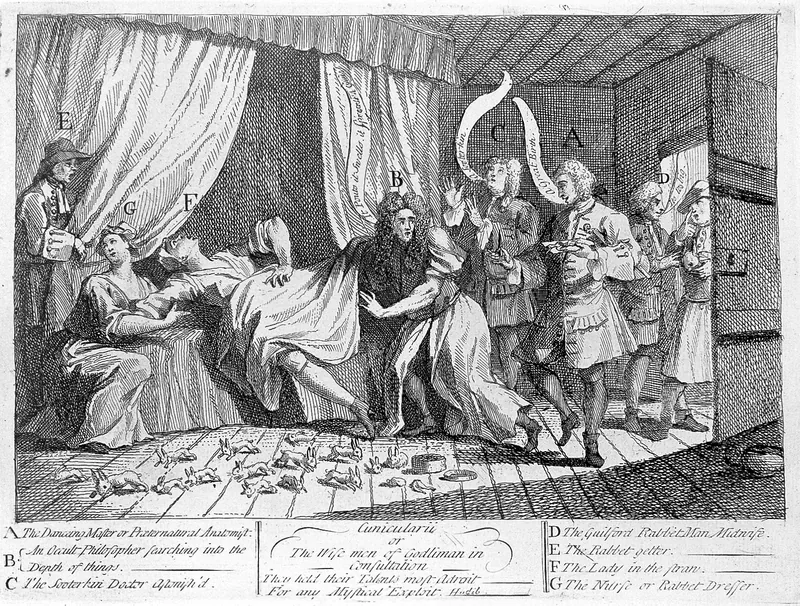
Pregnant women were surrounded by advice and taboos. A widespread belief in "maternal impression" held that what a mother saw or desired could mark her child, so that a fright or an unsatisfied craving produced birthmarks or deformities. Educated physicians accepted versions of this theory well into the eighteenth century; it was central to the case of Mary Toft of Godalming, who in 1726 claimed to have given birth to rabbits after being startled by one, deceiving several doctors before she confessed. Hogarth satirised the affair in his print Cunicularii. Pliny the Elder records a much older taboo: to sit beside a pregnant woman with the fingers interlaced was a spell that hindered birth.
A child born with a caul, part of the amniotic membrane over its head, was lucky and could never drown. Cauls were preserved and sold, especially to sailors, and advertisements offering them appeared in British newspapers in the eighteenth and nineteenth centuries; Dickens opens David Copperfield (1850) with the hero's caul advertised for sale. The day of birth was said to shape character, in the rhyme beginning "Monday's child is fair of face", first printed in 1838 by Anna Eliza Bray in her book on Devonshire traditions, with many later variants. Numbers and days more generally are treated in Lucky and Unlucky Numbers and Days.
Until baptism the infant was thought especially exposed. In British and Irish belief fairies might steal it and leave a changeling, so iron, such as scissors or a knife, was placed in or near the cradle, and the baby was not left alone. Gifts to a newborn on its first visit to a house, such as an egg, salt, bread and a silver coin, were customary in northern England and Scotland. It was unlucky to rock an empty cradle, and in modern times some families avoid buying the pram before the birth.
Courtship and Divining a Future Spouse§
Young people, especially young women, used small divinations to learn whom they would marry. On the eve of Saint Agnes (20–21 January), a girl who fasted and went to bed in silence might dream of her future husband, the custom Keats used in The Eve of St Agnes (1820). At Halloween, apple peel thrown over the shoulder was read for the shape of an initial, and hempseed was sown in the churchyard with a rhyme calling the future spouse to appear behind. A piece of wedding cake put under the pillow was supposed to bring dreams of a future partner. Such customs, recorded by eighteenth- and nineteenth-century collectors, belonged as much to play and courtship as to belief, and they link with the popular methods described in What Is Divination?
Weddings: Dates, Dress and the Threshold§
The choice of wedding day was hedged with rules. The Roman poet Ovid, in the Fasti, reports a popular saying that marriages made in May turn out badly, a belief linked to the Lemuria, festival of the restless dead, and the ill repute of May marriages persisted in Britain into the nineteenth century, when Queen Victoria was reported to have discouraged her children from marrying in May. Rhymes assign fortunes to the days of the week ("Monday for wealth, Tuesday for health, Wednesday the best day of all") and to the colours of the dress ("married in white, you have chosen all right").
The rhyme "Something old, something new, something borrowed, something blue" is first recorded in the later nineteenth century; the "silver sixpence in her shoe" was added later. The white wedding dress became fashionable after Queen Victoria wore white at her marriage in 1840, and was not a traditional sign of anything ancient. The belief that the groom must not see the bride in her dress before the ceremony is likewise recorded mainly from modern times.
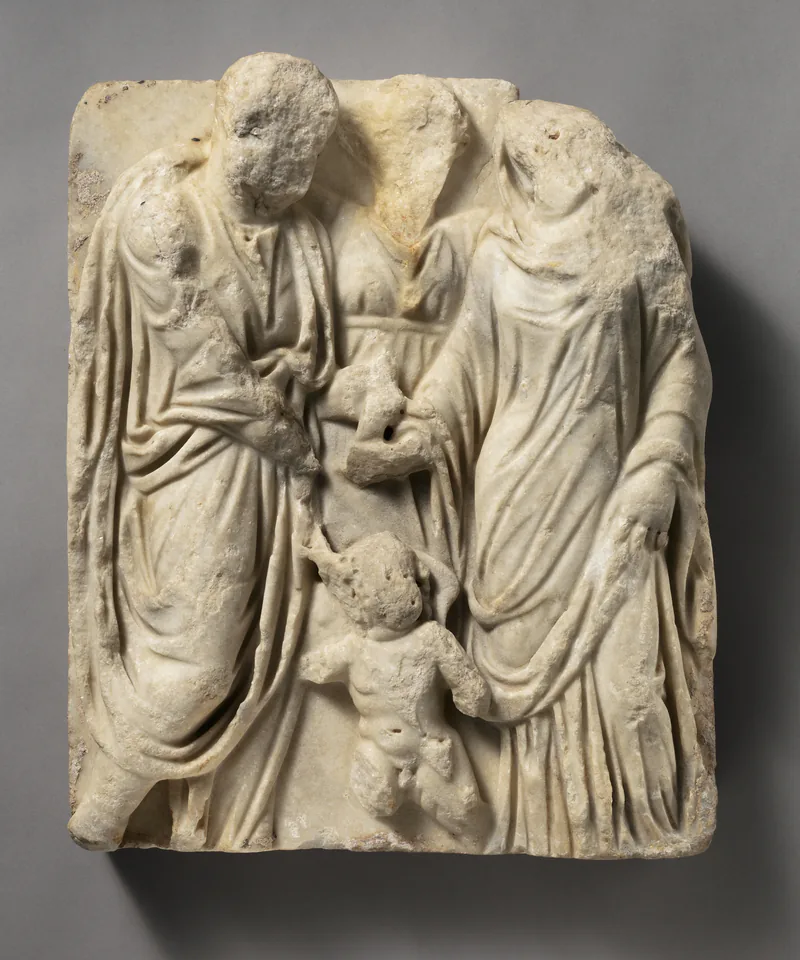
Some wedding customs do have ancient parallels. Plutarch's Roman Questions asks why the bride was not allowed to step over the threshold herself but was lifted across, and Catullus describes the same custom; Roman brides wore a flame-coloured veil, the flammeum. Whether the modern British and American custom of carrying the bride over the threshold descends from Roman practice or was revived through classical reading is uncertain. Throwing grain, later rice and paper confetti, at the couple symbolised fertility, and old shoes were thrown after them for luck from at least the eighteenth century. The common modern claim that bridesmaids dressed alike to confuse evil spirits seeking the bride has no historical evidence. The historical study of marriage is set out in John Gillis's For Better, For Worse.
Omens of Death and Deathbed Customs§
Death was announced by omens: a dog howling at night, a bird entering the house or tapping at the window, the ticking of the death-watch beetle, a picture falling from the wall, or a "corpse candle", a light seen moving along the route a funeral would later take, reported especially from Wales in the late seventeenth century. Many of these animal omens are discussed in Superstitions About Animals and Birds.
At the deathbed, it was believed in parts of England that a person could not die easily on a pillow containing pigeon or game-bird feathers, and such pillows were sometimes removed. When death came, doors and windows were opened to let the soul depart, clocks were stopped at the hour of death, and mirrors were covered or turned to the wall. Covering mirrors is also a Jewish mourning custom observed during shiva, with explanations rooted in Jewish religious teaching, such as setting aside vanity in mourning. In British folk practice a plate of salt was sometimes placed on the corpse's chest, explained variously as preventing swelling or keeping away evil.
Funerals, Mourning and Telling the Bees§
The body was usually carried out of the house feet first, explained in modern times as preventing the dead from looking back and beckoning others, though the explanation is not early. It was unlucky to meet a funeral, to count the cars in a procession, or to be the first buried in a new churchyard. The belief that carrying a corpse across private land creates a public right of way along a "corpse road" is a legal myth with no basis in English law.
Coins on the eyes of the dead had a practical purpose, keeping eyelids closed, and are sometimes linked to the ancient Greek "Charon's obol", a coin placed in the mouth to pay the ferryman of the dead; the Greek custom is attested in literature and some burials but was never universal, and a direct connection is unproven. John Aubrey, in his Remaines of Gentilisme and Judaisme (written in the 1680s, published 1881), described a "sin-eater" in Herefordshire who ate bread and drank beer over the corpse to take on the dead person's sins; historians remain unsure how widespread or real the practice was.
Bees were told of a death in the family, and their hives draped in black, or they would leave or die; the custom is recorded from the seventeenth to the twentieth century and inspired John Greenleaf Whittier's poem "Telling the Bees" (1858). Victorian mourning, with its rules of dress, jet jewellery and periods of seclusion, was largely a nineteenth-century elaboration, studied in Patricia Jalland's Death in the Victorian Family. Beliefs about what follows death belong to religion rather than superstition and are surveyed in Reincarnation and the Afterlife and Ghosts and Hauntings.
Frequently asked questions§
Why is it lucky to be born with a caul?§
A caul was believed to protect its bearer from drowning, so it was especially valued by sailors. Cauls were preserved and sold through newspaper advertisements in Britain in the eighteenth and nineteenth centuries.
Where does "something old, something new" come from?§
The rhyme is first recorded in Britain in the later nineteenth century. Its supposed ancient meanings, such as continuity with the past and borrowed happiness, are explanations added later, and the sixpence line is a further addition.
Why are mirrors covered after a death?§
In British folklore it was feared that the soul of the dead, or of the living, might be caught in the mirror, or that whoever next looked in it would die. In Judaism, covering mirrors during shiva is a mourning custom with its own religious meanings.
What is telling the bees?§
It is the custom of informing a household's bees of a death, and sometimes of births and marriages, often by knocking on the hive and draping it in black. People believed the bees would otherwise leave or die.
Sources and further reading§
- The Rites of Passage — Arnold van Gennep, 1909
- Birth, Marriage, and Death: Ritual, Religion, and the Life-Cycle in Tudor and Stuart England — David Cressy, 1997
- For Better, For Worse: British Marriages, 1600 to the Present — John R. Gillis, 1985
- The English Way of Death: The Common Funeral since 1450 — Julian Litten, 1991
- Death in the Victorian Family — Patricia Jalland, 1996
- Remaines of Gentilisme and Judaisme — John Aubrey, 1881
- Fasti — Ovid, c. 8 CE
- A Dictionary of English Folklore — Jacqueline Simpson and Steve Roud, 2000