Liber XXIX · Superstitions · Chapter IV: Birth, Marriage & Death
Changelings: Fairy Abduction, Folk Belief and Its Victims
The changeling in European folklore: fairies and trolls said to swap babies, the egg-shell test, Saint Guinefort, and the 1895 death of Bridget Cleary.

A changeling, in European folklore, is a fairy, troll or demon child believed to have been left in the cradle in place of a human baby who had been stolen away. The belief was used to explain infants who sickened, failed to thrive, cried constantly or seemed strangely old, and it shaped many customs for protecting newborns until baptism. It also had a dark side: from the Middle Ages to the nineteenth century, children and adults suspected of being changelings were sometimes abused or killed, most notoriously Bridget Cleary in Ireland in 1895.
What a Changeling Was§
The basic story is consistent across northern and western Europe. The fairies, or in Scandinavia the trolls and underground people, covet human children, especially healthy boys, and human mothers' milk. They steal an unguarded infant and leave in its place one of their own young, an aged fairy disguised as a baby, or a block of wood enchanted to look like a child, which soon appears to sicken and die. In Irish and Scottish tradition adults, particularly new mothers and brides, could also be "taken", and the person left behind was a fairy substitute.
The word "changeling" is first recorded in English in the sixteenth century, and Shakespeare uses it in A Midsummer Night's Dream for the human boy over whom Oberon and Titania quarrel. German speakers spoke of the Wechselbalg or Kielkropf, Scandinavians of the bortbyting or byting, and Irish speakers of a child "away with the fairies". The belief belongs among the superstitions of birth, marriage and death that treat the first weeks of life as a time when the child stands on a dangerous threshold between worlds.
Similar fears appear far beyond Europe. Mesopotamian incantations protected mothers and infants against the demoness Lamashtu (see Lamashtu and Pazuzu), and Jewish amulets guarded the birth chamber against Lilith, as described in Lilith in Jewish Folklore. The changeling is distinctive in imagining not only an attack but an exchange.
Medieval Evidence: Demons, Fauns and the Holy Greyhound§
Medieval theologians discussed children substituted by demons, which never grew, wailed and drained their nurses' milk, and debated whether such beings were real infants or illusions. The most vivid medieval evidence, however, comes from a Dominican preacher and inquisitor, Stephen of Bourbon, in the thirteenth century. In the Dombes region near Lyon he found peasants venerating a greyhound as a martyr, Saint Guinefort. According to their legend the dog had saved its master's baby from a snake and been killed by the master, who mistook the blood on its jaws for the child's.
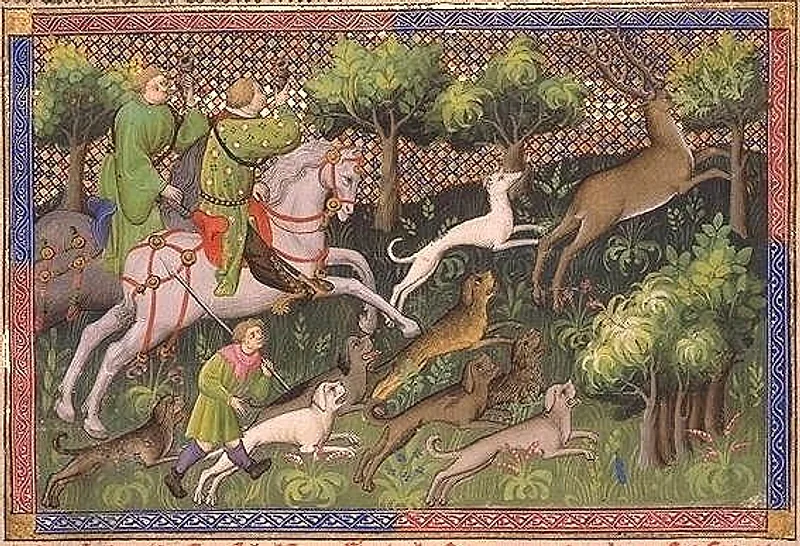
Stephen reports that mothers brought sick and weak children to the dog's grave in a wood, believing them to have been substituted by "fauns", and performed rites there to obtain their own healthy children back, leaving the infants alone for a time; some, he says, died. He had the dog's remains dug up and burned and the wood cut down, but the cult survived locally into the twentieth century. The historian Jean-Claude Schmitt's The Holy Greyhound (French 1979, English 1983) made the case a classic of the study of popular religion. The dog as guardian appears also in black dog folklore.
Signs and Tests: The Brewery of Egg-Shells§
Folk tradition described how to recognise a changeling. It ate ravenously yet stayed thin, cried day and night, failed to walk or talk, had a large head or an old, wizened face, and showed unexpected cleverness or malice when no one was watching. Many of these features describe infants with serious illness, malnutrition or developmental conditions.
The best-known folktale test makes the changeling betray its age through surprise. The mother boils water in egg-shells, or brews beer in them, in front of the cradle; the changeling, amazed, sits up and declares that it has seen the acorn before the oak, or the Westerwald forest when young, but never such brewing. Having revealed itself, it vanishes and the true child is returned. The Brothers Grimm included a version in their collection, and Thomas Crofton Croker's Fairy Legends and Traditions of the South of Ireland (1825) has "The Brewery of Egg-Shells". These comic tales sit uneasily beside the harsher methods recorded in practice, in which the suspected changeling was threatened with fire, water or exposure so that the fairies would take it back.
Protecting the Unbaptised Infant§
Most changeling customs were preventive. The period between birth and baptism, and for the mother between childbirth and her churching, was treated as especially dangerous. Iron or steel, such as a pair of open scissors, a knife or a nail, was placed in or near the cradle, since fairies were believed to fear cold iron; the same principle underlies the horseshoe over the door discussed in Household Superstitions. Salt, bread, a rowan twig, a red thread, the father's clothing laid over the cradle and a burning light at night were also used in different regions.
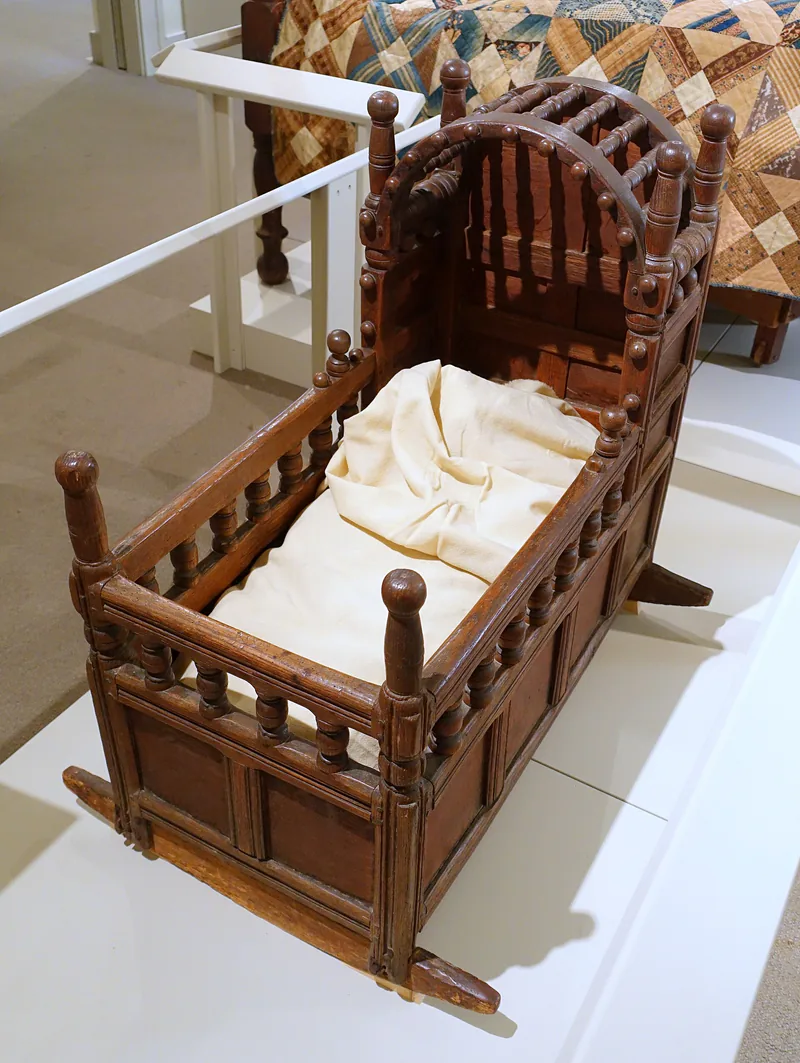
Above all, the baby was not left alone, and baptism was not delayed. In Christian belief the sacrament placed the child under God's protection, and many folk practices, such as drawing a cross on the cradle, borrowed Christian signs, as explained in Folk Christianity. Praise of a beautiful baby was avoided for the same reasons as in the beliefs about the evil eye: admiration might attract envy, whether of neighbours or of the fairies.
Cruelty and Tragedy: From Luther's Table Talk to Bridget Cleary§
The belief could justify terrible treatment. Martin Luther's Table Talk records his view that changelings were devils' offspring without souls; in one anecdote he is said to have advised that a twelve-year-old changeling at Dessau should be drowned. Nineteenth-century newspapers and court records in Ireland, Britain and Scandinavia include cases of children who were burned, immersed or left outside overnight in attempts to force the fairies to return the true child. In one widely cited case from County Kerry in 1826, a woman drowned a disabled four-year-old boy while trying to "put the fairy out" of him, and was acquitted.
The most famous case is that of Bridget Cleary, a young dressmaker of Ballyvadlea, County Tipperary. In March 1895, after she fell ill, her husband Michael Cleary and members of her family became convinced that she had been taken by the fairies and replaced. After days of coercive "treatment", Michael Cleary burned her to death. He claimed that the real Bridget would appear riding a white horse at a nearby fairy fort. He was convicted of manslaughter and sentenced to twenty years' penal servitude. Angela Bourke's study The Burning of Bridget Cleary (1999) places the killing in the context of rural Ireland, land, gender and the politics of Home Rule, when the case was used by opponents to portray the Irish as superstitious.
Interpreting Changelings: Illness, Disability and Social Stress§
Folklorists and historians read the changeling legend in several ways. Susan Schoon Eberly's influential article "Fairies and the Folklore of Disability" (1988) argued that many descriptions fit conditions such as failure to thrive, cerebral palsy or other congenital disorders, offering parents an explanation for a child's sudden change that placed the cause outside the family. Others point to postnatal illness in mothers, or to the strains of poverty and high infant mortality, in which a sickly child could be a heavy burden.
Scholars caution against diagnosing past children from folktales, and against assuming that belief in fairies was the same everywhere. Many tellers treated changeling stories as cautionary or comic narratives rather than as literal guides. Writers in the Romantic and Celtic Revival periods, from W. B. Yeats in "The Stolen Child" (1886) to Selma Lagerlöf, whose story of a mother's kindness to a troll child appeared in 1915, gave the legend new meanings of loss and compassion. The changeling remains a powerful image of the fear that a loved person may become a stranger.
Frequently asked questions§
What is a changeling in folklore?§
A changeling is a fairy, troll or demon child believed to have been substituted for a stolen human baby. The idea explained infants who fell ill, failed to grow or behaved strangely, and it is found throughout European folklore.
How did people protect babies from fairies?§
They placed iron such as scissors or a knife near the cradle, used salt, bread, rowan and red thread, kept a light burning, never left the baby alone and had it baptised promptly. Many households also avoided praising the child.
Who was Bridget Cleary?§
Bridget Cleary was a young woman from County Tipperary who was killed by her husband in March 1895 after he claimed she had been replaced by a fairy changeling. He was convicted of manslaughter, and the case became a notorious example of the dangers of the belief.
Sources and further reading§
- The Burning of Bridget Cleary — Angela Bourke, 1999
- The Holy Greyhound: Guinefort, Healer of Children since the Thirteenth Century — Jean-Claude Schmitt, 1983
- Fairy Legends and Traditions of the South of Ireland — Thomas Crofton Croker, 1825
- Strange and Secret Peoples: Fairies and Victorian Consciousness — Carole G. Silver, 1999
- Fairies: A Dangerous History — Richard Sugg, 2018
- A Dictionary of Fairies — Katharine Briggs, 1976
- The Fairy Faith in Celtic Countries — W. Y. Evans-Wentz, 1911