Liber XXIX · Superstitions · Chapter II: Animals & Birds
Black Dog Folklore: Black Shuck, Barghests and Spectral Hounds
Black dog folklore of Britain: Black Shuck and the Bungay storm of 1577, the barghest, the Moddey Dhoo, church grims and the hounds of the Wild Hunt.

Black dog folklore is the body of legends, chiefly from Britain, about large spectral black dogs that appear on lonely roads, in churchyards and at crossroads, often with glowing eyes, and that are taken as omens of death or as guardians of a place. The best-known examples are Black Shuck of East Anglia, linked to a violent storm at Bungay and Blythburgh in 1577, the barghest of Yorkshire and the Moddey Dhoo of the Isle of Man; related traditions of otherworldly hounds run from Welsh myth to the Wild Hunt of continental Europe.
The Black Dog in British and Irish Folklore§
The phantom black dog is one of the most frequently recorded apparitions in British folklore. Folklorists in the twentieth century, notably Ethel Rudkin in Lincolnshire (1938) and Theo Brown in Devon (1958), published surveys in the journal Folklore showing that black dog reports came from nearly every region. The typical dog is larger than any natural animal, shaggy and black, with eyes like saucers or burning coals; it pads silently along a lane beside a traveller, appears at a stile or a bridge, and vanishes, sometimes into the ground.
Its meaning varies. In some districts to see it foretold a death in the family within the year. Elsewhere, especially in Lincolnshire and Somerset, the dog was a protector that walked beside women travelling alone and kept them from harm. A third type is tied to a place, haunting a particular field, crossroads or house, frequently one connected with a murder, a suicide's grave or a gibbet. As with many animal omens, the same creature could be read as warning, guardian or curse depending on the region and the story.
Some writers have tried to trace the black dog to Norse or Celtic religion, citing the hounds of Odin or the dog-guardians of the dead. There may be distant connections, but the recorded legends are mostly from the sixteenth to the twentieth centuries, and their local variety is better explained by the long human association of dogs with the night, the road and the threshold.
Black Shuck and the Bungay Storm of 1577§
The most famous black dog story comes from Suffolk. On Sunday 4 August 1577 a severe thunderstorm struck the market town of Bungay during morning service. A pamphlet by the London writer Abraham Fleming, A Straunge and Terrible Wunder, published soon afterwards, reported that a black dog, "or the divel in such a linenesse", ran down the church between the kneeling people, wrung the necks of two of them and left another shrivelled but alive. The same day, at Holy Trinity, Blythburgh, a few miles away, a dog was said to have killed a man and a boy and left scorch marks on the north door, which visitors are still shown.
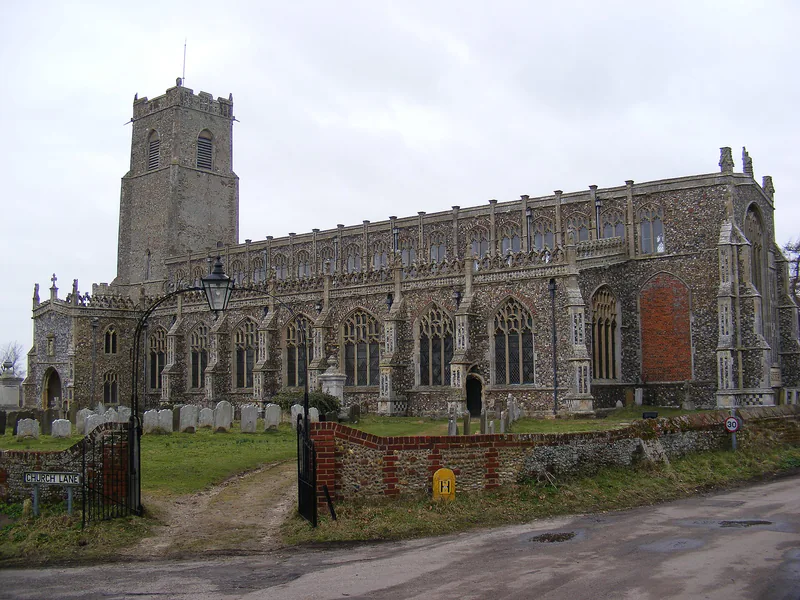
Fleming presented the event as a divine warning in the Protestant tradition of "wonder" pamphlets, alongside comets and monstrous births of the kind discussed in Luck, Omens and Portents. Modern readers have proposed that ball lightning or a lightning strike lies behind the account. The pamphlet does not use the name Black Shuck; that name belongs to the later folklore of Norfolk and Suffolk coasts, where Shuck roams the shore roads and churchyards. The word is often derived from Old English scucca, "demon", although the dialect sense "shaggy" has also been suggested. Bungay now uses the black dog as a town emblem.
Barghest, Padfoot, Gytrash and the Moddey Dhoo§
Northern England has its own repertoire. The barghest or bargest of Yorkshire and Durham was a goblin-dog, sometimes said to appear before deaths in a town and to howl through the streets; collectors such as William Henderson in Notes on the Folk-Lore of the Northern Counties (1866) recorded local accounts, and the etymology of the name is uncertain. The padfoot of the West Riding was known by the soft padding of its feet and the rattle of a chain. The gytrash of northern England could take the form of a horse, mule or great dog; Charlotte Brontë has Jane Eyre recall nursery tales of it when Mr Rochester's dog appears in the dusk.
On the Isle of Man the Moddey Dhoo ("black dog" in Manx) haunted the guardroom of Peel Castle. George Waldron's Description of the Isle of Man (1731) tells how a drunken soldier insisted on carrying the keys alone past the spectre, returned speechless and died three days later; Walter Scott's notes later spread the story to a wide audience. In Wales the gwyllgi, "dog of darkness", was said to haunt lonely roads.
A related tradition is the church grim, a guardian spirit in dog form believed to protect a churchyard from intruders and the Devil. Nineteenth-century writers recorded the idea, in England and in Scandinavia as the kyrkogrim, that a dog was buried on the north side of a new churchyard so that its spirit would keep watch, though there is little archaeological evidence for the practice.
Hounds of the Otherworld: Cŵn Annwn, Wisht Hounds and the Wild Hunt§
Spectral packs belong to a slightly different tradition. In the First Branch of the Welsh Mabinogi, Pwyll meets hounds of a shining white with red ears, the hounds of Arawn, king of Annwn, the otherworld. Later Welsh folklore turned the Cŵn Annwn into a death-pack whose baying, louder when distant and softer when near, announced a coming funeral.
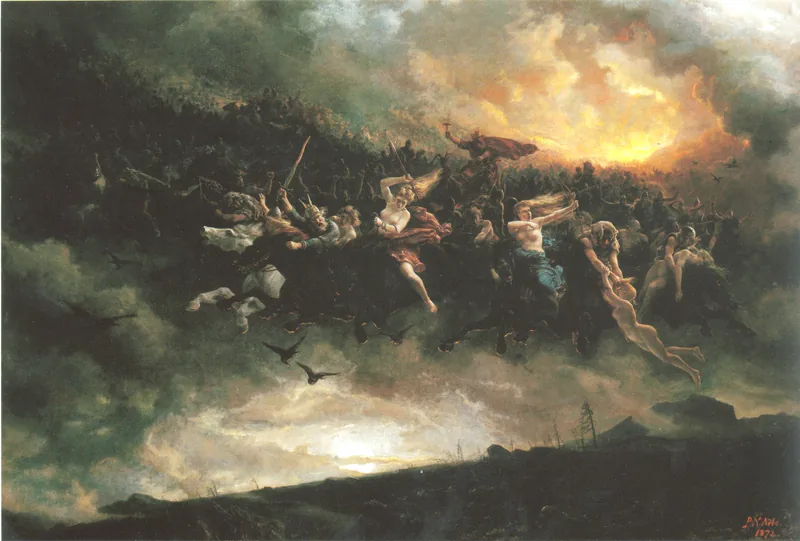
In England the pack appears as the Gabriel hounds or Gabriel ratchets of the north, the yeth or wisht hounds of Devon and Dartmoor, and the hounds of the Wild Hunt led by a variety of spectral huntsmen, from Herne to the Devil. Naturalists noted that the cries of migrating geese at night may account for some reports of hounds in the sky. On the continent the Wild Hunt is led by Odin or Wodan, by a cursed huntsman, or by female figures such as Holda and Perchta; see Odin, God of Wisdom, War and the Dead and Norse and Germanic Religion. Peter Nicolai Arbo's painting Åsgårdsreien (1872) gave the Scandinavian version its classic image.
Dogs, Death and the Underworld Beyond Britain§
The black dog draws on very old associations between dogs and death. In Greek religion dogs belonged to Hecate, goddess of crossroads and the night; Theocritus describes the dogs howling through the town when the goddess draws near, and Cerberus guarded the gate of Hades. Egypt had the jackal god Anubis as the guardian of embalming and the necropolis (see Ancient Egyptian Religion), and Norse myth gave Hel's realm the hound Garmr. In Aztec belief the god Xolotl had a dog's head, and dogs were thought to help the dead across a river on the way to Mictlan.
These associations survive in the widespread European superstition that a dog howling at night, especially near a house where someone is ill, foretells a death. In the early modern period dogs also became suspect as witches' familiars. During the English Civil War, Parliamentarian pamphlets mocked or accused Prince Rupert's white poodle Boy of being a familiar, and the dog's death at Marston Moor in 1644 was celebrated in print; see The Witch's Familiar.
From Folklore to Fiction: The Hound of the Baskervilles and the Black Dog of Melancholy§
The phantom hound found its most famous literary form in Arthur Conan Doyle's The Hound of the Baskervilles, serialised in 1901–1902. Doyle's friend Bertram Fletcher Robinson introduced him to Dartmoor, and local legends of spectral hounds, including the story of the wicked squire Richard Cabell of Buckfastleigh (died 1677), whose tomb was said to be haunted by baying dogs, are usually cited as inspirations. Doyle's achievement was to give the old omen a rational explanation within the story while keeping its terror.
The black dog also became a metaphor. Samuel Johnson wrote in his letters of resisting "the black dog" of melancholy, and Winston Churchill's later use of the phrase for his depressions made it familiar worldwide. In both literature and speech the image retains what the folklore gave it: a shadow that follows a person and announces that something is wrong. Collections such as those reviewed in Ghosts and Hauntings show that black dog sightings were still being reported in the twentieth century.
Frequently asked questions§
What is Black Shuck?§
Black Shuck is the name of a phantom black dog in the folklore of Norfolk and Suffolk, said to roam coast roads and churchyards with glowing eyes. Seeing him was often thought to foretell death, and he is popularly linked with the Bungay and Blythburgh storm of 1577.
What happened at Bungay in 1577?§
During a storm on 4 August 1577, according to Abraham Fleming's pamphlet, a black dog ran through Bungay church during the service and killed two worshippers. Similar damage was reported at Blythburgh the same day; lightning is the most likely natural explanation.
What is a church grim?§
A church grim is a guardian spirit, usually in the shape of a black dog, believed to protect a churchyard. Nineteenth-century folklore claimed that a dog was buried in new churchyards to provide one, but evidence for the practice is thin.
Are black dogs always evil in folklore?§
No. Many are omens of death or menacing spirits, but in parts of Lincolnshire, Somerset and elsewhere the black dog was a protector that escorted lone travellers home safely.
Sources and further reading§
- A Straunge and Terrible Wunder — Abraham Fleming, 1577
- Notes on the Folk-Lore of the Northern Counties of England and the Borders — William Henderson, 1866
- A Dictionary of Fairies — Katharine Briggs, 1976
- Explore Phantom Black Dogs — Bob Trubshaw (ed.), 2005
- Black Dog Folklore — Mark Norman, 2015
- The Hound of the Baskervilles — Arthur Conan Doyle, 1902
- The Penguin Guide to the Superstitions of Britain and Ireland — Steve Roud, 2003