Liber XXIX · Superstitions · Chapter VII: Luck, Omens & Portents
Luck, Omens and Portents: History of Signs and Lucky Charms
Luck, omens and portents in history: Fortuna, Babylonian omen lists, Roman augury, comets and prodigies, everyday signs and charms like the four-leaf clover.

An omen is a sign believed to announce future events, and a portent is an omen of unusual weight, such as a comet, an eclipse or a monstrous birth; luck is the idea that good and bad fortune can attach to people, objects and actions. Learned omen sciences flourished in Mesopotamia and Rome, Christian Europe read comets and prodigies as messages from God, and everyday signs and lucky charms, from the itching palm to the four-leaf clover, survive in folk belief to this day.
The Idea of Luck: Tyche, Fortuna and the Wheel§
The Greeks personified fortune as Tyche, the Romans as Fortuna, a goddess with temples, a festival and the cornucopia and rudder as attributes. Fortuna could be prayed to and courted, but she was also fickle. In Boethius' Consolation of Philosophy (about 524), written in prison, Lady Philosophy explains that Fortune's nature is to turn her wheel, raising and casting down; the image of the Wheel of Fortune became one of the most familiar in medieval art and survives in the tarot trump of that name, discussed in Major Arcana.
Christian theology subordinated fortune to providence: what seemed chance was God's hidden ordering. Yet the vocabulary of luck persisted. The English word "luck" appears only in the late fifteenth century, probably borrowed from Dutch or Low German gambling language, and its rise coincides with a world of trade, lotteries and games of chance. Folk belief added the idea that luck was a quantity that could be kept, lost, carried in a charm or "broken" by careless action, an idea behind many household customs.
Omens in the Ancient Near East§
Mesopotamia developed the most systematic omen literature of the ancient world. Scholars compiled long lists in "if... then" form: if a certain sign is seen, a certain event will follow. Enūma Anu Enlil, a series of around seventy tablets, collected celestial omens from eclipses, planets and weather; Šumma ālu, more than a hundred tablets, dealt with terrestrial signs, including snakes, scorpions, dogs and ants in the house, fungus on walls and events in the city. Extispicy, the reading of a sacrificed sheep's liver, was the most prestigious technique, and clay liver models were used to teach it.
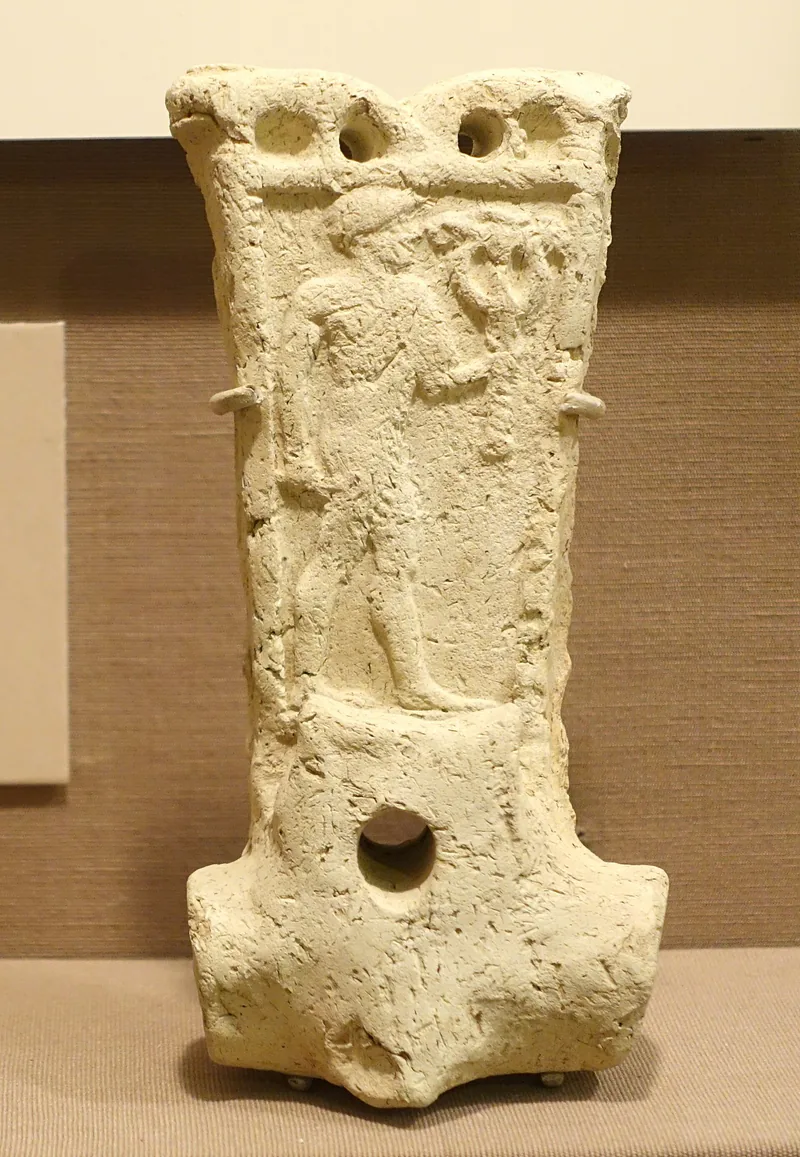
Crucially, Mesopotamian omens were not fixed fate. An ominous sign was a warning that could be averted by namburbi rituals, which dissolved the threatened evil. Francesca Rochberg's The Heavenly Writing shows how this learned tradition also gave rise to astrology, discussed in Mesopotamian Magic and What Is Divination?
Roman Augury, Auspices and Prodigies§
In Rome, no public action of importance, from holding an assembly to giving battle, was supposed to be taken without auspices, the observation of signs believed to show the gods' approval. Augurs interpreted the flight and cries of birds, thunder and lightning, and the feeding of sacred chickens; if the chickens ate eagerly, the sign was favourable. A famous story told by Cicero and others has the consul Publius Claudius Pulcher, at Drepana in 249 BC, throwing the unwilling chickens into the sea, saying that if they would not eat they could drink; he lost the battle.
Prodigies were unnatural events, such as rains of stones, speaking cattle, statues sweating blood or children born deformed, that indicated a rupture in the peace between gods and people. The Senate received reports, consulted priests and ordered expiation. Livy records many such lists, and a late antique writer, Julius Obsequens, compiled them into a Book of Prodigies. Roman historians describe the portents that preceded great deaths, such as the omens before Julius Caesar's assassination reported by Suetonius and Plutarch. The religious context is set out in Religions of Rome by Mary Beard, John North and Simon Price, and in the site's article on Roman Religion.
Comets, Eclipses and Monstrous Births in Christian Europe§
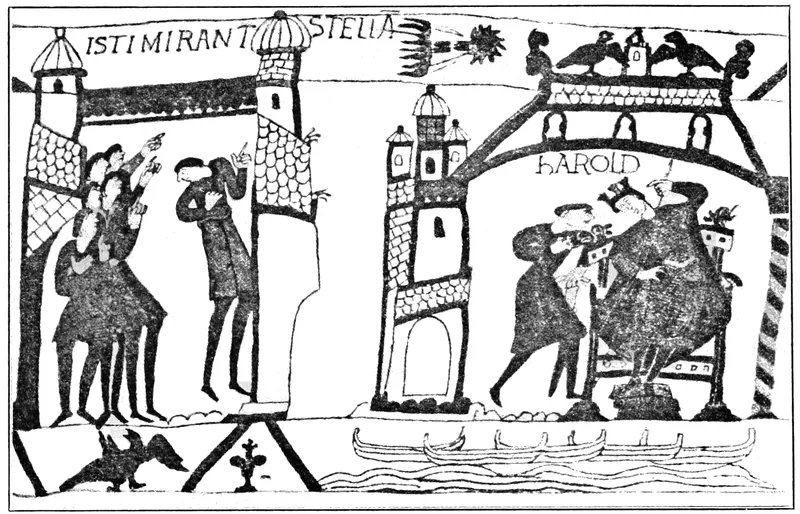
Christian Europe kept the ancient habit of reading the sky. The Bayeux Tapestry shows the comet of 1066, now known as Halley's, with the words "these men marvel at the star", above a messenger bringing news to King Harold. Chroniclers linked comets with the deaths of kings, plague and war, and eclipses were similarly feared.
The printing press multiplied portents. Broadsheets reported malformed births, rains of blood and armies seen fighting in the sky as warnings from God. In 1523 Martin Luther and Philip Melanchthon published an interpretation of two "monsters", a calf born at Freiberg and a creature reportedly found in the Tiber, as signs against the papacy. Conrad Lycosthenes' Prodigiorum ac ostentorum chronicon (1557) gathered prodigies from the creation to his own day. Lorraine Daston and Katharine Park's Wonders and the Order of Nature traces how such marvels passed from signs of divine anger to objects of natural philosophy.
Belief in celestial portents was weakened by astronomy and philosophy. Pierre Bayle argued in 1682 that the comet of 1680 portended nothing, and Edmond Halley showed that the comet of 1682 returned periodically; its predicted return in 1758 was a public triumph for Newtonian science. Yet comets continued to cause popular alarm, notably in 1910.
Everyday Omens: The Body, the Road and the Household§
Alongside the great portents ran a constant traffic in small signs. Some are genuinely ancient. In Xenophon's Anabasis a soldier sneezes during a speech and the army bows to the god, taking it as a favourable omen; Pliny the Elder records the belief that ringing in the ears means one is being talked about, and asks why people greet a sneeze with a wish for health. The popular claim that "God bless you" began with Pope Gregory the Great during a plague in 590 is a later story with no contemporary support; the custom is older.
Most everyday omens known today, however, are first recorded in early modern or later sources: an itching right palm means money is coming, a dropped knife means a male visitor, a picture falling from the wall foretells death, a shooting star grants a wish. John Melton's Astrologaster (1620) included a list of such popular beliefs, and later collectors gathered thousands. Animals were among the commonest omen-bearers, from birds tapping at windows to hares crossing the road; they are treated separately in Superstitions About Animals and Birds, and omens of the calendar in Lucky and Unlucky Numbers and Days.
Lucky Charms: From the Four-Leaf Clover to the Rabbit's Foot§
Lucky charms are objects kept to attract good fortune, as distinct from amulets made primarily to protect (see Amulets and Talismans). The four-leaf clover is genuinely old: Melton's list of 1620 includes the belief that a person who finds "four-leaved grass" will soon find some good thing, and folk tradition also credited it with letting the finder see fairies. Claims that it was sacred to the druids or that Eve carried one out of Eden are modern inventions.
The rabbit's foot as a charm is documented in African American folk magic in the United States in the nineteenth century, where its power was associated with specific conditions, such as the left hind foot of a rabbit killed in a graveyard; it is discussed in Hoodoo and Rootwork. By the 1880s it had been taken up and commercialised by white Americans, often with crude caricature, and lost its original context. The wishbone, or "merrythought", pulled by two people for a wish, is recorded in England from the seventeenth century. The horseshoe is treated in Household Superstitions.
Lucky charms flourished in times of danger. Owen Davies's A Supernatural War shows how soldiers and civilians in the First World War carried mascots, coins, prayers and small mass-produced charms, such as the "Touchwood" or "Fumsup" doll with a wooden head to touch. As with other superstitions, the charm was usually carried with a mixture of hope, habit and irony, not as a guarantee.
Frequently asked questions§
What is the difference between an omen and a portent?§
An omen is any sign believed to foretell the future, large or small. A portent is a weighty or extraordinary omen, such as a comet or a monstrous birth, usually thought to announce public events like war, plague or the death of a ruler.
Where does the four-leaf clover superstition come from?§
It is recorded in England by 1620, in John Melton's list of popular beliefs, and was linked in folklore with finding good things and seeing fairies. Stories linking it to the druids or the Garden of Eden are modern and unsupported.
Did the Romans believe in omens?§
Yes. Roman public life required auspices, and the Senate formally expiated prodigies such as lightning strikes and unnatural births. Writers such as Cicero, however, also questioned divination, and educated Romans held a range of views.
Why do people say "bless you" after a sneeze?§
Sneezes were treated as omens in ancient Greece and Rome, where people already greeted them with a wish for health. The popular story tying the blessing to a plague in 590 is a later explanation without contemporary evidence.
Sources and further reading§
- The Heavenly Writing: Divination, Horoscopy, and Astronomy in Mesopotamian Culture — Francesca Rochberg, 2004
- Ancient Greek Divination — Sarah Iles Johnston, 2008
- Religions of Rome — Mary Beard, John North and Simon Price, 1998
- The Goddess Fortuna in Mediaeval Literature — Howard Rollin Patch, 1927
- Wonders and the Order of Nature, 1150–1750 — Lorraine Daston and Katharine Park, 1998
- A Supernatural War: Magic, Divination, and Faith during the First World War — Owen Davies, 2018
- A Dictionary of Superstitions — Iona Opie and Moira Tatem, 1989
- Religion and the Decline of Magic — Keith Thomas, 1971