Liber XX · Kabbalah · Chapter IV: Hebrew Letters & Gematria
The Hebrew Letters in Kabbalah: Alphabet, Shapes and Secrets
The Hebrew letters in Kabbalah: the 22 letters as tools of creation, rabbinic letter lore, the Zohar's contest of letters, Torah as divine names and tarot.

In Kabbalah the twenty-two letters of the Hebrew alphabet are not merely signs for sounds but the building blocks of reality: the instruments with which God created the world and the substance of the Torah, which Kabbalists read as a fabric of divine names. Their shapes, names, numerical values and order have all been studied as carriers of meaning. This alphabet mysticism draws on rabbinic legend, the Sefer Yetzirah, the Zohar and Hasidic teaching, and it later passed into Christian Cabala and the Western occult tradition.
The Alphabet as the Instrument of Creation§
The idea that letters have creative power is older than Kabbalah. The Babylonian Talmud (Berakhot 55a) says that Bezalel, the builder of the Tabernacle, "knew how to combine the letters by which heaven and earth were created." Midrashic traditions ask why the Torah begins with the letter bet rather than alef: because, says Genesis Rabbah, bet is closed on three sides and open only forward, teaching that one should not inquire what is above, below or before creation. In compensation, alef was given first place in the Ten Commandments, which begin with Anokhi, "I am."
The decisive early text is the Sefer Yetzirah, which teaches that God created the world through thirty-two paths of wisdom: ten sefirot and twenty-two letters. It classifies the letters into three groups:
- Three mothers (alef, mem, shin), associated with air, water and fire;
- Seven doubles (bet, gimel, dalet, kaf, pe, resh, tav), letters that once had two pronunciations, linked to the seven planets, the days of the week and the openings of the head;
- Twelve simples, linked to the signs of the zodiac, the months and the organs and faculties of the body.
By engraving, combining and permuting these letters, according to the text, God formed everything that exists. Medieval commentators built on this model, and legends of the golem imagined human beings imitating the process.
Rabbinic Letter Lore: Crowns, Shapes and Meanings§
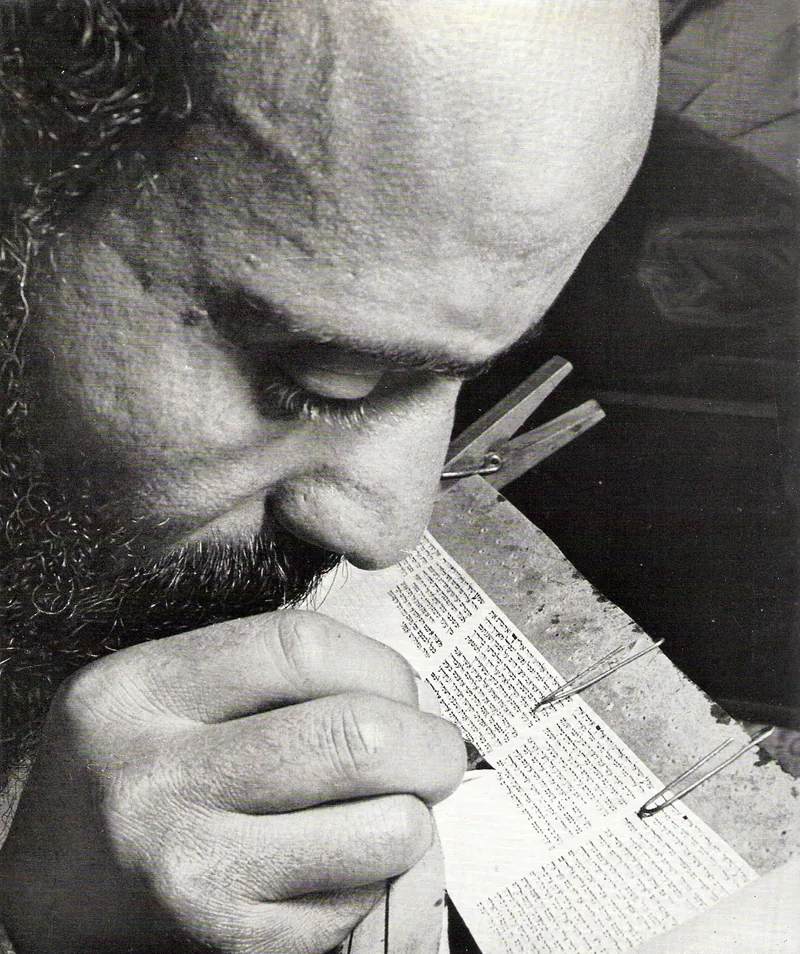
The rabbis paid close attention to the physical form of the letters. In a famous Talmudic story (Menaḥot 29b), Moses ascends to heaven and finds God attaching small crowns to the letters of the Torah. When he asks why, he is told that in a future generation Rabbi Akiva will derive heaps of laws from every one of these strokes. These crowns, called tagin, are still written on seven letters in Torah scrolls, and the rules for writing a scroll require that each letter be complete and surrounded by blank parchment.
The Talmud (Shabbat 104a) records a playful interpretation of the alphabet attributed to children in the study house: alef bet means "learn wisdom," gimel dalet means "be kind to the poor," because the foot of the gimel stretches toward the dalet, and so on through the alphabet. The same passage explains the five final forms of letters. A later midrash, Otiyot de-Rabbi Akiva ("The Letters of Rabbi Akiva"), probably from the Geonic period, develops such interpretations at length, treating each letter's name and shape as a lesson in theology and ethics.
Modern historians note that the letter names themselves (alef "ox," bet "house," and so on) go back to ancient Semitic pictographs, and that the square Hebrew script used today is an Aramaic form adopted in the Second Temple period; the Talmud (Sanhedrin 21b–22a) already discusses this change of script. Kabbalistic interpretation of the letter shapes therefore refers to the square script sanctified by tradition.
The Letters in the Zohar and Medieval Kabbalah§
The introduction to the Zohar contains one of the most beautiful passages of letter mysticism. Before creation, the letters come before God one by one, in reverse order from tav to alef, each asking that the world be created through it. Each is refused for a reason tied to its shape or to the words it begins, until bet, the first letter of berakhah ("blessing"), is chosen. Alef, which modestly did not come forward, is rewarded with first place in the divine names and the commandments.
For the Kabbalists the letters were connected to the ten sefirot. The four letters of the Tetragrammaton were mapped onto the structure of the divine powers: the tip of the yod to the highest crown, the yod to Wisdom, the first he to Understanding, the vav to the six central sefirot, and the final he to the Shekhinah. Vowels and cantillation marks were also given symbolic meanings, sometimes compared to the soul animating the body of the letters.
A remarkable development appears in Sefer ha-Temunah ("The Book of the Image"), an anonymous Kabbalistic work probably of the late thirteenth or fourteenth century. It interprets the shapes of the letters as images of divine powers and teaches a doctrine of cosmic cycles (shemitot), each governed by a different sefirah. Gershom Scholem drew attention to a striking idea in this circle: that in our present cycle one letter of the alphabet is missing or defective, which is why the Torah appears to us with prohibitions and limitations, and that in a future cycle the complete alphabet will reveal the Torah differently.
The Torah as Names of God§
Nahmanides, in the introduction to his commentary on the Torah (1260s), taught that the whole Torah is composed of names of God: if its letters were divided into words differently from the usual reading, they would yield divine names. He suggested that this was why a Torah scroll with a single missing or extra letter is invalid. Later Kabbalists went further, describing the Torah as one great name of God, or as a living organism whose outer garment is the stories and laws and whose soul is the hidden names.

A midrashic image, found in the Jerusalem Talmud and later sources, says that the primordial Torah was written in "black fire on white fire." Kabbalists interpreted the white spaces around the letters as a higher, still unreadable Torah. Scholem's essay "The Meaning of the Torah in Jewish Mysticism" traced how these ideas made the Torah infinitely interpretable. A popular later tradition, linked to the Safed Kabbalists, held that the Torah contains six hundred thousand letters corresponding to the six hundred thousand souls of Israel, although the actual count of letters in the Pentateuch is lower; the idea expresses the belief that each soul has its own share in the text.
Letter Combination and Meditation§
The most radical use of the letters belongs to the ecstatic Kabbalah of Abraham Abulafia in the thirteenth century. Building on the Sefer Yetzirah, Abulafia taught techniques of combining and permuting letters, especially those of divine names, accompanied by breathing and head movements, as a path to prophetic experience. He regarded this "science of combination" as higher than philosophy and as a form of music of the mind.
Practical Kabbalah used letters in amulets, letter-squares and secret alphabets (see Practical Kabbalah), and names derived from scriptural verses, such as the 72 Names of God, were built from letter arrangements. In Hasidism, the letters of prayer and study were described as vessels or "palaces" containing divine sparks; the worshipper was urged to enter into the letters of the words, so that speech itself became a means of communion with God. Contemporary works such as Michael Munk's The Wisdom in the Hebrew Alphabet and Yitzchak Ginsburgh's The Alef-Beit present this traditional letter lore for modern readers.
Hebrew Letters in Christian Cabala and Western Occultism§
From the Renaissance, Christian scholars such as Pico della Mirandola and Johannes Reuchlin studied Hebrew letters for hidden Christian meanings, famously arguing that inserting the letter shin into the Tetragrammaton produced a name of Jesus. In the nineteenth century Éliphas Lévi linked the twenty-two letters to the twenty-two trumps of the tarot, and the Hermetic Order of the Golden Dawn assigned them to the twenty-two paths connecting the sefirot on its Tree of Life diagram. These correspondences are modern esoteric constructions, not part of Jewish Kabbalah, but they became standard in occult tarot (see History of Tarot and tarot and Qabalah in Thelema).
Frequently asked questions§
Why are the Hebrew letters important in Kabbalah?§
Kabbalists believe that God created the world through the twenty-two letters and that the Torah is made of divine names. The letters' shapes, names, numbers and combinations are therefore studied as keys to the structure of reality and to the hidden meaning of scripture.
What are the mother letters?§
In the Sefer Yetzirah the three mother letters are alef, mem and shin, associated with air, water and fire. The other letters are divided into seven doubles and twelve simples.
What does it mean that the Torah is names of God?§
Nahmanides and later Kabbalists taught that the letters of the Torah, read in a different division, form a continuous series of divine names. This belief explains the strict rules for writing every letter of a Torah scroll correctly.
Are the tarot letter correspondences Jewish?§
No. The link between Hebrew letters and tarot trumps was proposed by French occultists in the nineteenth century and systematised by the Golden Dawn. It is part of Western esotericism, not of Jewish Kabbalistic tradition.
Sources and further reading§
- Sefer Yetzirah: The Book of Creation — Aryeh Kaplan, 1990
- On the Kabbalah and Its Symbolism — Gershom Scholem, 1960
- Language, Eros, Being: Kabbalistic Hermeneutics and Poetic Imagination — Elliot R. Wolfson, 2005
- Absorbing Perfections: Kabbalah and Interpretation — Moshe Idel, 2002
- The Wisdom in the Hebrew Alphabet — Michael L. Munk, 1983
- The Alef-Beit: Jewish Thought Revealed through the Hebrew Letters — Yitzchak Ginsburgh, 1991
- Kabbalah — Gershom Scholem, 1974