Liber XX · Kabbalah · Chapter VIII: Sefer Yetzirah
The Golem in Jewish Tradition: From the Talmud to Prague
The golem in Jewish tradition: Psalm 139, the Talmud's artificial man, medieval Sefer Yetzirah rituals, emet and met, Elijah of Chelm and the Prague legend.

A golem, in Jewish tradition, is an artificial human being formed from earth or clay and brought to life through the power of Hebrew letters and divine names. The idea begins with a few lines in the Talmud, was developed by medieval mystics as a ritual connected to the Sefer Yetzirah, and became world-famous through the legend of Rabbi Judah Loew of Prague, which in its familiar form dates only from the nineteenth century. Today the golem is a symbol of creative power, protection and the dangers of making what one cannot control.
The Word Golem: From Psalm 139 to the Mishnah§
The word golem occurs only once in the Hebrew Bible, in Psalm 139:16, where the psalmist says that God's eyes saw his golem, rendered in the King James Version as "my substance, yet being unperfect". The sense is of an embryo or of matter not yet given form. The Mishnah (Avot 5:7) uses the word for the opposite of a wise man: a golem interrupts, answers hastily and does not admit ignorance. In modern Hebrew and Yiddish the word can still mean a clumsy or slow-witted person.
Rabbinic tradition also applied the term to Adam. A Talmudic passage (Sanhedrin 38b) divides the first day of Adam's life into hours: in the first his dust was gathered, in the second he became a golem, a shapeless body, in the third his limbs were stretched out, and in the fourth a soul was cast into him. Midrashic texts describe the newly formed Adam lying as a golem stretching from one end of the world to the other until God breathed life into him. The later golem legends always echo this image: the human maker imitates, on a small scale, God's creation of the first man from the dust of the earth.
Talmudic Roots: Rava's Man and the Sabbath Calf§
The decisive text is a short passage in the Babylonian Talmud, Sanhedrin 65b, part of a discussion of what is and is not forbidden sorcery. It reports a saying that "if the righteous wished, they could create a world". It then tells that Rava created a man (gavra) and sent him to Rabbi Zeira. Zeira spoke to him, but the man did not answer, and Zeira said: "You come from the companions; return to your dust." Immediately after, it tells that Rav Hanina and Rav Oshaia sat every Sabbath eve studying the "Book" or "Laws of Creation" (Hilkhot Yetzirah), and a third-grown calf was created for them, which they ate.
Several features of this passage became central to the later tradition. The creature lacks speech, so human creation remains imperfect compared with God's. The creation is achieved through study of a text about "formation" (yetzirah), which medieval readers identified with the Sefer Yetzirah. And the Talmud places the stories in a discussion that distinguishes permitted creation by holy names from illicit magic, a distinction explored in Jewish magic and folklore.
Golem-Making in Medieval Ashkenaz§
The word golem was first applied to the artificial man in the Rhineland in the twelfth and thirteenth centuries, among the Hasidei Ashkenaz, the German Pietists. Their commentaries on the Sefer Yetzirah, especially one by Eleazar of Worms (c. 1176–1238) and another circulated under the name of Saadia Gaon, describe a ritual of creation. In outline, adepts in a state of purity took virgin earth, recited the 231 "gates" or combinations of letters described in the Sefer Yetzirah, and combined each letter of the alphabet with the letters of the divine name. Reciting the combinations in one direction gave life; reciting them in reverse returned the figure to dust.
Moshe Idel, in his study Golem (1990), argued that these texts describe primarily a mystical experience. The goal was not to manufacture a servant but to attain a state of ecstatic or prophetic consciousness by mastering the creative language of God, and the short-lived golem was a demonstration that the adept had understood the Sefer Yetzirah. Similar letter techniques appear in the ecstatic Kabbalah of Abraham Abulafia and in the wider practice of gematria and letter mysticism.
Emet and met§
A famous motif appears in medieval Ashkenazi texts associated with the Pietist circle. The prophet Jeremiah and his son, or Ben Sira, create a man who bears on his forehead the words "YHWH Elohim emet" ("The Lord God is truth"). The creature takes a knife and erases the first letter, aleph, leaving "God is met" (dead), as a warning that people would worship the creature and forget the Creator. The makers then unmake him. Later legend simplified this into the familiar image of a golem with emet on its brow, deactivated by erasing the aleph to leave met. Other versions place a slip of parchment bearing the divine name in its mouth.
Elijah of Chełm and the minyan question§
By the sixteenth and seventeenth centuries the golem had become a legend told about named wonder-working rabbis. The best attested concerns Rabbi Elijah, a ba'al shem of Chełm in Poland (died 1583). According to his descendants, including the eighteenth-century scholar Jacob Emden, he made a golem that grew larger every day until he feared it would destroy the world; he removed the name from its forehead, and as it collapsed it scratched his face. Emden's father, Zevi Hirsch Ashkenazi, discussed in a responsum whether a golem could be counted in a minyan, the prayer quorum of ten men, and concluded that it could not. A brief account of a Polish golem published by Jacob Grimm in 1808 introduced the legend to German Romantic readers.
How the Golem Came to Prague§
Rabbi Judah Loew ben Bezalel of Prague (c. 1520–1609), known as the Maharal, was a major rabbinic thinker, but nothing in his extensive writings or in contemporary sources connects him with a golem. The association appears only in the nineteenth century, in German-language collections of Prague Jewish legends, notably those published in the Sippurim series from the 1840s. These stories located the golem's remains in the attic of the Old-New Synagogue and explained the Friday-evening repetition of a psalm in that synagogue as a memorial of the night the golem ran amok.
The fullest version is Nifla'ot Maharal ("The Wonders of the Maharal"), published in Hebrew in 1909 by Rabbi Yudl Rosenberg of Poland, who presented it as a manuscript by the Maharal's son-in-law. Scholars regard it as Rosenberg's own creation. In his telling the golem, named Yossele, protects the Jews of Prague from blood libels, the false accusation that Jews used Christian blood in ritual, which was being revived in Rosenberg's own time. This protective golem, created on behalf of a threatened community, became the canonical modern image.
The Golem in Modern Literature, Film and Science§
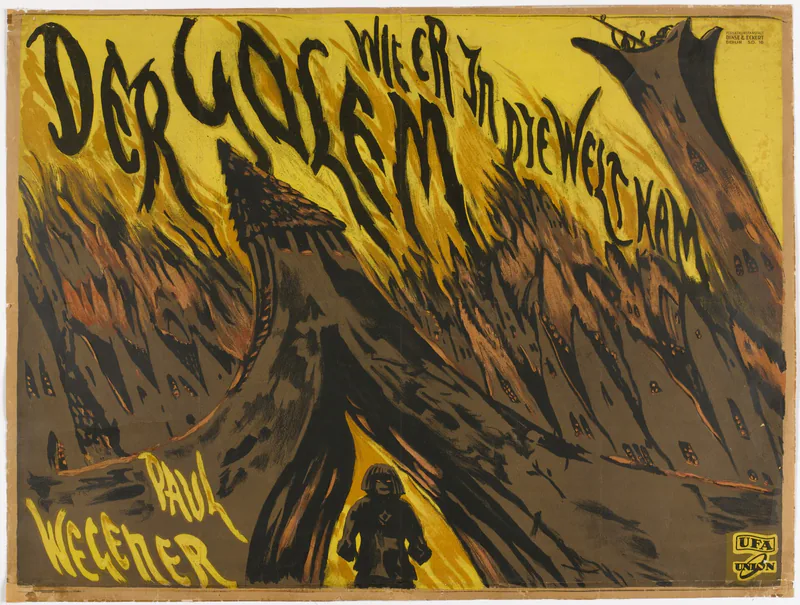
The golem passed quickly into literature and art. Gustav Meyrink's novel Der Golem (1915) made it an emblem of the mysterious ghetto and the divided self, and Paul Wegener's film Der Golem, wie er in die Welt kam (1920) fixed the creature's appearance. H. Leivick's Yiddish drama Der Goylem (1921) turned the story into a meditation on messianic hope and violence, and retellings continue to Michael Chabon's The Amazing Adventures of Kavalier & Clay (2000).
The golem also became a metaphor for technology. The mathematician Norbert Wiener used it in God and Golem, Inc. (1964) to discuss machines that learn, and in 1965 Gershom Scholem gave the dedicatory address for an early computer at the Weizmann Institute in Rehovot, nicknamed "Golem Aleph", reflecting on the old legend and the new machine. Cathy Gelbin's The Golem Returns (2011) traces how the figure moved between German Romantic literature, Jewish identity and global popular culture.
What the Golem Means: Scholarly Interpretations§
Gershom Scholem, in his essay "The Idea of the Golem" (collected in On the Kabbalah and Its Symbolism), connected the golem with the earthy, "telluric" side of Adam's creation and with ancient ideas of the power of names, and saw in the legend a deep ambivalence about human creative power. Idel stressed the ecstatic and theological meaning of the medieval rituals and showed how they differ from the later folk legends. Other scholars, including Gelbin and Elizabeth Baer, emphasise the modern golem as a figure through which Jews and non-Jews explored anxieties about persecution, emancipation, the Holocaust and artificial life.
Within Jewish tradition the golem has always carried a double message. It displays the creative power of Hebrew letters and divine names, which the Sefer Yetzirah describes as the building blocks of the world, and it warns that human imitation of creation remains incomplete: the golem cannot speak, cannot truly pray, and must be returned to dust. In practical Kabbalah and in rabbinic discussion, golem-making was treated as a theoretical possibility reserved for the holy, not a practice for ordinary believers.
Frequently asked questions§
What does the word golem mean?§
In biblical and rabbinic Hebrew, golem means unformed matter or an incomplete being; Psalm 139 uses it for an embryo, and the Mishnah for an uncultivated person. From the medieval period it came to mean an artificial human made from earth and animated by holy names.
Did Rabbi Judah Loew really create a golem?§
There is no evidence that he did or that anyone in his lifetime said so. The Maharal's own writings never mention a golem, and the legend attaching it to him appears in the nineteenth century, reaching its classic form in Yudl Rosenberg's book of 1909.
How was a golem brought to life in legend?§
Medieval texts describe the recitation of letter combinations from the Sefer Yetzirah together with the divine name over a figure of earth. Later folk legends speak of writing emet ("truth") on the golem's forehead or placing a parchment with the name of God in its mouth.
Is the golem part of Kabbalah?§
The golem tradition grew from the Talmud and the Sefer Yetzirah and was developed by the German Pietists before the classical Kabbalah of the Zohar. It is usually treated as part of Jewish mystical and magical tradition and of practical Kabbalah, rather than of theosophical Kabbalah centred on the sefirot.
Sources and further reading§
- Golem: Jewish Magical and Mystical Traditions on the Artificial Anthropoid — Moshe Idel, 1990
- On the Kabbalah and Its Symbolism — Gershom Scholem, 1960
- The Golem and the Wondrous Deeds of the Maharal of Prague — Yudl Rosenberg, 2007 (trans. Curt Leviant)
- The Golem Returns: From German Romantic Literature to Global Jewish Culture, 1808–2008 — Cathy S. Gelbin, 2011
- Golem! Danger, Deliverance and Art — Emily D. Bilski, 1988
- The Golem Redux: From Prague to Post-Holocaust Fiction — Elizabeth R. Baer, 2012
- Der Golem — Gustav Meyrink, 1915
- Jewish Magic and Superstition — Joshua Trachtenberg, 1939