Liber XIX · Judaism · Chapter IV: Jewish Folklore & Magic
Jewish Magic and Folklore: Amulets, Demons, Golem and Dybbuk
Jewish magic and folklore from the Talmud to modern times: demons and Lilith, incantation bowls, amulets and holy names, the evil eye, golem and dybbuk.

Jewish magic and folklore are the beliefs and practices through which Jews, from late antiquity to modern times, sought protection from demons, illness and the evil eye, and power through the holy names of God. The Bible forbids sorcery and divination, yet the Talmud is full of demons and wonder-working sages, Aramaic incantation bowls and Hebrew amulets survive in their thousands, and legends of the golem and the dybbuk became part of world culture. This popular religion lived beside, and often overlapped with, the mystical tradition of Kabbalah.
Magic and Its Prohibition in the Bible and Talmud§
The Torah condemns a whole range of occult practitioners — the diviner, the soothsayer, the enchanter, the sorcerer, the charmer and the one who consults the dead (Deuteronomy 18:10–11) — and Exodus commands, in the King James wording, "Thou shalt not suffer a witch to live". Yet the Bible also tells of King Saul consulting a woman of Endor who raises the spirit of Samuel (1 Samuel 28), and its prophets work wonders. Later readers drew on these stories to cast Moses himself as a master magician, a tradition traced in Moses as magician.
The rabbis of the Talmud forbade sorcery but drew fine distinctions. They separated true sorcery, punishable in principle, from mere "deceiving of the eyes" and from wonders performed through holy names, which they did not regard as forbidden in the same way. Talmudic sages such as Honi the Circle-Drawer, who brought rain by drawing a circle and refusing to leave it, and Hanina ben Dosa, famed for healing by prayer, appear as holy men with extraordinary powers. One passage tells that two rabbis studied the "laws of creation" every Sabbath eve and created a calf, which they ate, and that another sage created a man who could not speak — the seed of the golem legend. The Talmud also records medical charms, incantations against demons and rules for interpreting dreams, alongside warnings against the "ways of the Amorites", forbidden pagan superstitions.
Demons, Lilith and the Protection of Mother and Child§
Rabbinic literature describes shedim (demons) and mazzikin (harmers), invisible beings who haunt ruins, privies and the night, and who can be warded off by prayer and by avoiding certain dangerous acts, such as drinking water left uncovered. Their king is sometimes named Ashmedai, who in Talmudic legend is captured by King Solomon to help build the Temple; the story and its later echoes are told in Solomon and Asmodeus.
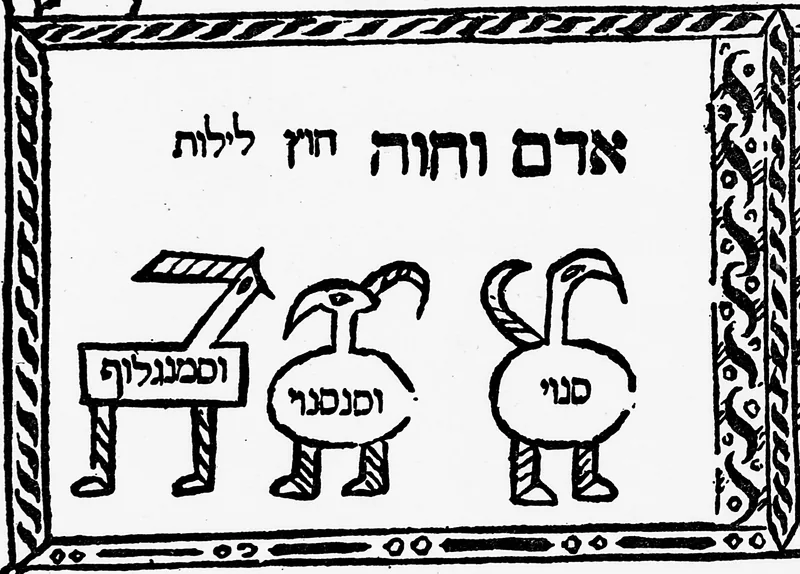
The most famous demon is Lilith. A creature called lilit appears once in the Bible, among the wild beasts of a ruined land (Isaiah 34:14), and the name probably derives from Mesopotamian wind demons. The Talmud describes Lilith as a winged female demon with long hair who threatens men sleeping alone. In the Alphabet of Ben Sira, a satirical work usually dated between the eighth and tenth centuries, she becomes Adam's first wife, who refuses to be subordinate, flees Eden and vows to harm newborn children unless she sees the names of three angels, Snvi, Snsnvi and Smnglf. From the Middle Ages to the twentieth century Jewish families hung amulets bearing these names, or Psalm 121, around the bed of a woman in childbirth and the cradle of her baby.
Incantation Bowls, Amulets and Books of Secrets§
Some of the richest evidence of Jewish magic comes from Sasanian Mesopotamia. Thousands of incantation bowls, from roughly the fifth to the seventh century CE, were inscribed in spiral lines of Jewish Babylonian Aramaic, Syriac or Mandaic and buried upside down beneath the floors of houses to trap demons and protect the household. Their clients included Jews, Christians, Mandaeans and Zoroastrians, and their texts invoke the God of Israel, angels and biblical verses, sometimes beside figures of bound demons. The Cairo Genizah, a medieval storeroom of discarded manuscripts in Old Cairo, has yielded hundreds of later magical recipes and amulet texts. For the wider history of such objects see amulets and talismans.
Late antique Jewish magical handbooks include Sefer ha-Razim ("The Book of Mysteries"), reconstructed by Mordecai Margalioth in 1966, which describes the angels of seven heavens and the rites for commanding them, and Harba de-Moshe, The Sword of Moses. Central to all of them is the power of divine names, especially the ineffable four-letter name and the seventy-two-letter name, discussed in the seven names of God. The medieval Shimmush Tehillim prescribes magical uses of the Psalms, and Sefer Raziel ha-Malakh, printed in Amsterdam in 1701, was kept in many homes as a protection against fire and harm (compare the related Latin Sepher Raziel).
Such practices came to be called kabbalah ma'asit, "practical Kabbalah", distinguished from contemplative Kabbalah (see What Is Kabbalah?). Rabbinic opinion was divided. Maimonides scorned amulets and the use of names as foolishness and condemned those who added angels' names to the mezuzah; many other authorities permitted amulets written by experts, especially for healing. In early modern Eastern Europe wandering healers called ba'alei shem, "masters of the name", wrote amulets and performed exorcisms; Israel ben Eliezer, the founder of Hasidism, was one of them, as told in Hasidism and the Baal Shem Tov.
The Evil Eye and Everyday Protection§
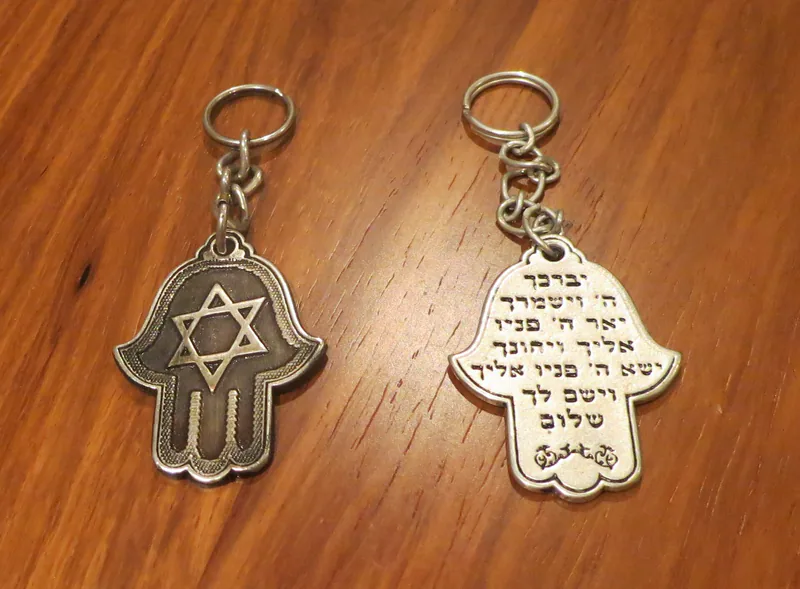
Belief in the evil eye (ayin ha-ra), the harm caused by an envious or admiring glance, is ancient and widespread across the Mediterranean and Near East. One Talmudic sage attributed most deaths to it. Jews developed many customs of protection: avoiding public praise of children or counting people directly, adding the Yiddish formula keyn eyn hore ("no evil eye") when speaking of good fortune, tying a red thread around a baby's wrist or crib, and, among Sephardi and Mizrahi Jews, hanging the hand-shaped hamsa, a symbol shared with Muslim neighbours. Medieval German Jewish pietists, the Hasidei Ashkenaz, recorded a lively folklore of witches, werewolves and vampire-like estries in works such as Sefer Hasidim, showing how deeply Jewish and Christian popular beliefs intertwined. Joshua Trachtenberg's classic study surveyed this world in 1939.
The Golem: Legends of the Artificial Man§
The idea of creating a living being with holy letters grew from the Talmudic stories above and from the Sefer Yetzirah, which describes God creating the world through the letters of the Hebrew alphabet (see Sefer Yetzirah). Medieval German pietists, notably Eleazar of Worms around 1200, described rituals of letter combination by which a golem — the word means an unformed mass — might be made from earth, understood largely as a mystical demonstration of creation rather than a practical project. Later legends attached the feat to Rabbi Elijah of Chełm in the sixteenth century and, most famously, to Rabbi Judah Loew (the Maharal) of Prague, who died in 1609. The Prague story of a clay servant animated with a divine name to protect the Jews, which ran out of control, is first attested only in the nineteenth century and was popularised by Yudl Rosenberg's Hebrew booklet of 1909, Gustav Meyrink's novel Der Golem (1915) and Paul Wegener's films. Moshe Idel's study of 1990 traces the long history of these traditions.
The Dybbuk and Spirit Possession§
Accounts of spirits of the dead entering the living appear in the sixteenth century among the kabbalists of Safed, whose disciple Hayyim Vital described exorcisms; they connected possession with the doctrine of gilgul, the transmigration of souls (see reincarnation and the afterlife). The term dybbuk, a clinging spirit, became common in Yiddish from the seventeenth century, and printed reports of rabbis exorcising them with prayers, divine names and the sounding of the shofar circulated widely. The folklorist S. Ansky, who led ethnographic expeditions to Jewish towns of Ukraine before the First World War, wrote the play The Dybbuk, first staged in 1920, which made the figure famous on stage and screen.
Frequently asked questions§
Does Judaism allow magic?§
The Torah forbids sorcery, divination and consulting the dead, and rabbinic law upholds these prohibitions. However, many rabbis permitted amulets, prayers and the use of divine names for protection and healing, so the boundary between forbidden magic and acceptable practice was often debated.
Who is Lilith in Jewish folklore?§
Lilith is a female demon of the night, mentioned briefly in Isaiah and described in the Talmud. The medieval Alphabet of Ben Sira made her Adam's first wife, and amulets naming three protective angels were used to guard mothers and newborns against her.
Is the golem of Prague a historical story?§
No historical source from Rabbi Judah Loew's lifetime mentions a golem. The Prague legend appears in the nineteenth century and was popularised in the early twentieth century, though it draws on much older Jewish traditions about creation through holy letters.
What is a dybbuk?§
A dybbuk is the spirit of a dead person believed to cling to and possess a living person. Accounts of possession and exorcism appear among early modern kabbalists and became famous through S. Ansky's play The Dybbuk.
Sources and further reading§
- Jewish Magic and Superstition: A Study in Folk Religion — Joshua Trachtenberg, 1939
- Ancient Jewish Magic: A History — Gideon Bohak, 2008
- Jewish Magic before the Rise of Kabbalah — Yuval Harari, 2017
- Amulets and Magic Bowls: Aramaic Incantations of Late Antiquity — Joseph Naveh & Shaul Shaked, 1985
- Golem: Jewish Magical and Mystical Traditions on the Artificial Anthropoid — Moshe Idel, 1990
- Tree of Souls: The Mythology of Judaism — Howard Schwartz, 2004
- Spirit Possession in Judaism: Cases and Contexts from the Middle Ages to the Present — Matt Goldish (ed.), 2003